Key points
- A new Risk/Reward Tool was co-developed with farming systems groups to improve how research findings are communicated to farmers, by showing both the benefits and trade-offs of adopting new practices.
- The tool presents information in a three-tiered format — infographic, four-page summary, and full report — designed to match different learning styles and time constraints.
- User testing showed that presenting information in a clear, comparative format helped farmers better understand trial results and made them more likely to consider adoption.
- A companion guide, ‘Writing for Purpose’, helps grower groups use the tool consistently, improving the quality and continuity of extension materials.
The challenge
Farmers are faced with increasingly complex decisions when adopting new practices, often relying on fragmented and inconsistent information. Traditional research reports are typically technical and narrowly focused, making it difficult for farmers to assess practical relevance and real-world risk.
Farming systems groups involved in this project identified the need for a better way to communicate the full range of benefits and trade-offs involved in adopting new technologies or practices. The aim was to create a tool that would present research findings in a clear, consistent format — one that farmers could use to make informed, confident decisions at the paddock level.
Our research
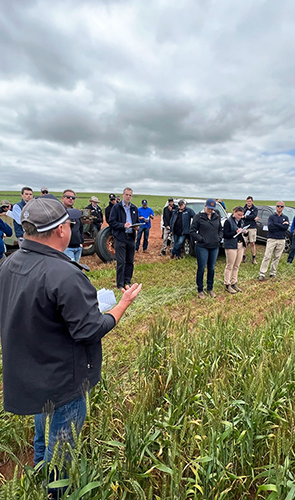
Between 2022 and 2024, the project team developed a Risk/Reward Tool to help farming systems groups communicate research outcomes more effectively to farmers. The work was a collaboration between Charles Sturt University and three farming systems groups: West Midlands Group and Corrigin Farm Improvement Group in Western Australia, and Central West Farming Systems in New South Wales.
Farmers and grower group staff were involved in each stage of development, including surveys, workshops, matrix exercises, and repeated rounds of testing and refinement. Farming systems groups trialled the tool on completed projects and gathered feedback from farmers and staff using process diaries and interviews.
Research findings
The Risk/Reward Tool provides a consistent framework for presenting research in a way that supports on-farm decision-making. To suit different decision-making styles and time constraints, the tool uses a tiered reporting structure:
- A one-page infographic for quick, visual communication (Figure 1).
- A four-page synthesis report for moderately detailed summaries.
- A full report template for comprehensive analysis.
Each format presents key findings across financial, environmental, social, and governance dimensions, helping farmers assess the full range of trade-offs and decide whether a new practice is right for them.
The tool is accompanied by a ‘Writing for Purpose’ guide, which provides templates and guidance for translating technical content into accessible, decision-oriented material. It also helps extension staff apply the tool consistently.
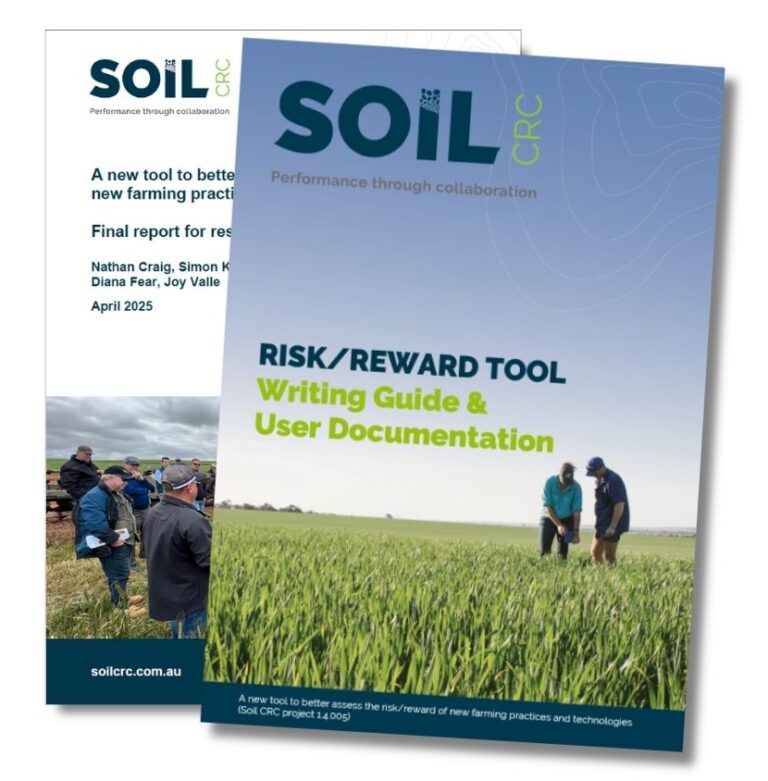
User testing with the three farming systems groups in WA and NSW showed that:
- Farmers found the infographic and synthesis report particularly helpful for quickly understanding trial results and assessing relevance to their own operations.
- Staff found it streamlined reporting processes and reduced the need to create new report formats.
The project confirmed that farmers are more likely to adopt innovations when information is contextualised, comparative, and aligned with their priorities. The Risk/Reward Tool addresses this need and provides a scalable, adaptable framework for more effective agricultural extension.

Significance of findings
This project highlights an opportunity to strengthen the link between research and on-farm adoption by improving how information is communicated. Farmers consistently report that existing research outputs are too technical, difficult to interpret, or lack relevance to their context. The Risk/Reward Tool addresses this longstanding barrier by providing a clear, farmer-oriented framework for reporting research outcomes in a consistent, comparative format that reflects on-farm realities.By standardising how research is communicated, the tool helps farmers compare options and make more confident, informed decisions at the farm-gate. It consolidates economic, environmental, social, and governance factors into a single structure, helping farmers weigh short-term benefits against long-term considerations such as labour requirements, environmental impact, and social licence. Its tiered format also caters to different learning preferences and time constraints.
For farming systems groups and extension professionals, the tool improves reporting efficiency, reduces duplication, and makes it easier for staff — especially new or rotating team members — to produce consistent, high-quality reports. The accompanying ‘Writing for Purpose’ guide ensures extension materials can be tailored to local needs without compromising structure or quality. The tool can also be used in workshops to guide structured, evidence-based discussions on soil improvement options.
By making research more accessible and relevant, the tool strengthens extension efforts and supports practice change. With potential for national rollout through Soil CRC and industry-led programs, it offers a scalable way to lift adoption of soil and practice-based innovations — contributing to more productive, sustainable, and resilient farming systems.
Next steps
- The Risk/Reward Tool has shown strong potential to improve how research findings are communicated. The next step is to build capacity within farming systems groups, such as through example reports, peer-learning workshops, and by embedding the Writing for Purpose guide into everyday extension work.
- Testing the tool across more regions, farming systems, and enterprise types will help confirm its adaptability and relevance beyond the initial trial sites. There is also strong potential to develop a digital version, enabling interactive, region-specific reporting and integration with existing farm management software.
- Long-term evaluation is needed to measure the tool’s influence on adoption rates, reporting quality, and farmer decision-making over multiple seasons. Embedding the tool into Soil CRC research projects—as part of their communication and adoption strategy—will ensure consistency across the program and increase its collective impact.
- There is also scope to expand the tool’s use, for example, in comparing different enterprise types, assessing natural capital, or supporting sustainability reporting. Continued feedback from users will help keep the tool aligned with changing industry needs.