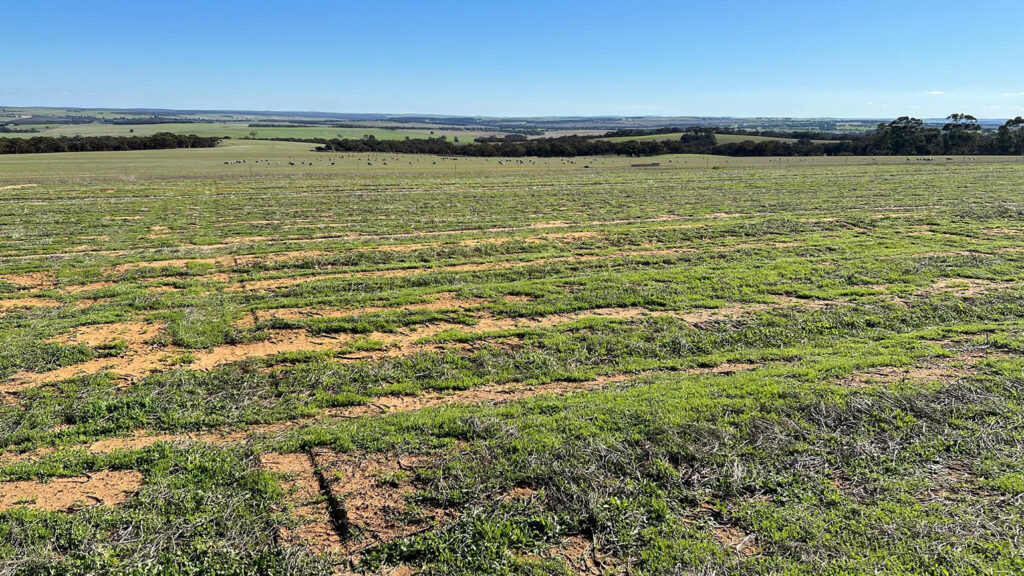
Many Western Australian farms have sandy soils with low organic carbon, characterised by low water holding capacity, poor nutrient retention and reduced productivity. These soils also limit opportunities to participate in carbon markets, which depend on measurable carbon gains.
For grain growers across the state, improving productivity, building resilience and accessing new market opportunities can be supported by finding ways to increase soil organic carbon.
The aim of this project was to trial, measure and demonstrate crop sequencing and new technologies that can sequester organic carbon, mitigate greenhouse gas emissions and improve soil fertility in crop production systems that have traditionally struggled to accumulate carbon.
Four large-scale field trials were established across the West Australian wheatbelt to assess soil amelioration, organic amendments and living plant systems along with carbon stabilisation methods, to minimise carbon losses from the system and look to establish a long-term crop sequence. The project also investigated soil health benefits and productivity related to the new farm practices.
This project received funding from the Western Australia Department of Primary Industries and Regional Development through the Future Carbon Program with additional funding being provided by the Soil CRC.
Key takeaways
Soil carbon gains were small and variable across the sites, which was expected given the short timeframe of the project.
Building soil carbon is a slow process, especially in sandy soils with low clay and organic matter.
The combination of crop sequencing, soil amelioration and amendments showed the strongest potential for achieving long-term gains in soil carbon.
Improvements in soil fertility were greatest when amendments were combined with physical amelioration. Water holding capacity and nutrient retention increased, helping crops make better use of rainfall and fertiliser. The yield responses were more modest and often declined by the third year.
Our research
Four trial sites targeting a range of climatic and soil type differences were selected in collaboration with 5 participating farming system groups: Liebe Group, West Midland Group, Facey Group, Corrigin Farm Improvement Group (CFIG) and the Western Australian No-Tillage Farmers Association (WANTFA), and research partner, Murdoch University.
The sites were selected on the basis that sequestering carbon has historically been difficult in predominately sandy soils of low fertility and productivity. The growers were interested in improving these soil types to be more profitable.
Treatments
The overall treatments targeted by the 4 trials were:
Farmer practice – Traditional crop rotation for the production zone.
Crop sequencing – To investigate mixed species of pasture and crop (increasing biodiversity) that will sequester carbon more efficiently.
Soil amelioration – To investigate soil amelioration effects on texture and subsequent carbon sequestration.
Soil amendments – To investigate the application of organic pellets and manures for carbon sequestration at depth.
A combination of the above.
Trial sites
In 2022, 3 sites across Western Australia were established at Kweda, Bullaring and Wathingarra. The fourth site at Coorow was not sown due to severe drought in the region during 2022 and 2023. Instead, it was set up in 2023 and sown in 2024.
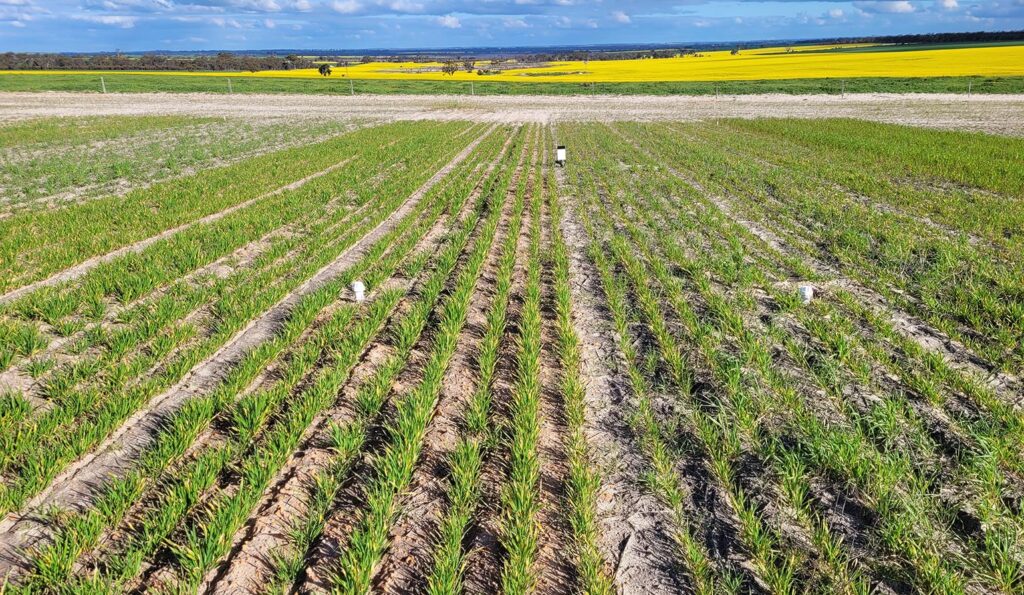
Bullaring – A trial was established to include different farming system approaches (soil disturbance, clay amelioration, mixed cropping with legume inter-row sown and a perennial legume). It was set up as a randomised block with seven crop treatments, including monocrops and intercrops. Plant and soil water assessments and soil analysis were carried out.
Kweda– Two trials were established in 2023 and sown to barley. An on-farm experiment and small plot trials were carried out to evaluate a range of organic and inorganic amendment options, as well as soil amelioration (deep ripping).
Coorow – Bentonite clay and chicken manure amendments were applied in 2022 with the aim to start the trial in 2024.
Wathingarra – An existing long-term site was used with further treatments applied in 2022. The site was bulk sown to Serradella pasture species from 2023 to give the site a break from cereals.
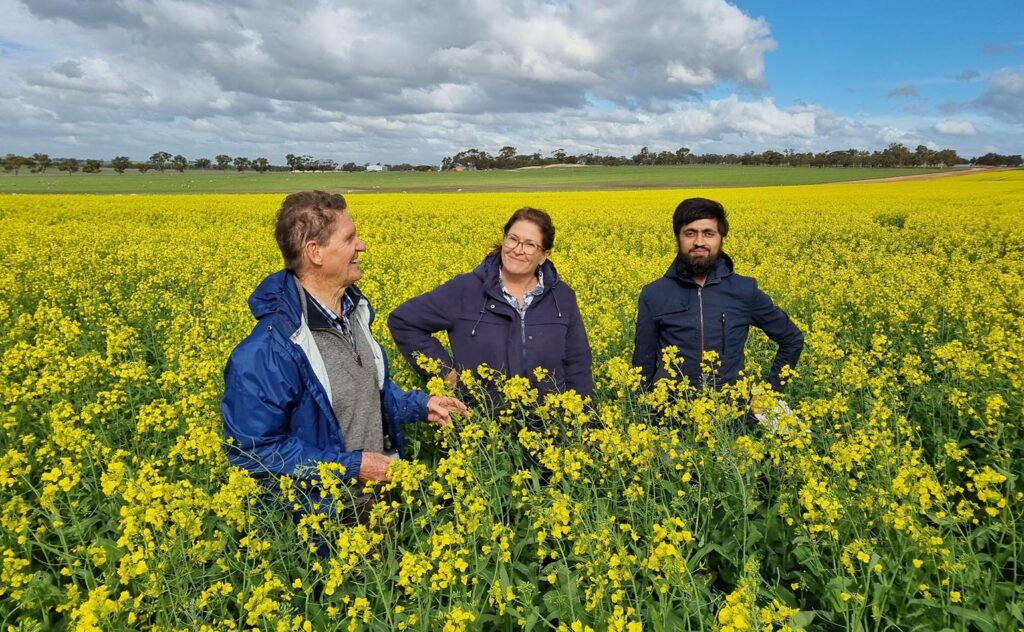
CFIG’s Executive Officer Joy Valle (centre) stands in the canola crop at the Kweda field site in WA with Soil CRC and Murdoch University researchers, Prof Richard Bell (left) and Dr Hassan Sardar. Source: CFIG.
What we found
A summary of the results from each trial site is provided here. Further detail can be found in the individual trial reports (links below).
Kweda
Overall, the trial showed that incorporating soil amendments, could decrease subsoil constraints and increase water use efficiency. These were achieved by raising soil organic matter and availability of nutrients by increasing subsoil aluminium toxicity, leading to increased soil carbon and soil water retention and crop health, biomass and yield.
Over 3 years, these results suggest that organic amendments, such as compost alone, in the given conditions (low rainfall and sandy duplex soil) may not be sufficient to significantly improve the soil total organic carbon on the surface. However, if applied in combination with soil manipulation such as deep ripping, it could provide better results, especially at depth.
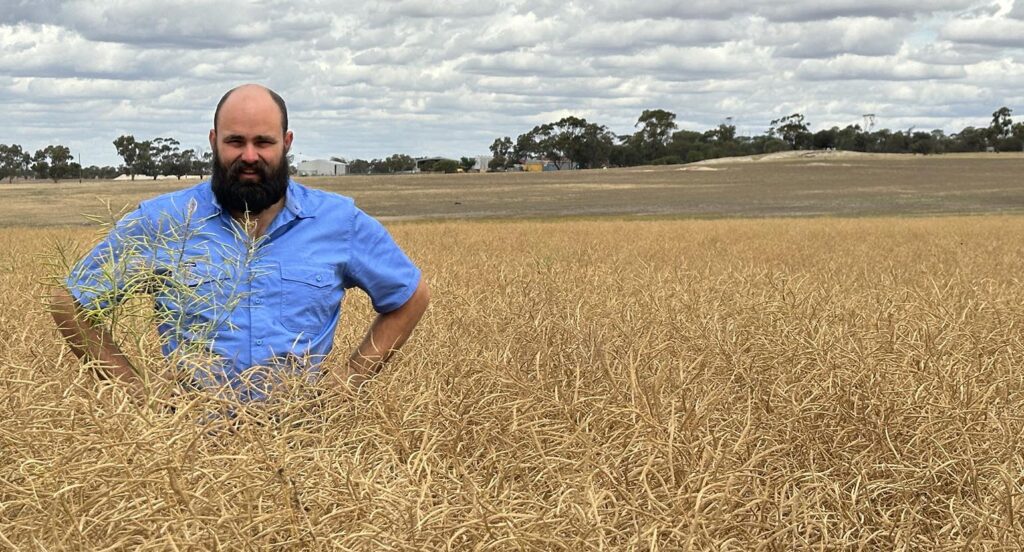
CFIG Project Officer David Storer standing in the small trial plots at Kweda prior to harvest in 2024. Source: CFIG.
Bullaring
Innovative farming system approaches using plant-based solutions, such as legumes and legumes intercropping, were investigated to increase soil amelioration in terms of biomass, carbon and soil stabilisation, and compared to mechanical procedures, including soil disturbance and clay incorporation in deep sandy soils.
Soil structural disturbance and clay incorporation could improve the reactivity, nutrient retention and weed competition for soil moisture in deep sandy soil.
Legumes teamed up with soil amelioration practices are an innovative cropping option to improve the health of deep sandy soils and increase the soil carbon content versus conventional soil disturbance and soil clay incorporation.
The Wathingarra site showed improved biomass production. There were significant increases in serradella biomass in 2024, particularly with rotary spading and mouldboard ploughing. This demonstrates the effectiveness of soil amelioration practices in improving crop growth.
While combining different amendments and amelioration methods showed additive benefits, no synergistic effects were observed. This suggests that these treatments can be used independently or together for incremental soil improvement.
Higher weed levels were observed in compost-treated plots, highlighting the need for careful management of organic amendments to avoid unintended weed proliferation.
Biochar/frass applications improved nutrient uptake (N, P, K) and could offer long-term benefits for soil fertility. Compost showed diminishing returns after 3–4 years, indicating the need for periodic reapplication to maintain its impact.
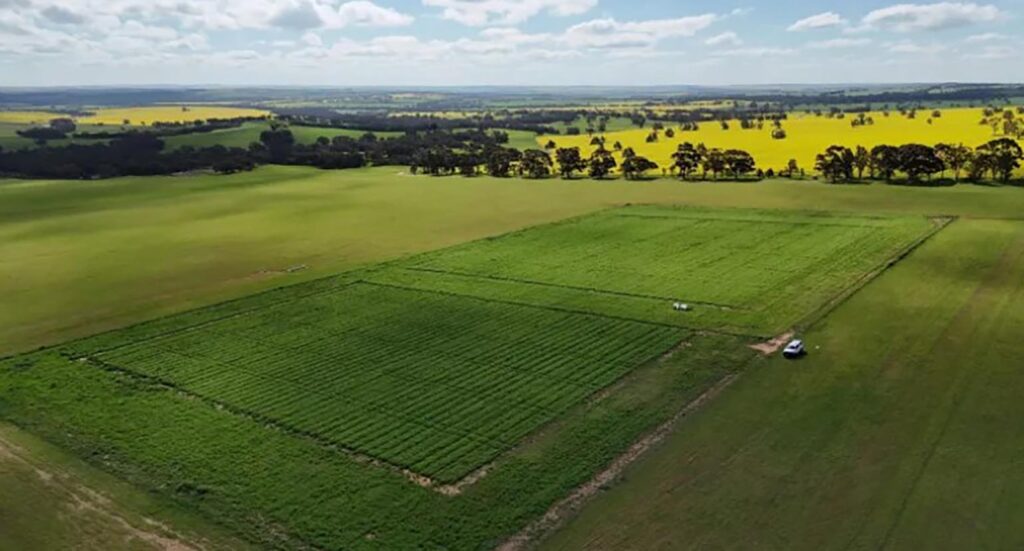
The Wathingarra trial site shown from above. Source: West Midlands Group.
Coorow
On a poor sand, with limited production history, adding clay and organic matter may increase the water holding capacity of the soil, in turn increasing plant health, biomass and yield.
Changing the farming system on these infertile soils had positive impacts on productivity and fertility in these trials. Especially where organic/inorganic and physical amendments were applied. However, these impacts were more pronounced after 1 year than after 3 years, indicating some of the treatments need to be re-applied over time.
Sequestering carbon in the soil was harder to achieve with large variability between treatments. Where organic amendments were applied in conjunction with some form of incorporation, there was a tendency for more carbon at depth but not on the surface. This result was not surprising, as 3 years is an extremely short amount of time to sequester carbon and for these systems to show measurable, significant differences. In other research trials, a time frame of up to 10 years was required and even then, seasonal variation and biomass production had a bigger impact then treatment.
Next steps
A Soil CRC project will extend 3 of the 4 trial sites until June 2028, with funding from the Australia Government’s Future Drought Fund Long-Term Trials Program. The continuation of these trials will allow a more in-depth analysis of carbon over time and will help to answer key questions around water use.
This project received funding from the Western Australia Department of Primary Industries and Regional Development through the Future Carbon Program with additional funding being provided by the Soil CRC.