Key points
- Soil microbial activity is a reliable indicator of how well a soil resists and recovers from stress such as compaction and drought.
- When environmental stress is low, microbial activity is governed by the availability of soil carbon and nitrogen. Under compaction or drought, soil texture, water-filled pore space and the severity of the stress determine a soil’s resistance and resilience.
- Fine-textured (clayey) soils resist stress better, while coarse-textured (sandy) soils recover faster once the stress passes.
- Management history does not change how well a soil initially resists stress. The benefit of good soil management comes through recovery, where improved practices such as crop rotation, legume fallow and residue amendment supply the organic matter, labile carbon and nitrogen and microbial diversity a soil draws on to rebuild.
The challenge
Healthy soil is a living system, home to billions of microbes that drive the processes plants depend on, such as breaking down organic matter, cycling nutrients and maintaining soil function. When soil is healthy, it can withstand tough conditions and recover.
Compaction and drought can stress the soil ecosystem and slow microbial activity, impacting crop growth and yield. How well a soil can cope with stress is described by resistance (the ability to keep functioning while under stress) and resilience (how quickly it returns to normal once the stress is removed).
However, there is currently no clear way to measure soil resistance and resilience, and there is limited understanding of how management practices such as cover cropping and minimum tillage affect soil resistance and resilience.
Our research
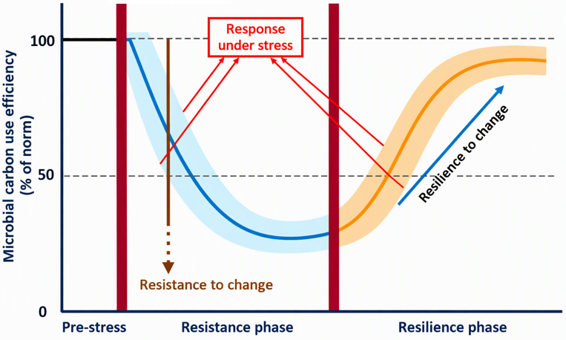
The project aimed to develop a clear understanding of how compaction and drought stress affect soil resilience and function across different farming systems. A key measure in the research was microbial carbon use efficiency – how efficiently soil microbes use carbon rather than losing it as CO₂. This was tested through three experiments, described below. Microbial carbon use efficiency was measured while the stress was applied (the resistance phase) and after it was removed (the resilience phase) (Figure 1).
Experiment 1 measured how two contrasting sugarcane soils, one sandy and one clayey, resisted and recovered from combined compaction and water stress. Each soil was packed to a gradient of bulk densities from 0.9 to 1.5 g/cm3, where 0.9 g/cm3 represented nil compaction, 1.1 to 1.2 g/cm3 represented low compaction, and 1.3 to 1.5 g/cm3 represented high compaction. Water treatments ranged from drought (water-filled pore space around 21%) through a non-stressed control, to waterlogging (water-filled pore space 100%).
Experiment 2 tested whether a farm’s management history affected how its soil resists and recovers from compaction. Two adjacent sugarcane soils of similar silty loam texture and physicochemical properties were compared, one under improved management (permanent raised beds, minimum tillage, mound planting, and a multiple-species legume fallow) and one under conventional management (repeated full tillage, planting in furrows, and grassy fallow). Both soils were compacted to 1.4 g/cm3 for the resistance phase. For the resilience phase, recovery was tested by:
- Ploughing the soil to loosen it back to 1.0 g/cm3.
- Adding a legume residue amendment (soybean, cowpea and lablab) as organic matter, at a rate equivalent to 50 tonnes per hectare.
Experiment 3 tested whether a farm’s management history affected how its soil resists and recovers from drought in a grain cropping system. Two soils with similar loamy texture and physicochemical properties were compared, one under improved management (a four-year crop rotation of wheat, lupins, barley and wheat) and one under conventional management (continuous wheat). Soil from each farm was set to three moisture levels: 15% water holding capacity (severe drought), 30% (moderate drought) and 55% (no drought, the control). For the resilience phase, recovery was tested by:
- Re-wetting all samples back to 55% water holding capacity.
- Adding a wheat residue amendment as organic matter to half the samples.
Research findings
Experiment 1. Soil texture in sugarcane systems
The clayey soil showed greater resistance, maintaining microbial carbon use efficiency closer to the unstressed control throughout the compaction and water stress. This may be because its finer particles, stronger aggregation and greater microbial diversity gave it more stability under disturbance.
The sandy soil showed greater resilience, returning more fully to baseline function once the stress was removed. Sandy soils drain and re-wet more freely than clayey soils and have a lower buffering capacity. Their internal conditions shift more readily as external conditions change, and the microbial communities within them are adapted to this variability, resuming normal activity quickly once the stress lifts.
This experiment also showed that what governs the microbial response depends on the level of stress. Under low stress, microbial activity and respiration are driven mainly by the availability of soil carbon and nitrogen. Under stress, resistance and resilience are regulated by soil texture, water-filled pore space and stress severity.
Experiment 2. Management history and compaction in sugarcane systems
Resistance was similar across both soils, indicating management practices did not shield the microbes from the initial compaction stress. Microbial response to compaction is governed primarily by soil moisture and water-filled pore space rather than by management history.
However, recovery depended on how the compaction was relieved. Where the soil was only loosened by ploughing, the conventionally managed soil recovered better. Where legume residue was added alongside ploughing, the improved-management soil recovered better and did so more consistently across compacted and uncompacted treatments.
Experiment 3. Management history and drought in grain systems
The response to drought was governed by soil water content rather than management history. In both soils, resistance fell as moisture declined.
The improved-management soils recovered from moderate and severe drought faster than back-to-back wheat. This is likely due to the higher organic matter and more complex microbial community built up under the crop rotation.
Adding wheat residue raised soil labile carbon and nitrogen, microbial biomass and enzyme activity in both soils regardless of management history, improving the supply of carbon and nitrogen to the microbial community during recovery.
Together, these experiments indicate that:
- The pattern of a soil’s microbial response to stress is set by its texture and the severity of the stress, not by its management history.
- However, improved practices such as minimum tillage, cover cropping, crop rotation, legume fallow and residue amendment raise soil organic matter, labile carbon and nitrogen, and microbial diversity, which support greater overall resistance and resilience to compaction and drought.
Significance of the findings
This project has shown that microbial carbon use efficiency reliably tracks soil resistance and resilience. Researchers can use the assessment methods to test whether new systems such as regenerative farming and cover cropping are producing higher-performing soils, with resilience as a direct measure of performance. If commercialised, the methods would give farmers and agronomists a way to assess their soil’s response to compaction and drought stress.
The findings also clarify what management can and cannot do. Practices such as crop rotation and cover cropping build resistance and resilience over time by raising organic matter, labile nutrients and microbial diversity, but they cannot change a soil’s texture, which along with stress severity, governs how the soil first responds to disturbance.
Next steps
Further research priorities include:
- Long-term field trials comparing soils under conventional and improved management such as cover cropping and crop rotation to confirm the resistance and resilience results under varying field conditions.
- Testing organic amendments such as plant residues and compost in the field to measure their effect on resistance and resilience to compaction and drought.
- Quantifying shifts in microbial resistance and resilience across a wider set of stresses, such as pesticide residues and carbon decline.
- Building decision-support tools that let growers understand the soil carbon and resilience benefits of various land management practices.
Soil CRC project Evaluating ecosystems role in increasing soil carbon and soil resilience (4.1.005) explored how different land management practices affect soil resilience, with the goal of identifying which practices build more resilient soils and under what conditions they are most likely to benefit farmers.