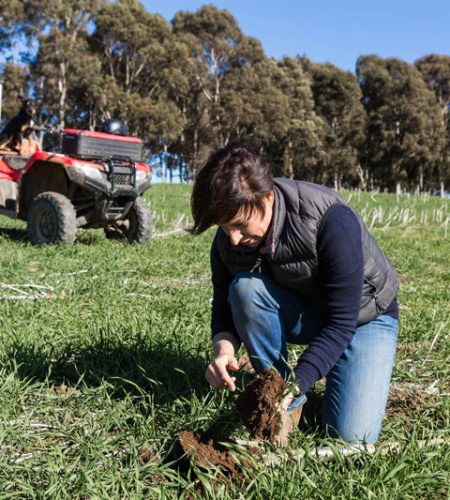
Dr Mehran Rezaei Rashti
Project Leader
Griffith University
The challenge
Healthy soil is a living system, home to billions of microbes that drive the processes plants depend on, such as breaking down organic matter, cycling nutrients and maintaining soil function. When soil is healthy, it can withstand tough conditions and recover.
Soil resilience describes how well a soil maintains its function under stress, and how quickly it recovers once that stress is removed. Drought is one of the most damaging stressors for soil microbial communities. When moisture drops, microbial activity slows, nutrient cycling stalls and the soil becomes less able to support plant growth. Recovery can also be slow. Microbial communities take time to rebuild after periods of stress, and soils that have been heavily degraded may take years to regain their function.
Soils with higher organic matter, better structure and greater nutrient availability tend to cope better and recover more quickly. Management practices such as cover cropping and minimum tillage can build soil carbon and improve soil condition over time. However, there is still limited understanding of how these practices influence a soil’s ability to resist stress and recover once conditions improve, and under what circumstances they are most likely to deliver results.
Improving this understanding is important for farmers and advisors making decisions about which practices will deliver reliable gains in productivity and resilience under increasingly variable conditions.
Our research
Building on the Soil CRC project Evaluating soil functional resilience (4.1.003), this project examined how land management practices affect soil resilience, with the goal of identifying which practices build more resilient soils and under what conditions they are most likely to benefit farmers.
Two concepts were used to evaluate soil health:
- Soil resistance, a soil’s ability to maintain its function after a disturbance.
- Soil resilience, how quickly it recovers to its pre-disturbance state.
Management practices studied included cover cropping, minimum tillage, lime application and the Bednar method. The Bednar method can address subsoil compaction, subsoil acidity and non-wetting sands by incorporating surface-applied amendments into the subsoil via deep ripping.
Microbial properties assessed included microbial biomass (the size of the microbial community, both active and dormant), microbial respiration (how actively microbes are breaking down organic matter and cycling nutrients), enzyme activity (the rate at which organic matter is being broken down and nutrients released for plant uptake) and plant growth responses.
The research had three components:
- Literature review
- Field site assessments
- Laboratory experiments
Research findings
- Read our research findings fact sheet for an overview of our research.
- Read our final project report to dig deeper.