Key points
- Healthy soil is a living system driven by microbial communities. When these communities are disrupted by stress, soil function declines and recovery can be slow. Healthier soils are generally better able to withstand and recover from stress.
- Soils with higher organic matter, better nutrient availability, more clay and suitable pH are better able to withstand and recover from drought.
- Tillage intensity strongly affects soil resilience. Minimum tillage supports higher microbial activity, better nutrient retention and stronger plant growth under drought and compaction, while excessive tillage reduces soil function and recovery.
- Cover cropping increases carbon and nitrogen inputs to the soil, supporting microbial activity and nutrient cycling during drought stress. Combining cover cropping with minimum tillage gives stronger improvements in nitrogen retention, and plant growth and recovery under drought stress.
- Lime application improves soil pH, supporting larger and more active microbial communities and increased available nitrogen. It shows potential for improving resistance to moderate drought stress and supporting recovery after stress.
The challenge
Healthy soil is a living system, home to billions of microbes that drive the processes plants depend on, such as breaking down organic matter, cycling nutrients and maintaining soil function. When soil is healthy, it can withstand tough conditions and recover.
Soil resilience describes how well a soil maintains its function under stress, and how quickly it recovers once that stress is removed. Drought is one of the most damaging stressors for soil microbial communities. When moisture drops, microbial activity slows, nutrient cycling stalls and the soil becomes less able to support plant growth. Recovery can also be slow. Microbial communities take time to rebuild after periods of stress, and soils that have been heavily degraded may take years to regain their function.
Soils with higher organic matter, better structure and greater nutrient availability tend to cope better and recover more quickly. Management practices such as cover cropping and minimum tillage can build soil carbon and improve soil condition over time. However, there is still limited understanding of how these practices influence a soil’s ability to resist stress and recover once conditions improve, and under what circumstances they are most likely to deliver results.
Improving this understanding is important for farmers and advisors making decisions about which practices will deliver reliable gains in productivity and resilience under increasingly variable conditions.
Our research
This project (4.1.005) examined how land management practices affect soil resilience, with the goal of identifying which practices build more resilient soils and under what conditions they are most likely to benefit farmers.
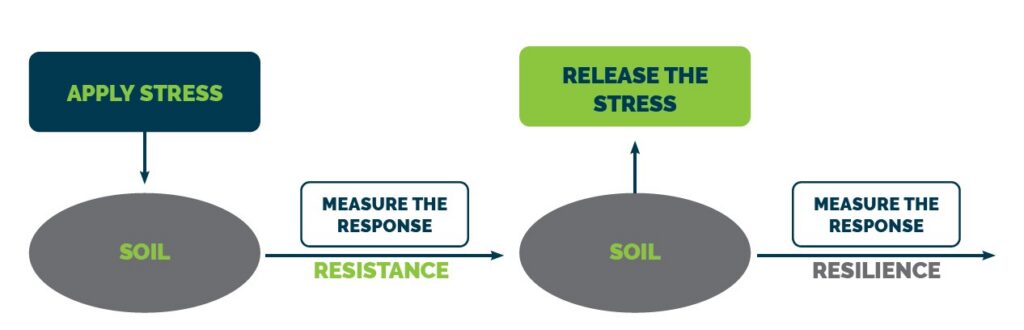
Two concepts were used to evaluate soil health:
- Soil resistance, a soil’s ability to maintain its function after a disturbance.
- Soil resilience, how quickly it recovers to its pre-disturbance state.
Management practices studied included cover cropping, minimum tillage, lime application and the Bednar method. The Bednar method can address subsoil compaction, subsoil acidity and non-wetting sands by incorporating surface-applied amendments into the subsoil via deep ripping.
Microbial properties assessed included microbial biomass (the size of the microbial community, both active and dormant), microbial respiration (how actively microbes are breaking down organic matter and cycling nutrients), enzyme activity (the rate at which organic matter is being broken down and nutrients released for plant uptake) and plant growth responses.
The research had three components:
Literature review
Published studies from around the world were analysed to understand how soil microbial communities respond to drought stress across different land use types, and what soil properties most influence soil resilience.
Field site assessments
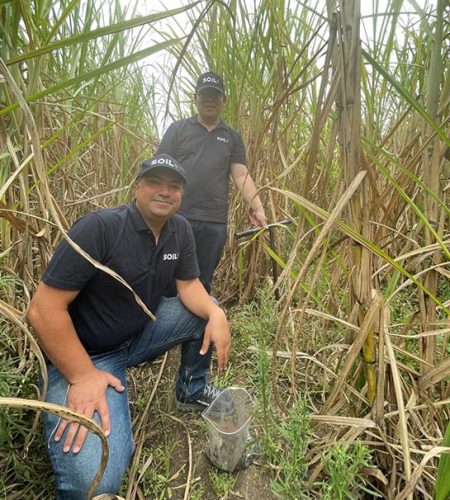
Soils were collected from paired field sites across New South Wales, Western Australia, Queensland and South Australia. Researchers measured key soil properties including carbon, nitrogen, pH, water holding capacity and microbial activity to establish a baseline understanding of how different management histories affect soil health.
Laboratory experiments
Soils from the field sites were exposed to controlled drought and compaction stresses, at moderate and severe levels. Researchers measured changes in microbial biomass, microbial respiration and enzyme activity during the stress period and after recovery (Figure 1). A glasshouse pot trial also assessed how these stresses affected plant growth and nutrient uptake in soils with different management histories.
Research findings
Literature review
Disturbing the soil (either by human activities or natural stresses such as drought) affects soil microbes, which affects soil resistance and resilience. Drought stress reduces microbial activity across agricultural, forest and grassland soils. Microbial respiration declines under drought but can recover once moisture returns. Microbial biomass recovers more slowly and often incompletely. Rebuilding the microbial community takes time, particularly where drought has caused significant die-off, meaning a soil may appear to be functioning again while the underlying community remains depleted, leaving it less able to withstand future stress.
A soil’s capacity to resist and recover from drought depends strongly on its intrinsic properties. Soils with higher organic matter content and nutrient availability support more active and resilient microbial communities. Soils with more clay (e.g. loam and heavier soils) retain more moisture than sandy soils and show greater resistance and resilience to stress. In agricultural soils, pH is a key factor influencing how well soils resist and recover from drought. Acidic soils are generally less resistant and less resilient to drought stress than neutral to alkaline soils, particularly with respect to soil microbial biomass and respiration.
Management history
Soils were collected from paired field sites to establish a baseline understanding of how management history shapes soil health before any stress was applied. Management history influenced soil carbon, nitrogen and microbial activity, though responses were not consistent across all locations.
Physical soil properties such as water holding capacity showed little difference between management systems in most cases. Microbial indicators including respiration and biomass were more responsive, suggesting that biological properties reflect management change earlier than physical ones.
Cover cropping increased organic matter inputs while minimum tillage reduced soil disturbance. Together these practices tended to produce more active carbon and nitrogen pools, which are the primary energy and nutrient sources for microbes and help maintain microbial activity and nutrient cycling. The Bednar treatment similarly increased carbon and nitrogen compared to conventionally managed soils.
Cover cropping generally raised soil pH, while minimum tillage produced less acidic soils compared to heavily tilled soils. Lime application raised soil pH, creating more favourable conditions for microbial activity. Lime-treated soils supported a larger and more active microbial community, and had more carbon available to soil microbes compared to un-limed soils. Lime treatment also increased available mineral nitrogen, likely by improving conditions for nitrogen breakdown in the soil.
Overall, responses varied by site and soil type, but cover cropping and minimum tillage showed the most consistent benefits across locations.
Management practices
Laboratory experiments and pot trials exposed soils from different management histories to drought stress. Soils from sites with different tillage histories were also tested under compaction stress.
Tillage
Tillage intensity had a significant and consistent effect on soil resilience.
Under compaction stress, minimum tillage supported a larger microbial community and recovered carbon and nitrogen availability more quickly once compaction was alleviated. Moderate compaction under minimum tillage enhanced microbial biomass. Excessive tillage consistently disrupted soil structure and the habitat microbes depend on, resulting in lower resistance and resilience, particularly under severe compaction.
Under drought stress in pot trials, minimum tillage soils retained more nutrients, supported higher plant biomass and greater nitrogen uptake compared to heavily tilled soils. Minimum tillage with mixed fallow cover crop management maintained higher microbial biomass even under severe drought stress. Heavily tilled soils showed reduced microbial activity, lower nutrient availability and poorer plant growth under drought conditions.
Cover cropping
Cover cropping was tested under drought stress conditions.
Soils with a cover cropping history showed higher resistance to moderate drought stress compared to conventionally managed soils, maintaining microbial function and retaining nutrients both during and after stress. Under severe stress, the difference between cover cropping and conventional management was less pronounced.
Cover cropping soils also maintained greater microbial functional diversity under stress, meaning that when some microbial groups were affected, others continued to perform essential soil processes. In contrast, sites without cover crops showed a notable decline in functional diversity under severe stress.
The combination of cover cropping and minimum tillage had the most positive effects. Cover cropping increased microbial biomass and enzyme activity, while minimum tillage improved nutrient retention. In pot trials, these soils supported higher plant biomass and shoot nitrogen content under moderate drought stress conditions. In contrast, conventional management and excessive tillage were associated with reduced microbial activity, lower nutrient availability and poorer plant growth under drought conditions.
Lime
Lime was tested under drought stress conditions. At sites where lime had been applied, microbial communities were more active, and nitrogen cycling more stable, particularly under drought conditions.
Compared to un-limed soils, lime-treated soils showed a greater ability to withstand moderate drought stress, but not severe drought stress. After drought stress was removed, lime-treated soils recovered well, with microbial biomass carbon and nitrogen both higher than in un-limed soils by the end of the recovery period.
Bednar
The Bednar treatment was tested under drought stress. The Bednar treatment maintained stable microbial processes and supported higher microbial biomass carbon and nitrogen compared to untreated soils, particularly under moderate drought stress. Its effects on microbial activity were variable across conditions. The treatment did not reduce plant productivity in the trials.
Significance of the findings
Farmers need practical tools and guidance to build soils that can withstand and recover from stress. This project provides evidence that sustainable management practices like cover cropping and minimum tillage can meaningfully improve soil resilience.
The findings give farmers, advisors and farming groups a stronger basis for deciding which management practices to adopt and when. This knowledge is particularly valuable for those working to rebuild stressed soils and improve crop productivity and farm profitability.
In the longer term, this work will contribute to developing soil resilience assessment tests and decision support tools that farmers can use to monitor soil health and guide management decisions across different cropping systems. These tools will have broad application across Australian agricultural industries and grower networks.
Next steps
This project lays the groundwork for practical tools that farmers and advisors can use on the ground. The next phase of work will focus on education and training, including face-to-face workshops and online resources, to help farmers apply these findings in their own systems and determine which management practices are most likely to improve soil performance and productivity.