Key points
- The project surveyed landholders across six regions in rural Australia to understand how their values, beliefs, and practices influence land management decisions. Landholders share strong values related to family, stewardship, and leaving the land in better condition for future generations.
- While values are consistent, beliefs — particularly about climate change — vary widely between regions. Many landholders do not believe climate change is caused by human activity, yet most support reducing agricultural emissions.
- A number of recommended soil and land management practices have been adopted, though implementation of different practices varies widely across regions.
- Practice implementation is closely linked to landholder knowledge of those practices.
- The survey offers a practical, repeatable way to understand how landholder attitudes, values, and practices are changing over time.
The challenge
Improving soil health and productivity requires not just technical solutions, but also an understanding of how landholders make decisions and why. Landholder choices are shaped by practical and economic realities, and strongly influenced by personal values, beliefs, knowledge, and the social norms of their communities.
However, these social and cultural drivers of decision-making are often overlooked in research, policy, and extension. This research responds to several challenges:
- A lack of robust, regionally grounded data on the social and cultural factors that influence farm decision-making.
- Limited visibility of how landholder decisions affect long-term soil health and sustainability outcomes in various farming contexts.
- A potential disconnect between landholder priorities and the policies or programs designed to support them.
- Difficulty for extension providers and grower groups in tailoring engagement to diverse values and motivations.
- Improving linkages between soil-performance innovation and landholder priorities.
- A need for greater understanding among the public and policy-makers of the pressures farmers face and the rationale behind their decisions.
Without this understanding, efforts to promote sustainable land management may fail to resonate or gain traction. Tailoring strategies to regional contexts — including who landholders trust, what they value, and how they weigh risks — is essential for meaningful, lasting change.
Our research
The Soil CRC’s national survey project, ‘Surveying On-Farm Practices’, began in 2019 in partnership with local farming organisations. It forms part of the CRC’s goal to survey landholders in six regions, twice, over its 10-year timeframe, to track changes in values, attitudes and practices. This fact sheet presents the findings from the first round of surveys.
Surveys were posted to landholders, with properties larger than 10 hectares, in six regions: North Central Victoria (2019), the Western Australian Wheatbelt (2020), the Eyre Peninsula in South Australia (2020), Central West New South Wales (2022), Tasmania (2022), and the Wimmera in western Victoria (2023). In lower-population regions, all landholders received the survey; elsewhere, a random sample was selected.
Each survey included a core set of questions, along with region-specific additions. The questions explored:
- Actual and intended land management practices
- Self-assessed knowledge of, and confidence in, best practice
- Landholder background and enterprise
- Farm management styles
- How landholders are sourcing information, and from whom
- Perception of risk and other attitudinal factors
- Challenges and aspirations
- Values and beliefs, including those related to climate change and trust in science.
The survey method was implemented and developed by Dr Hanabeth Luke, building on a foundation of earlier benchmarking work (Curtis & de Lacy, 1995; Curtis & Luke, 2019).
Individual reports from each region and a final report for the first round of surveys are available on the Soil CRC Knowledge Hub.
Research findings
Table 1 summarises key attributes of the survey respondents, such as land size and proportion of income earned from farming. These key attributes are important for contextualising and interpreting the factors influencing farming knowledge, values, and practices.
The survey sample was dominated by farmers, with full-time landholders owning the majority of land in each region. Respondents were generally older (median age 57–70), with relatively low female participation (8–25%).
Table 1. Key attributes of the survey respondents
| Key attributes (mean unless indicated) | North Central Victoria (2019) | The Eyre Peninsula, South Australia (2020) | Northern Wheatbelt, Western Australia (2020) | Central West NSW (2021) | Tasmania (2022) | The Wimmera, Victoria (2023) |
|---|---|---|---|---|---|---|
| Full-time farmers | 49% | 62% | 72% | 55% | 33% | 58% |
| % of land surveyed that is owned by full-time famers | 80% | - | - | 89% | 87% | 87% |
| Part-time farmers | 19% | 14% | 10% | 19% | 19% | 17% |
| Non-farming landholders | 19% | 16% | 10% | 8% | 8% | 17% |
| Female respondents | 22% | 10% | 8% | 21% | 25% | 24% |
| Age of respondent (median) | 62 | 57 | 70 | 61 | 61 | 62 |
| Mean property size (area owned) | 118 ha | 2885 ha | 4712 ha | 1300 ha | 359 ha | 1240 ha |
| Median property size (area owned) | 228 ha | 1500 ha | 3227 ha | 1140 ha | 42 ha | 550 ha |
| Income from agriculture (2018/19) | 69% | 78% | 89% | 70% | 57% | 80% |
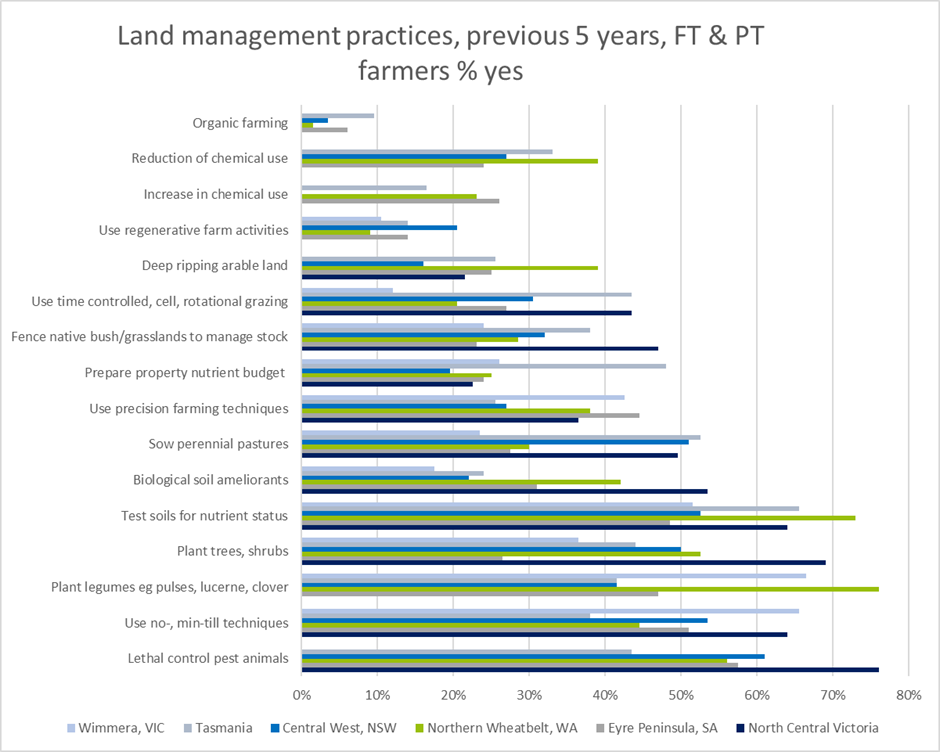
Adoption of best practice land and soil management by farmers (full-time and part-time combined), over the past three to five years, was evident across the regions, with regional variation in focus (Figure 1). The top three land management practices by region include:
- North Central Victoria: Use of no-tillage techniques (64%), soil testing (64%) and planting trees and shrubs (63%)
- Eyre Peninsula, South Australia: minimum/no-till farming (56%), planting legumes or pulses (51%) and soil testing (49%)
- Western Australia: Testing for soil nutrients (79%), sowing legumes and pulses (76%), and planting legumes or pulses (70%)
- Central West NSW: Maintaining at least 70% groundcover (67%), soil testing (55%) and no/minimum-till to establish crops or pastures (54%)
- Wimmera, Victoria: Sowing legumes and pulses (66%), no-till to establish crops or pastures (64%) and soil testing (51%)
- Tasmania: Soil testing (65%), lime applications (61%) and perennial pastures (53%).
Across the regions, knowledge of current recommended best practice is often correlated with increased uptake of the associated practices.
Key values reported by landholders reflect a strong focus on family, livelihood, and care for the land. When asked about guiding life principles, 95–99% of landholders prioritised looking after family and loved ones. This was followed by:
- Preventing pollution and protecting natural resources (80–88%)
- Creating wealth and business profit (lower priority in most regions, 54–65%; except for the Northern Wheatbelt WA and Central West NSW, both 85%)
- Respecting the earth and living in harmony with nature (68–82%).
For values attached to property, the most widely held was the desire to pass on a healthier environment for future generations, reported by 84–90% of respondents. Other highly rated values included having an attractive place to live (74–90%) and raising a family on the land (71–84%).
Values related to native habitat were ranked lower, with 61–74% valuing the presence of birds, animals and native vegetation. The results suggest that landholders’ views on what makes an environment “healthy” or “attractive” are varied and often shaped by personal or family-oriented values, rather than native ecosystems or biodiversity.
Understanding of climate risk varied considerably, with full-time farmers least likely to view this as a risk. While 65% of Tasmanian respondents and 70% of those in the Northern Wheatbelt of WA agreed that climate change poses a risk to their region, this dropped to 55% in Central West NSW, 45% in the Wimmera, and 43% on the Eyre Peninsula.
Understanding that climate change is anthropogenically driven, also varied. Of Tasmanian landholders, three quarters (75%) agreed that human activity was driving climate change, compared to 48–61% in other regions. Despite these differences, most respondents agreed that primary producers should reduce emissions, with support ranging from 50–73%, though only 41% of Wimmera respondents agreed. Fewer landholders (40–52%) agreed that fundamental changes to farming systems are needed to improve sustainability.
Differences in climate change beliefs may reflect differences in farmers’ direct experiences of weather extremes, their trust in climate-related messaging, or the prevailing social norms within their communities. Modelling from this project found that adopting resilience-building farming practices is strongly associated with belief in climate change and with being a younger farmer (Alexanderson et al., 2023). In contrast, farmers who were older, more risk-averse, less supported, and coping less-well with farm-related stress were less likely to adopt these practices.
Key challenges related to region-scale issues were fairly consistent. Water security (72–81%) and changes in weather patterns (63–85%) were rated the most pressing issues across all regions. Interestingly, the belief that climate change poses a risk to each region varied between 43 and 70% despite weather pattern changes and water security being relevant to landholders across all regions.
At the property scale, soil-related challenges were also widespread, particularly soil erosion and the interrelated issues of low biological activity, declining nutrient status and low organic carbon. While some landholders are already using best practice soil management to address these issues, regional data suggests there are opportunities to increase adoption by building knowledge and confidence in the effectiveness of these practices.
Capacity to change varied. There was strong openness to new ideas about farming (87–91%), but 15–31% reported seeing no reason to change, and 33–48% preferred to avoid risk. Risk aversion was highest on the Eyre Peninsula (58%) and lowest in the Northern Wheatbelt (33%).
Even among those open to change, there were practical barriers. Time and money were key constraints, with only 44–50% of landholders reporting the financial freedom to implement changes. Limited internet access was also a common obstacle, with 49–53% saying it affected their ability to access or use farm data effectively, limiting their capacity to plan, adapt, and try new approaches.
Between one-third and nearly half of full-time farmers (31–44%) identified as early adopters. Farmers identifying as early adopters were significantly more likely to:
- Be involved in soil health and commodity groups
- Make changes on their farms to meet both productivity and environmental goals
- Respond to climate change by adjusting their operations to reduce emissions or increase carbon storage.
Preferred communications channels and sources were similar across all regions. The top modes of communication used by landholders were field days, websites, newspapers and magazines. The top source of information for landholders was ‘Other Farmers’ in all regions that included this as an option — Eyre Peninsula (77%), Northern Wheatbelt (70%), Central West NSW (63%), Tasmania (59%) and the Wimmera (62%). Close social connections were the second most important overall, including friends, neighbours and family. The third most important source listed across regions were independent agricultural consultants.
Significance of findings
This research captures both the common ground and the differences in how landholders in six regions across Australia manage their farms, make decisions, and respond to challenges. It provides a solid evidence base to inform planning, policy and investment, particularly for organisations supporting rural and farming communities.
The research clearly demonstrates that landholder decisions are shaped not only by economic or practical considerations, but by deeply held values, social norms, and trusted peer networks. Across all regions, family, legacy, and care for the land consistently emerged as core values. These provide a strong and practical entry point for engagement.
Framing messages around long-term viability, stewardship, and the desire to leave the land in better condition for future generations is likely to be more effective than purely technical or issue-based approaches. In particular, avoiding fear-based climate messaging and instead emphasising positive outcomes — such as resilience, continuity, and intergenerational benefit — can build trust and improve uptake.
Many farmers identified other farmers as their main source of information, highlighting the importance of local champions in driving practice change. Supporting these individuals and building communities of practice around them can be a powerful way to encourage change, but ongoing support is often needed to maintain momentum.
Grower groups can use the data on land management practices to track changes over time, assess the impact of their knowledge-sharing efforts, and identify where further support or engagement may be needed.
Finally, the survey tool itself provides a consistent framework for comparing and tracking change in agricultural regions. It supports both cross-sectional and long-term analysis and can be used to guide future research and ensure investments are better aligned with the values, capacities and aspirations of landholders.
Next steps
Soil CRC projects 1.2.007 and 1.2.009 are delivering follow-up surveys across all six regions to track changes in landholder values, attitudes, and practices over time. This marks the second round of data collection in the Soil CRC’s national Social Benchmarking Rural Landholders Program.
The results from these surveys are building a national dataset tracking trends in landholder values, beliefs, and management practices. This will support targeted policy at state and federal levels, guide investment in soil health programs, and help identify which practices are gaining traction and where further extension or support is needed. There is potential to cross-reference this social data with biophysical and spatial datasets to explore links between attitudes, decisions, and on-ground conditions.
These repeat surveys are being implemented by the Soil CRC across all regions listed above. Additional regions may also be included to broaden national coverage and better understand how landholders in different contexts are responding to emerging challenges. It would be ideal to continue implementing the surveys at 4 to 5-year intervals to monitor ongoing shifts in social and farming dynamics, which is partly why this project is extensively supported by our regional partners. Given that the Soil CRC’s funding comes to an end in 2027, the opportunity exists for other funding bodies to invest more in the future.