Key points
- Many Australian agricultural soils contain multiple physical and chemical constraints that restrict root growth, limiting the water and nutrients available to crops and reducing yield potential.
- Field trials at sites in New South Wales, Victoria, Queensland and Western Australia evaluated a range of tailored subsoil amendments to improve yield in constrained soils. Nutrient-rich organic matter treatments produced the strongest crop responses at the New South Wales and Victorian sites, including yield increases of up to 19% in wheat and 42% in canola compared to untreated controls.
- It remains unclear whether the effectiveness of nutrient-rich amendments is driven by improved nutrition, better soil physicochemical conditions, or a combination of both. Further research is needed to resolve this.
- Soil amendments take time to change soil properties, and responses vary from year to year with the climate. Long-term field trials are essential for understanding the effects of amelioration on soil health, crop growth and water use efficiency.
The challenge
More than 60% of Australia’s 20 million hectares of cropping soils exhibit subsoil constraints such as sodicity, acidity and salinity. These constraints limit root growth, restrict access to water and nutrients stored deeper in the soil profile and cause crops to yield below their potential. When roots cannot penetrate the subsoil freely, crops miss out on moisture that would otherwise carry them through dry periods and deliver higher yields. Even modest gains in subsoil moisture extraction can translate into meaningful productivity improvements, because yield is closely tied to transpiration.
Ameliorating subsoil constraints is a major opportunity to lift farm productivity and profitability, but past research results have been highly variable. Yield responses have ranged from negative outcomes through to increases of 50% or more. This variability is a particular problem where multiple constraints occur together, which is common across Australian cropping soils.
Growers need better information on which amelioration approaches work, under what conditions, and how to tackle sites where several physical and chemical constraints are present at once. Without this knowledge, investment in subsoil amelioration carries significant risk.
Our research
This project (4.2.004) established four on-farm field experiments in 2022 to test new practices and products for ameliorating multiple soil constraints across key soil types in the Australian grains and sugarcane industries. Sites were selected to represent a range of constraint profiles common to cropping soils in each region (Table 1).
Table 1. Soil type and constraint profiles across the four trial sites
| Site | Crop | Soil type and key constraints |
|---|---|---|
| Clare, Qld | Sugarcane | Vertosol. Compacted, waterlogged, limited structure; dispersive and magnesic below 20 cm (see Figure 1) |
| Lockhart, NSW | Grain | Brown Sodosol. Alkaline, dispersive, sodic, hard pan at 30 cm and history of waterlogging |
| Wonwondah, Vic | Grain | Sodic Vertosol. Dense sandy-clay subsoil, poorly drained, highly dispersive, moderate salinity at depth |
| Kweda, WA | Grain | Duplex sandy soil. Low pH, aluminium toxicity, low fertility, waterlogging and possible compaction |
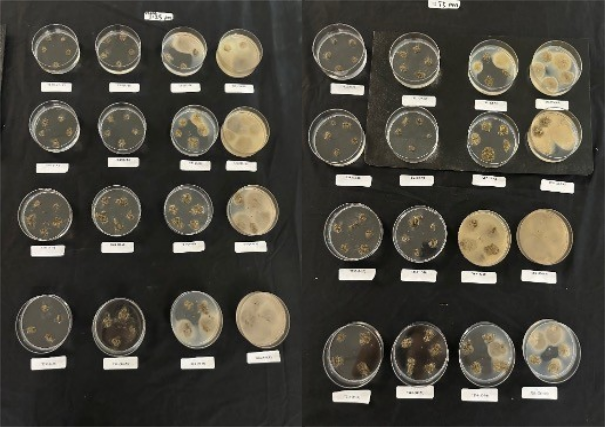
The project trialled a wide range of amendments across the four sites, including:
- Mineral amendments: gypsum (including enhanced and liquid forms), reactive silicate, hydrotalcite and zeolite
- Organic matter pellets: lucerne, wheat straw, and carbon-coated mineral (biochar) pellets, often fortified with nutrients
- Composts and recycled organics: council green-waste compost, food organics and garden organics (FOGO), urban green-waste mulch
- Mill by-products: sugarcane mill mud and ash
- Inorganic fertilisers: liquid and solid nitrogen, phosphorus, potassium and sulphur (NPKS) blends
- Soil conditioners: polyacrylamide (PAM) polymer, applied with organic matter to improve soil aggregation
- Novel products: pelletised clay/gypsum blends and proprietary water-retention products.
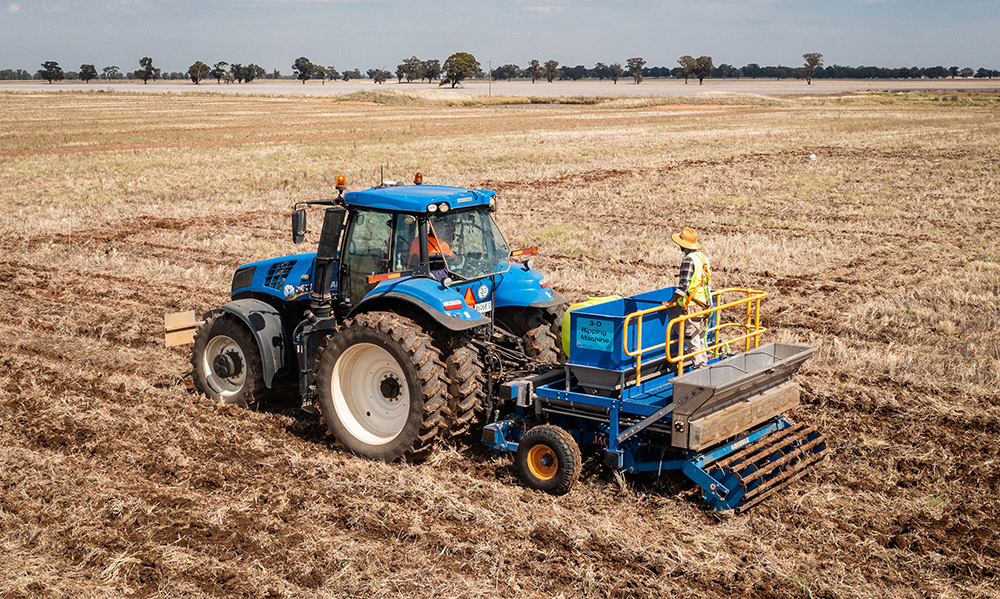
Amendments were customised to the specific constraints present at each site and placed directly into the subsoil using modified deep rippers, subsoilers and other heavy-duty tillage implements.
The experiments measured how effectively each amelioration strategy increased soil water storage, improved crop water use efficiency and lifted crop performance.
Research findings
Results across the four trial sites have been mixed. The New South Wales and Victorian sites have shown large crop responses to some amelioration strategies, while the Queensland and Western Australian sites have so far been largely unresponsive.
Lockhart, New South Wales
At the New South Wales site, nutrient-rich organic matter treatments produced the strongest responses. In the second year following amendment application, deep organic matter pellets combined with carbon-coated mineral yielded 9.5 t/ha of wheat, compared to 8.0 t/ha for the untreated control, a yield increase of almost 19%. While total soil water use was not statistically different between treatments, more data on this is required as it is likely to be a key driver in yield response. On average, organic matter-based treatments produced an extra 2.4 kg of grain/ha/mm of water used compared to the control.
Wonwondah, Victoria
At the Victorian site, all nutrient-rich amelioration treatments delivered substantial gains in the second year. Deep lucerne, deep lucerne with gypsum, deep lucerne + PAM, deep nutrients, deep wheat straw + nutrients, and deep urban green-waste mulch + nutrients produced an average canola yield of 4.54 t/ha, compared to 3.20 t/ha for the control, a 42% mean increase in yield. Water use efficiency also improved markedly, reaching 14.0-14.4 kg grain/ha/mm at the site, compared with 11.1 kg grain/ha/mm in the untreated control.
A consistent finding across the NSW and Victorian sites is that the presence of nutrient-rich organic matter in the ameliorants had the greatest impact on crop performance, outperforming mineral-only treatments and controls. Crops on organic matter-based plots were able to access substantially more soil water than crops on other treatments. At this stage it is not yet possible to determine whether the effectiveness of these ameliorants is due to improved nutrition, better soil physicochemical conditions, or a combination of both mechanisms.
Clare, Queensland
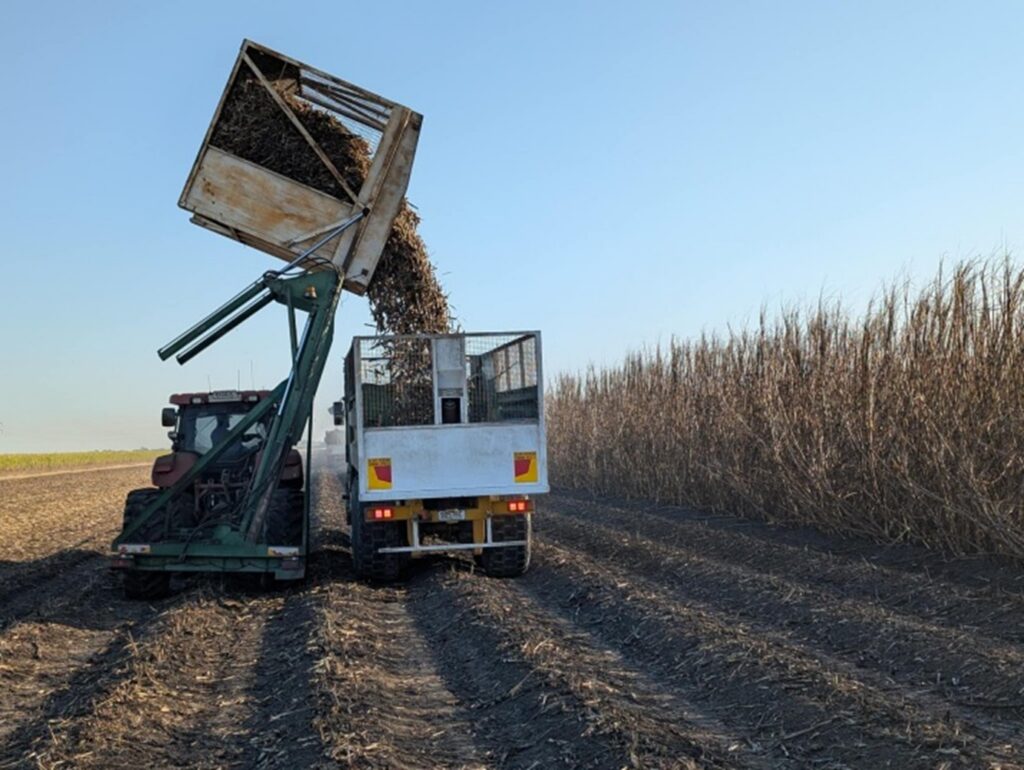
At the Queensland site, no statistically significant treatment effects were found in either year for cane yield, commercial cane sugar (CCS) or tonnes of sugar per hectare. Soil testing showed no significant treatment effects on soil chemistry. Several factors may explain the lack of response. The amendments were placed at around 25 cm depth, where the subsoil was only moderately dispersive and the exchangeable sodium percentage was not particularly high. Both seasons also had above-average rainfall, which may have allowed the cane to draw sufficient water from the upper soil layers and bypass the subsoil constraints. Amendments may also need longer than two years to take effect in this soil type and farming system. The site will continue to be monitored by Burdekin Productivity Services to assess any impacts in the third and fourth years of the crop cycle.
Kweda, Western Australia
At the Western Australian site, treatment responses were modest overall, likely influenced by above-average rainfall across both seasons (429 mm in 2022 and 418 mm in 2023, against a long-term average of 327 mm), which reduced the extent to which subsoil constraints limited crop performance. In barley, gypsum-based treatments produced a 15 to 16% yield increase compared with the untreated, unripped control. When compared against ripping alone (using a Bednar plough), the advantage reduced to 7 to 8%, indicating that ripping contributed part of the benefit. In year two, lupin NDVI (Normalised Difference Vegetation Index) at 11 weeks after sowing was significantly higher where compost was included, with low-rate compost (2 t/ha) producing the strongest canopy response, although this did not translate into yield or protein differences.
Significance of the findings
The project identifies new and more effective approaches to ameliorating subsoil constraints. It advances knowledge of how to manage multiple soil constraints at once and gives growers and advisors a clearer evidence base for matching amendments to site conditions.
The NSW and Victorian trials show that subsoil amelioration can deliver substantial yield gains on heavy, dispersive, sodic soils, provided the amendment contains a proportion of plant nutrients. Amendments where nutrients, particularly nitrogen, are at least partially held in organic form appear to have a more lasting impact than mineral-only products, as they are more protected from loss pathways such as leaching and volatilisation.
The findings also point to more affordable options for growers. Cost has long been a barrier to the adoption of subsoil amelioration. The price of the amendment itself is the single largest factor influencing profitability, followed by the size of the yield response and how long the benefits last. This project indicates that cheaper alternatives such as wheat straw pellets with added mineral nutrients, or green-waste mulch with added nutrients, performed comparably to more expensive organic matter products.
Next steps
The WA, NSW and Queensland sites are being monitored under Soil CRC project Capitalising on established field trials for ameliorating (sub)soil constraints (4.2.006), with further monitoring planned beyond that through a Soil CRC project (6.4.002) funded by the Australian Government’s Future Drought Fund. This will provide several more years of data for analysis and give the amendments more time to express their long-term effects.
Data from all four trial sites has been supplied to Soil CRC researchers at the University of Southern Queensland, who are using the Agricultural Production Systems sIMulator (APSIM) to assess the impact of subsoil constraints on water use efficiency and crop production (projects 4.3.005 and 4.3.006). Calibrating the model with field data from this project, alongside other Soil CRC experiments, will allow promising amelioration techniques to be tested in simulation, the long-term impacts of subsoil constraints to be explored, and crop responses to be predicted under a range of conditions including future climate scenarios.
Gaps remain in the understanding of when and where subsoil amelioration will be effective. Further work is needed to clarify how different amendments drive change, how the soil environment and water availability shape the amelioration process, and how crops and their root systems respond. A specific unresolved question is whether the effectiveness of nutrient-rich organic amendments is driven by improved nutrition, better soil physicochemical conditions, or a combination of both.