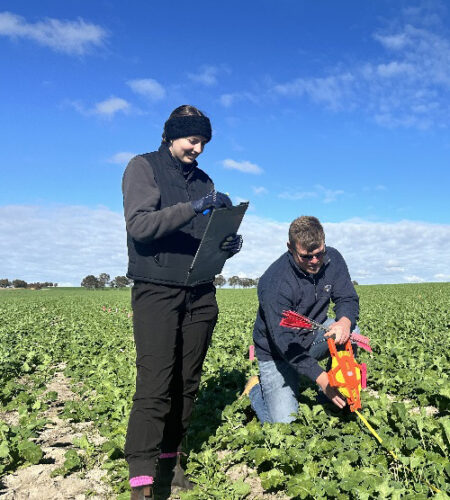
Many Australian crops are not reaching the potential yields for the rainfall they receive. That is because the soils in which they grow have physical and chemical components, usually in the subsoil, that are limiting root growth. This limits a plant’s usage of available water and reduces nutrient uptake. This reduction in yield represents major opportunity losses for growers.
‘Integrated solutions for underperforming constrained soils: accessing soil moisture’ (4.2.004) is quantifying crop responses to different management practices, on key soils across 4 cropping regions. The project is a collaboration between the NSW Department of Primary Industries and Regional Development, Agriculture Victoria, Murdoch University, Charles Sturt University and Burdekin Productivity Services.
Understanding how subsoil affects a crop’s ability to access water is an important step in improving both productivity and water use efficiency, as transpiration (water’s movement through a plant) is linked to crop yields.
“The ability of roots to grow through soil unhindered by physical or chemical constraints is key to making full use of the available water resources,” said Dr Murray Hart, Project Leader and Research Officer at the NSW Department of Primary Industries and Regional Development.
Long-term sites enable testing of multiple variables
The project has established one medium-term and 3 long-term (5 plus years) trial sites: Wonwondah in Victoria (medium-term site), Lockhart in New South Wales, Clare in Queensland and Kweda in Western Australia.
The sites are putting recent advances in soil amelioration (improving quality with either inorganic or organic chemical products) techniques into practice, to enhance understanding of how these techniques can improve crop rooting depth, water use, productivity and ultimately – yield.
The project is also assessing the amelioration strategies from an economic perspective, to help farmers choose the right strategies for them.
"Economic assessments of amelioration strategies will be developed to guide the adoption of better soil management strategies by farmers. By maintaining experiments for more than 5 years, the project will address the most challenging problems of managing hostile soils,” said Dr Hart.
Findings from the sites to date have been varied. A benefit of long-term sites is that practices can be tested over multiple seasons, with some ameliorants not showing benefits in their first application. This is often the case for soils with constraints including high sodium or dispersiveness – where soils collapse when wet.
It also allows for techniques to be tested in different weather conditions. High rainfall can reduce the impact of soil constraints, so understanding how soil will respond to these conditions can help growers be more efficient with ameliorant application.
Between them, the sites are testing amelioration effects on sugarcane, and broadacre crops such as barley, lupin, faba bean, canola and wheat.
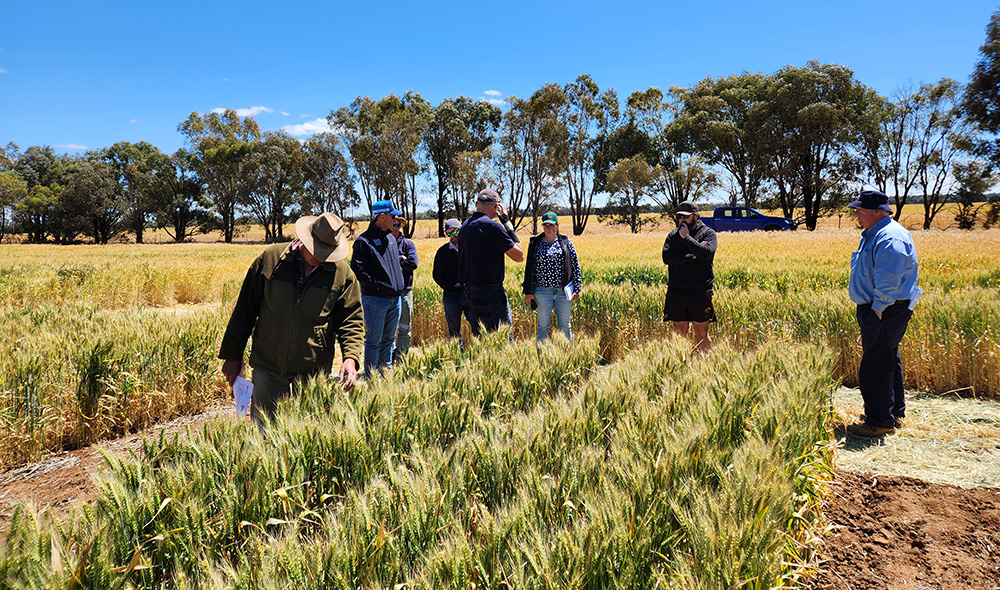
Sugarcane ameliorants in focus
Burdekin Productivity Services (BPS), a levy-funded sugarcane agronomic service and Soil CRC participant, is managing the Clare site in Queensland. Rob Milla, Manager at BPS, said it’s great to be able to test novel soil treatments for sugarcane within the region.
Some soils in the region are quite challenging for growers, including heavy clays that are sodic with a high moisture content.
“The site presents several soil constraints including compacted and structureless subsoil that is sodic and magnesic, making it an ideal candidate for treatment. To assess the extent of these constraints, soil pits were dug prior to establishment, revealing waterlogged soils from approximately 20cm down.”
Because of the long growing season for sugarcane, the site has only had one harvest so far – in July 2024. It was a high-yielding season with minimal difference observed from the amendments utilised at the site – different combinations of gypsum, mill mud and ash, compost, reactive silicate and FOGO (food organics and green organics) outputs.
Addressing subsoil amelioration is complex
Climatic conditions have a huge impact on amendments. In dry conditions, especially in early growth stages, a lack of moisture can prevent amendments from improving soils. If conditions are much wetter than average, crops may not be water-limited and can effectively bypass otherwise significant constraints.
Initial results indicate that organic matter has the potential to improve water use and crop productivity for sodic, clay soils in Victoria and New South Wales – provided they have a minimum carbon to nitrogen ratio.
It is too early for the effectiveness of the ameliorants to be attributed to improved nutrition, better physiochemical conditions or a combination, but ongoing testing will provide further insights.
Capitalising on established field sites
Three of the trial sites from this project are being extended, under a follow-on Soil CRC project: ‘Capitalising on established field trials for ameliorating (sub)soil constraints’ (4.2.006). A further 3 sites from other Soil CRC projects will also be extended under the project.
Led by Professor Richard Bell from Murdoch University, the project will continue investigations for 2 more cropping seasons. This will enable the capture of more data on climate variability, as well as economic analysis of outcomes.