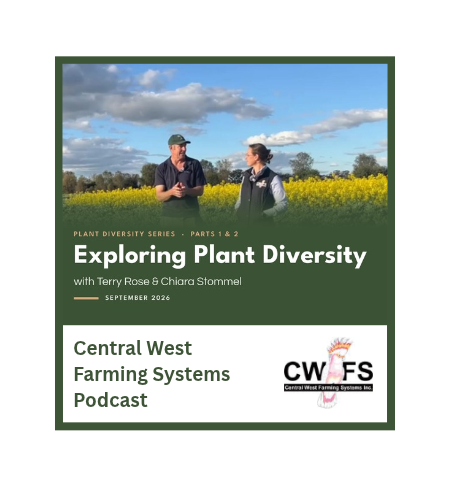
Professor Terry Rose from Southern Cross University talks with CWFS Agronomist Chiara Stommel about whether increasing plant diversity in cropping systems can build soil resilience and, in turn, support productivity and yield.
Part 1
In Part 1, Prof Rose outlines the trial design. It’s a fully sequenced wheat, canola and faba bean rotation, with diversity added in two ways:
- In time: three-species and nine-species summer cover crops replace the summer fallow.
- In space: a temporary vetch intercrop is sown with the wheat.
Prof Rose explains why the vetch needs to be terminated at around 12 weeks to avoid wheat yield losses.
Part 2
In Part 2, the discussion turns to the soil health measures used in the trial, including microbial respiration, citrate-extractable protein and hot water extractable carbon. Prof Rose and Chiara also cover new research into water infiltration and groundcover, and the trade-off between infiltration benefits and the stored summer moisture that winter crops rely on. Prof Rose finishes with two key takeaways for growers in the Central West.
This project is delivered in partnership with Southern Cross University, Murdoch University and Central West Farming Systems. The project also supports six other long-term trials in WA (East Pingelly, Bullaring, Dandaragan), NSW (Lockhart) and Victoria (Birchip and Yarrawonga).
Listen to the podcast
This podcast was recorded during the CWFS Annual Spring Field Day at the Condobolin Research Station.