

Calcareous soils are widespread across south-eastern Australia, occupying 60% of the cropping soils in the region. They present multiple constraints to crop production, including low phosphorus availability, poor nitrogen cycling, low water-holding capacity, and high levels of rhizoctonia. Crops may also be affected by fertiliser toxicity during germination, extreme pH, sodicity and salinity. These constraints can severely limit early crop growth and overall productivity.
This project focused on identifying practical approaches to improve soil condition, early crop vigour, and crop productivity on calcareous soil in the south-east and upper Eyre Peninsula of South Australia.
Controlled environment studies were used to better understand carbon processes in calcareous soils. This work examined:
A range of materials were also investigated for their ability to stabilise soil organic carbon (SOC) and improve nutrient cycling, availability and soil stability. This work identified a carbon-coated mineral as a promising amendment, which was subsequently included in the field trials.
Six field trials ran from 2021–2023 on the upper Eyre Peninsula under commercial farming conditions. Four of these trials were located on highly calcareous grey sandy soils (at Poochera and Port Kenny) and the other two on a red calcareous sandy loam (at Minnipa).
Three trials investigated long-term subsoil improvement strategies, while the other three investigated short-term topsoil strategies to improve early crop establishment and productivity. Treatments included fertilisers, fungicides, deep ripping, a carbon-coated mineral engineered by the NSW Department of Primary Industries and Regional Development (DPIRD), wetting agents and organic matter.
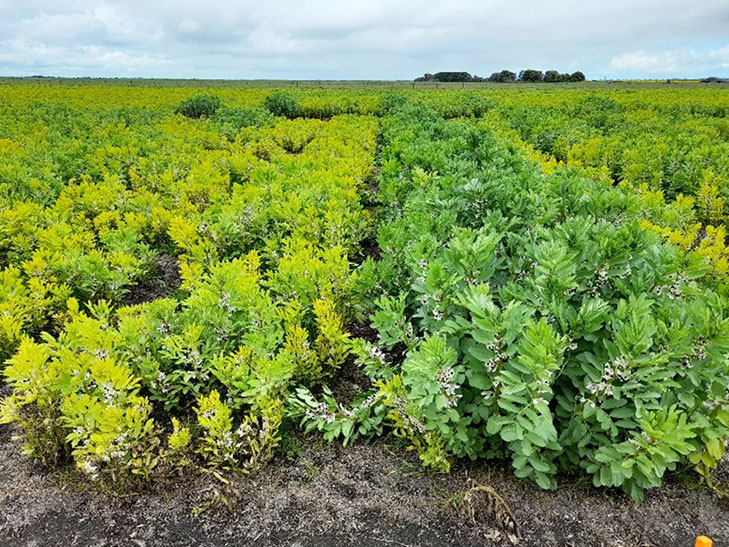
Field trials at Lake Hawdon in south east South Australia (2021 and 2022) and glasshouse trials in 2023 investigated iron and manganese deficiencies in broad beans on highly calcareous soils. These deficiencies commonly cause yellowing and poor early growth under cold, wet winter conditions.
The trials compared different ways of supplying iron and manganese to the crop, including seed coatings, fertiliser at sowing, and foliar applications, as well as different fertiliser forms such as chelates and sulphates. These approaches were tested against standard district practice (in-season foliar applications once yellowing is apparent) to determine if alternative iron and manganese application strategies could prevent deficiency symptoms and improve crop production.
Phosphorus fertiliser placement influenced carbon dynamics in calcareous soils. Broadcasting phosphorus fertiliser increased carbon losses from both:
In contrast, phosphorus stabilised existing SOC in the root zone, indicating that placing phosphorus fertiliser close to plant roots is more effective for retaining carbon in highly calcareous soils.
Iron-based amendments helped stabilise carbon. Goethite reduced the loss of easily decomposed (labile) carbon, while iron oxides increased stabilisation of both soil-derived and plant-derived carbon. However, iron oxide application was also accompanied by increased carbon dioxide loss from soil carbonates.
Biochar increased the breakdown of plant material (lucerne stubble) but also improved how efficiently this carbon was retained in the soil.
Together, these results highlight the potential for iron-based amendments and biochar to improve soil carbon storage in calcareous soils.
High soil strength is a constraint in calcareous soils. However, positive responses to deep ripping were inconsistent and often limited by the hostile subsoil. For example, by 2023 there were signs of re-compaction in ripped treatments, with penetration resistance slightly higher than initial measurements taken in 2021.
Short-term topsoil strategies which focused on improving early crop establishment and vigour consistently outperformed longer-term subsoil approaches. Increasing seeding rates, supported by adequate nutrition including nitrogen, phosphorus and trace elements, improved plant establishment, biomass and grain yield.
Subsoil amendments aimed at improving fertility (fertiliser, organic matter) showed some potential to increase yield on highly calcareous soils. However, responses were delayed and only became evident in the third season. Their economic value remains uncertain.
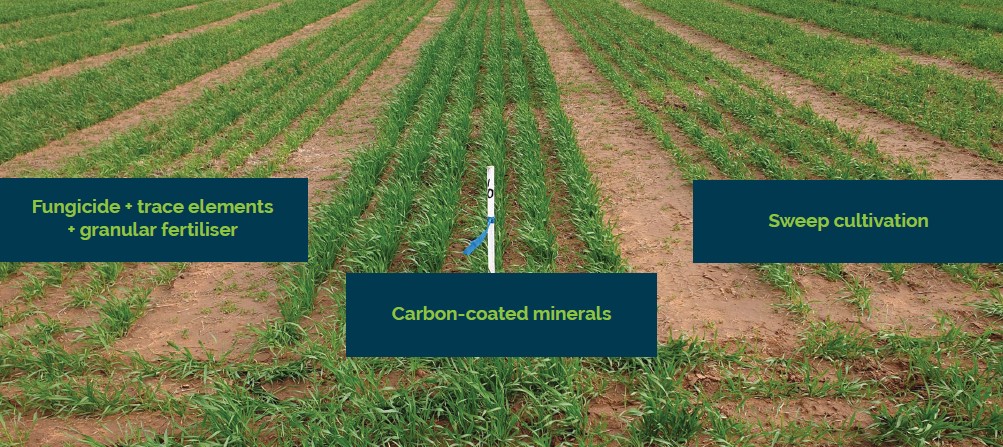
Applying the carbon coated mineral just below the seed improved crop vigour, biomass and yield (Figure 1). This was attributed to the superior delivery of phosphorus to the crop compared to conventional fertilisers. Benefits were also observed in the following crop, indicating some carryover effect.
The field and controlled environment studies showed that yellowing in broad beans grown on highly calcareous soils is primarily caused by iron deficiency, with little evidence of manganese deficiency.
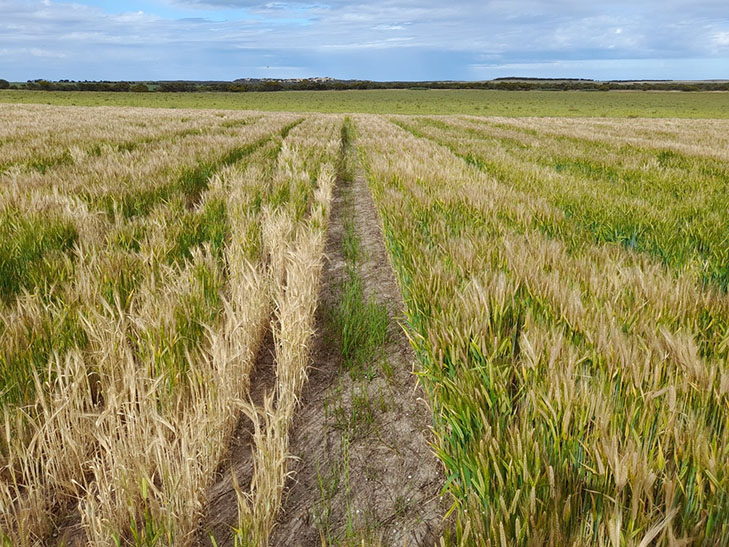
Standard district practice of multiple foliar applications of iron and manganese sulphates, or EDTA chelates had limited effect on crop condition. In contrast, applications of iron in a chelated form stable under high pH (iron-EDDHA) corrected deficiency symptoms and led to substantial increases in crop growth and yield (Figure 2).
A controlled environment system was developed that reliably reproduces iron deficiency in pulses on the Lake Hawdon soil. This system enables faster and more targeted testing of iron sources, rates, formulations and application strategies than can be achieved through field trials alone.
These findings indicate that improving early crop vigour is a reliable pathway to increasing productivity on highly calcareous soils. In contrast, subsoil interventions are higher risk and less predictable. Constraints at depth are difficult to overcome, and practices such as deep ripping may not deliver sustained benefits due to re-compaction and hostile subsoil conditions. This has important implications for grower investment decisions, where upfront costs are high but returns may be uncertain.
Identifying the carbon-coated mineral as a promising amendment provides a potential new tool for improving crop performance on calcareous soils. However, further work is needed to confirm its consistency, optimal application (rate, location, timing) and economic viability.
The growth and yield of broad beans growing on highly calcareous clay-loams of the south-east of South Australia can be greatly improved with applications of iron-EDDHA. However, this product is very expensive for broadacre farmers. Further investigations are required to test the effectiveness of reduced rates of iron-EDDHA, to develop more effective application strategies or to find alternative (and effective) sources of iron before an economically attractive package can be recommended to growers and advisers in the region.
The controlled environment studies provide new insight into how carbon behaves in calcareous soils, particularly the role of iron-based amendments in stabilising soil organic carbon. This improves our understanding of how these soils function and identifies potential pathways to re-engineer hostile subsoils and increase carbon storage.
The development of a reliable controlled environment system to reproduce iron deficiency is also significant, as it enables faster and more targeted testing of fertiliser strategies than field trials alone. This will support more efficient development of management practices for calcareous soils.
The project ‘Improving crop phosphorus supply on highly calcareous soils’ (4.2.007) is examining the importance of the phosphorus component in the carbon coated mineral to improve phosphorus delivery to plants, and investigate if other types of biochar provide similar benefits to crops.
Further research is needed to determine practical carbon coated mineral application protocols for broadacre farming, such as optimal placement methods and minimum effective rates. Research is also needed to quantify the impact of the carbon coated minerals on farm profitability under commercial conditions. The carbon coated mineral has demonstrated strong agronomic potential in research trials but is not yet commercially available.
Further work is also required to improve the practicality of correcting iron deficiency in broadacre systems. This includes refining application methods, reducing costs of iron chelates, and identifying alternative iron sources suitable for high pH soils.
This project was co-funded by the Grains Research and Development Corporation (GRDC).