
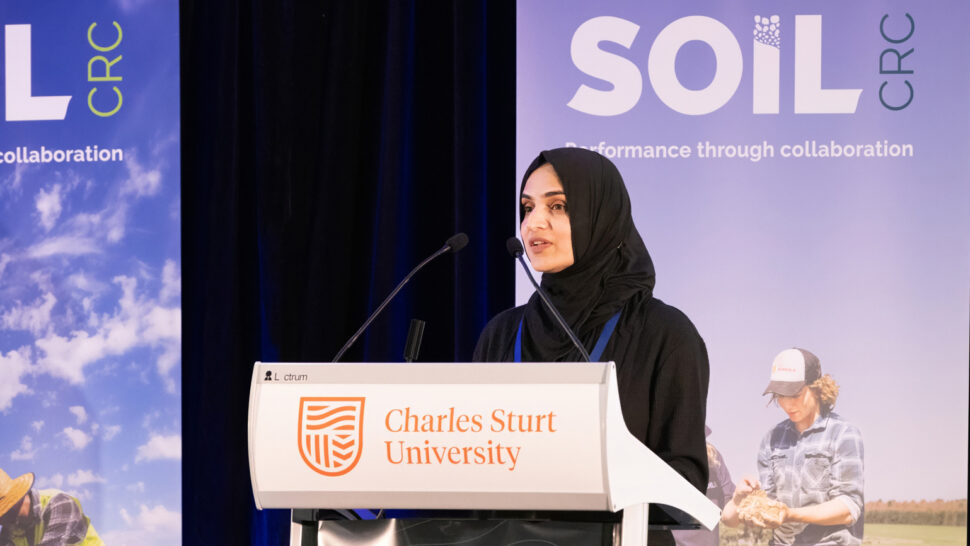
Soil scientist Dr Naveeda Majid is inspired by the process of discovery – investigating soils at a deeper level, understanding the mechanisms behind problems like soil water repellency, and translating scientific knowledge into practical remediation strategies.
“I enjoy research that brings together fieldwork, lab analysis, and data interpretation to create real impact, which is why a PhD with the Soil CRC and the University of Newcastle was the perfect fit for me,” Naveeda said.
Naveeda began her PhD in 2021, with a focus on understanding and remediating soil water repellency, a major challenge affecting dryland farming in Australia.
“I conducted field sampling in South Australia and I undertook extensive laboratory analyses to investigate the physical, chemical and biological factors contributing to soil hydrophobicity (its tendency to repel water),” she explained.
“Key analyses included pH, electrical conductivity, dissolved organic carbon, total carbon and nitrogen, particle size, bulk density, moisture content, surface tension, dehydrogenase enzyme activity (DHA) and soil water repellence.”
Working in the soil laboratories at the University of Newcastle, Naveeda was able to use a range of instruments in her investigations, including gas chromatography-mass spectrometry, solid-state nuclear magnetic resonance, ion chromatography, atomic absorption spectrometry, total organic carbon analysers and CNS analysers (to determine the percentage composition of carbon, nitrogen and sulphur).
“A central part of my work involved isolating and characterising microbes capable of degrading hydrophobic compounds and testing remediation strategies, including microbial inoculation alone or combined with biochar or clay, to restore soil wettability.”
Naveeda’s research identified critical physical, chemical and biological factors responsible for soil water repellency. She demonstrated that specific microbes can effectively degrade waxes and oils causing hydrophobicity, and she showed that combining microbial inoculation with biochar or clay significantly improves soil wettability.
“My research provides practical solutions for managing water-repellent soils, which is a major challenge for farmers and land managers. By identifying some of the key factors causing soil hydrophobicity, I have developed strategies that can restore soil wettability and improve water infiltration,” she said.
“These approaches can enhance crop growth, increase agricultural productivity, reduce reliance on chemical treatments, and promote long-term soil health. Overall, my work equips end users with effective, sustainable tools to manage soils more efficiently and supports more resilient and productive agricultural systems.”
In pursuit of passion and purpose
Naveeda completed a Master of Science (Honours) in Soil Science in Pakistan, where she worked for two years as a soil consultant before immigrating to Australia with her husband. Initially, Naveeda threw herself into caring for her daughter full time, but she was also keen to pursue her passion for soil science and immerse herself in soil research once again.
“My husband encouraged me to think long-term about my career and supported me to apply for a PhD once I became an Australian citizen,” Naveeda said.
“I have always been passionate about understanding soil systems and improving agricultural sustainability. I wanted to deepen my expertise, advance my research capabilities, and contribute to solutions for important soil challenges.
“A PhD through the Soil CRC provided the ideal opportunity to expand my technical skills, engage in meaningful research, and strengthen my professional career in soil science,” she said.
When asked what she enjoyed about her PhD, Naveeda said conducting hands-on laboratory experiments to investigate soil water repellency and testing microbial remediation strategies was the most rewarding aspect.
“I also valued the opportunity to collaborate with fellow researchers, build professional connections, and work closely on complex projects that combined field and lab work,” she enthused. During her PhD, Naveeda collaborated with scientists at Murdoch University in WA and Primary Industries and Regions South Australia (PIRSA).
“Presenting my findings at national and international conferences allowed me to share my research, gain feedback, and engage with the wider scientific community, which made the experience both rewarding and inspiring.”
What comes next
Having successfully completed her soil-focused PhD in Environmental Remediation, Naveeda is excited to begin her professional research career in Australia and to contribute her skills, experience and dedication to the field of soil science.
“I am eager to advance my professional career as a research scientist or postdoctoral researcher in soil science. I want to apply the skills and knowledge I developed during my PhD to practical projects that tackle real-world agricultural and soil science challenges,” she said.
Beyond her technical skills and research experience, Naveeda brings strong collaboration and communication abilities, having worked closely with multidisciplinary teams.
“My goal is to contribute to sustainable land management, strengthen collaborations with industry and academia, and develop innovative solutions to improve soil health and productivity.”
Find out more
Watch Naveeda’s 2024 PhD presentation
Read Naveeda’s publications:
- Majid, N., Bahar, M.M., Harper, R., Hughes, B. & Naidu, R. (2026). Identifying critical determinants of soil water repellency in an Australian dryland farming system. Soil and Tillage Research, 255, 106794. https://doi.org/10.1016/j.still.2025.106794
- Majid, N., Bahar, M.M., Harper, R., Mallavarapu, M. & Naidu, R. (2023). Influence of biotic and abiotic factors on the development of non-wetting soils and management approaches: A review. Soil Security, 11, 100091. https://doi.org/10.1016/j.soisec.2023.100091