The QUOLL® electronic nose (e-Nose) is a low-cost, field-deployable device that detects changes in soil biological activity in near real time, addressing a long-standing gap in soil monitoring.
It works by sampling soil gases, with sensors detecting the volatile organic compounds, ammonia, and carbon dioxide associated with soil microorganisms.
Glasshouse and field trials confirmed that the QUOLL® e-Nose can distinguish between soils under different management conditions, including compacted and non-compacted soils, and soils under a pyrethrum-treated crop.
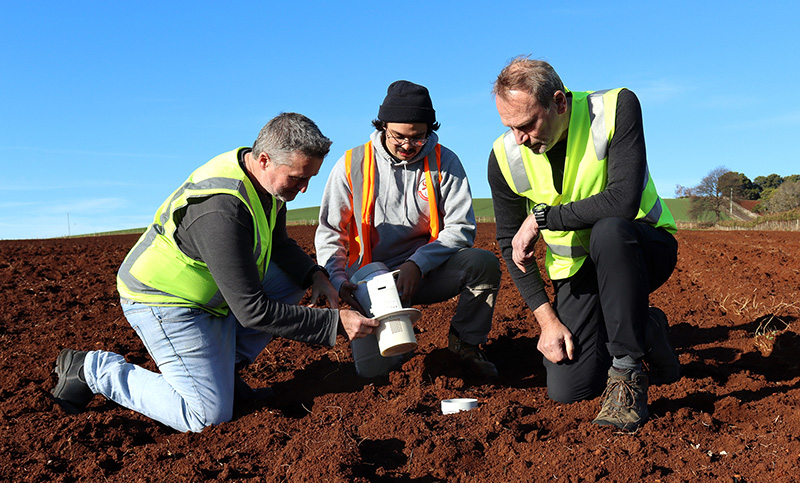
From left to right: Simon Edwards, Daniel Gardner and Chris Boucher from the University of Tasmania, installing the QUOLL® e-Nose at the Forthside Vegetable Research Facility, Tasmania.
The challenge
Soil biology drives the processes that make soil productive, such as cycling nutrients, improving soil structure, and turning over organic matter. Because microbial activity responds rapidly to changes in soil conditions, it is also a useful indicator of how the soil is functioning.
Measuring biological activity, therefore, has significant practical value. Tracking it over time would allow farmers, agronomists, and researchers to assess whether management practices such as cover cropping, soil amendments, microbial inoculants or changes in tillage are producing the intended effects.
However, biological activity is difficult to measure. Soil chemical and physical properties can be assessed reliably and at low cost. Biological assessment methods are slow, expensive, and confined to the laboratory, with the result that most soil management decisions are made without reference to biological data.
Addressing this gap requires a method of measuring biological activity in the field that is straightforward to use, produces results quickly and is inexpensive enough for routine application. This would support better soil management decisions, accelerate research into soil function and enable the impact of soil improvement products to be assessed under real-world conditions.
Our research
The aim of this project was to develop a low-cost electronic nose (e-Nose) for detecting changes in soil biological activity. The e-Nose needed to be easy to use, provide rapid data collection, and show how soils respond to different management practices such as applying soil amendments or planting cover crops.
Development focused on producing a device that would be reliable and easy to deploy under farm conditions. It was rainproofed, powered by an internal rechargeable battery so it could run unattended in the field, and fitted with a telemetry system that transmits data wirelessly from the paddock to the researchers, thus removing the need to visit the site to retrieve readings.
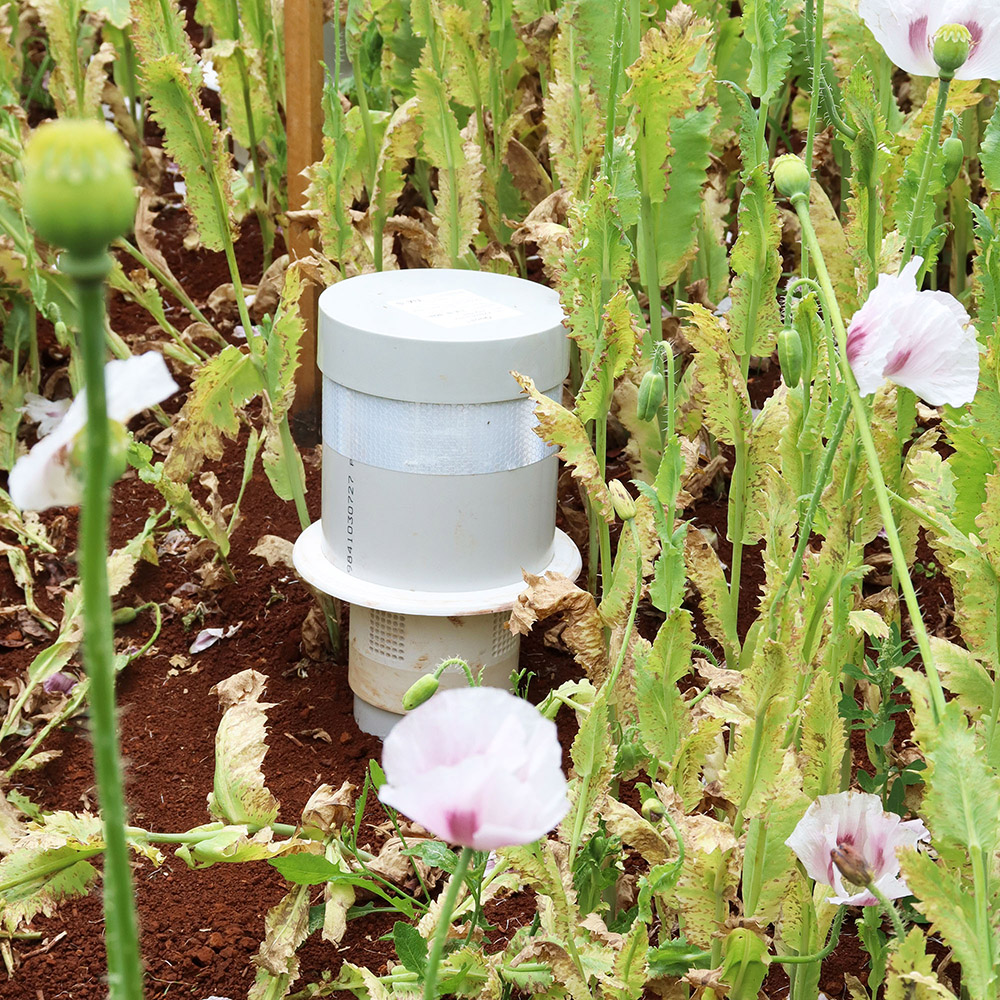
Glasshouse experiments tested whether the device could detect changes in soil gas emissions following different soil treatments. The results were used to refine the design before the device was moved to field trials at the University of Tasmania’s Forthside Vegetable Research Facility (Figure 1), where it was tested in compacted soil, non-compacted soil, and soil under a pyrethrum crop.
Figure 1. The QUOLL® e-Nose in the field at the University of Tasmania’s Forthside Vegetable Research Facility.
Research findings
The project designed and built the QUOLL® e-Nose, a field-deployable device that can detect changes in soil biological activity. It can be manufactured inexpensively from commercially available gas sensors and is housed in a custom-built, field-ready unit. The QUOLL® e-Nose builds on an earlier Soil CRC project (2.1.004) that developed a first-generation e-Nose and consulted growers about what they wanted from soil sensing technology.
The QUOLL® e-Nose is inserted around five centimetres into the soil, where most biological activity occurs. From this position it samples, or “sniffs”, the soil gases, with sensors detecting the volatile organic compounds, ammonia, and carbon dioxide associated with soil microorganisms. As soil biological activity changes, the mix of gases shifts, and the e-Nose records these changes.
Glasshouse experiments demonstrated that the QUOLL® e-Nose detected changes in soil gases each time a soil treatment was applied. These shifts in biological activity were corroborated by laboratory measurements of increased soil enzyme activity. Field trials at the Forthside Vegetable Research Facility confirmed that the QUOLL® e-Nose could distinguish between different soil conditions, including recently compacted soil, the same soil that was not compacted, and soil under a pyrethrum-treated crop.
Significance of the findings
The QUOLL® e-Nose provides a way for farmers to examine how soil management practices affect soil biology and function.
Carbon farming is one area of promise. Current soil carbon testing is slow and expensive, but if relationships can be established between the QUOLL® e-Nose’s readings and soil carbon, the device could provide near real-time indications of whether carbon levels are trending in the ‘right’ or ‘wrong’ direction. This would potentially offer a cheaper and faster early indicator for soil carbon sequestration projects.
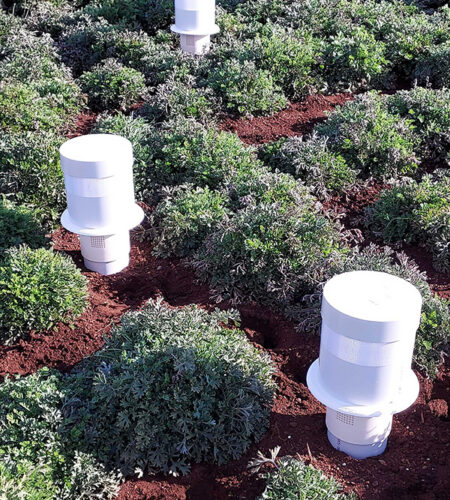
Because the QUOLL® e-Nose is inexpensive to manufacture and easy to use, multiple units can be deployed across a paddock and used for repeated measurements, giving a level of spatial and temporal replication that is often too expensive with laboratory tests.
The QUOLL® e-Nose also has value for a range of other users:
Product developers, including those producing microbial inoculants, biological amendments, and agrichemicals, gain a practical means of understanding the effect of their products on soil biological activity under field conditions.
Researchers have access to a field-deployable tool for studying soil microbial dynamics in agricultural and ecological contexts.
Land managers can assess biological activity in degraded soils and use the information to guide rehabilitation.
Educators have a hands-on technology that engages students and the wider public in discussions about soil health and sustainability.
Next steps
The QUOLL® e-Nose prototype has been validated in both glasshouse and field settings. In March 2026, the Soil CRC assigned the intellectual property of the QUOLL® e-Nose to the University of Tasmania, entrusting its future development and commercialisation to the research team at the University. The device is now being refined through further engineering, calibration, and broader field testing across a wider range of soil types, climates, and farming systems. Key areas of ongoing work include:
Refining the sensing capabilities and improving the robustness of the device for routine on-farm use.
Building larger datasets to strengthen interpretation of the “sniff signals” and their links to specific biological processes such as carbon cycling.
Working with industry partners to test the QUOLL® e-Nose across different management practices, soil amendments, and biological products.
Progressing the engineering required to move from a research-grade prototype toward larger-scale production.
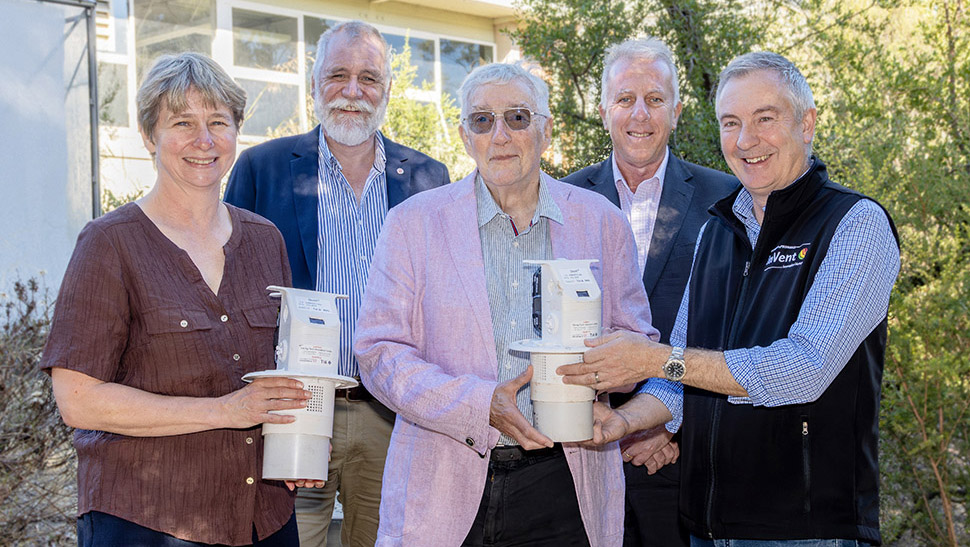
Left to right: Dr Shane Powell (University of Tasmania), Professor Mike Rose (University of Tasmania), Dr Paul Greenfield (Soil CRC Board Chair), Dr Michael Crawford (Soil CRC CEO), Brett Harris (University of Tasmania).
Dr Shane Powell, Dr Marcus Hardie, Dr Muhammad Shahinur Alam, Prof Caroline Mohammed, Mr Simon Edwards, Mr Chris Boucher, Mr Daniel Gardner, Mr Phillip Kay (PhD student), Prof Byeong Kang - University of Tasmania
Related PhD project
Relationships between the volatile organic compounds (VOCs) emitted from the soil and the microbial communities within. PhD project (2019-2024) by Phillip Kay. Supervised by Dr Morag Glen, Prof Caroline Mohammed, Dr Marcus Hardie and Dr Ian Hunt from the University of Tasmania.