Key points
- A rapid, in-field nitrate testing system was developed and validated, combining Lab-on-a-Chip technology with smartphone imaging to give a reading on the spot for around $20 per test, well below standard laboratory fees.
- In field testing, the device measured nitrate accurately and consistently, averaging around 85% accuracy under good conditions.
- A proposed commercialisation pathway includes injection moulding for mass production and a subscription-based smartphone app model, ensuring affordability and widespread adoption.
The challenge
Traditional soil testing methods are slow, expensive and impractical for the frequent monitoring that large-scale farming systems require. The growing demand for sustainable agriculture and precision nutrient management has highlighted the need for a better option. In modern farming, the window for effective nutrient intervention is narrow. For example, being able to assess nitrate levels at sowing allows a graingrower to make a timely decision to either apply nitrogen where it is needed or hold back where existing supply is already adequate. Conventional testing cannot provide results within the timeframe such decisions require.
Faced with these barriers, farmers often reduce or skip testing altogether, leading to inefficient fertiliser use and greater environmental risk from nitrate leaching and excess nutrient application.
There is a clear need for a rapid, affordable, and accurate in-field solution to support responsive, data-driven decision making.
Our research
Building on the Soil CRC’s Affordable rapid field-based tests project (2.2.004), this project (2.2.007) aimed to build a small testing device, known as a Lab-on-a-Chip, that measures soil nitrate in the paddock. The chips were 3D printed and improved throughout the project, addressing challenges such as:
- Variable paddock lighting
- Print lines and reflections on the chip
- Reagent stability
- Sealing and leaking
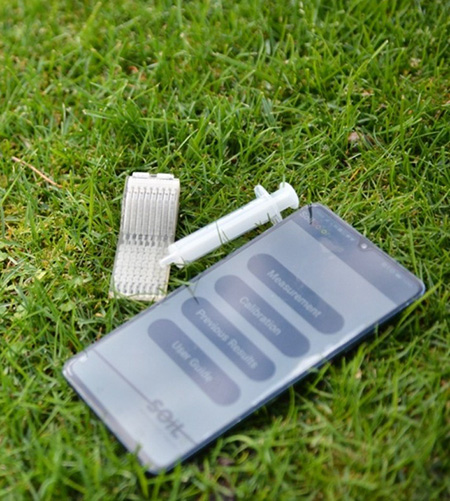
A smartphone app was developed to capture an image of the chip and process the colour change into a nitrate reading.
The project also assessed cost and a path to market. This included comparing the cost of 3D printing each chip against injection moulding for larger volumes, along with commercialisation planning covering IP protection, pricing models, and industry partnerships to get the device into growers’ hands.
Research findings
The project developed a working Lab-on-a-Chip (LOC) prototype that measures soil nitrate. A soil sample is loaded into the device where it then mixes with a reagent and triggers a colour change. The chip is then photographed with a smartphone, and the app reads the colour value of each channel to calculate the nitrate result.
The smartphone reading stayed reliable across changing light, averaging around 85% accuracy against known nitrate standards under variable light conditions, and the device tracked nitrate closely and linearly across concentrations from 1 to 40 mg/L (R² > 0.96). The prototypes were refined over the course of the project to improve flow channels within the device, reagent stability, and sealing.
The system is designed for high-frequency use at an estimated $20 per test, well below standard laboratory fees. Cost analysis confirmed that manufacturing the device is viable. Each chip cost $38.65 to 3D print, dropping to a projected $10 per chip with injection moulding at volume.
Market analysis suggests this LOC has competitive advantages in affordability, portability, and ease of use compared with laboratory tests and existing portable kits. A commercialisation strategy has been developed, covering IP protection, pricing models, and industry partnerships, and built around affordable LOC units paired with a subscription smartphone app for interpreting and mapping the data.
Significance of the findings
The device gives farmers and agronomists a fast, affordable, and accurate way to test soil nitrate in the field. With a reading available on the spot, growers can match fertiliser rates to soil needs, and make timely, data-driven decisions that lower input costs and support yield. By supporting precise nutrient management, the device will also reduce nitrate leaching and runoff that contributes to excess nutrients in waterways, helping growers limit their environmental impact, meet sustainability expectations, and protect sensitive ecosystems such as the Great Barrier Reef.
By reducing reliance on expensive laboratory testing and enabling near real-time nutrient data, this innovation addresses a critical barrier to precision agriculture. The low cost and portability could be particularly useful for small and medium-sized farms, where the expense and time demands of frequent laboratory testing can be harder to justify.
Pairing the device with a smartphone app and digital agriculture platforms could turn it from a standalone diagnostic into a decision-support tool, with data recorded, mapped, and tracked over time to guide nutrient decisions. Used this way, it moves nutrient management from one-off tests toward an ongoing picture of the paddock.
Next steps
The underlying technology is being adapted for a new application. In a follow-on project funded by Queensland’s Department of Primary Industries and managed by Sugar Research Australia, the LOC is being developed to measure nitrates and phosphates in sugarcane tissues, such as leaves, stalks, and juice, at critical growth stages. Working directly with plant tissue rather than soil gives growers a more direct read on crop nutrient status.
This research is focussing on transitioning from 3D printing to injection moulding for the LOC devices. This will enable mass production, improve durability, and reduce per-unit costs, making the technology commercially viable for widespread adoption.
The funding also enables further development of the smartphone application. The app will integrate advanced features such as GPS mapping, cloud-based data storage, and automated calibration, creating a complete decision-support tool for farmers and agronomists.
The device’s functionality is being extended beyond nitrate to detect phosphorus, potassium, and other key soil indicators within a single device. This will involve optimising the reagents, redesigning the channels, and validating the device across a range of soil conditions. Improvements to reagent stability and packaging will extend shelf-life, while further algorithmic work, including automated light correction and machine learning-based calibration, will improve accuracy under challenging field conditions.