Key points
- Food waste fertilisers are an alternative nutrient source which can improve the soil’s agronomic value and reduce reliance on synthetic fertilisers.
- Anaerobic digestion offers a sustainable way to manage food waste, reducing environmental pollution and recovering valuable nutrients. However, the liquid digestate produced via anerobic digestion is bulky and difficult to handle, while evaporating the liquid leads to nitrogen loss.
- Acidifying the liquid digestate before evaporation effectively retains ammonium, creating a higher-value product that is more cost effective to transport.
- Acidified digestate products can provide high available nitrogen, potentially reducing the use of synthetic nitrogen fertilisers such as urea, with added benefits of increased microbial function and being a source of carbon.
The challenge
Food waste management is often inefficient. Disposing of food waste to landfill and its incineration contributes to about 20% of global greenhouse gas (GHG) emissions, as well as groundwater and surface water contamination.
Reusing food waste on agricultural land comes with many potential benefits, including:
- Reducing reliance on synthetic fertilisers
- Reducing the carbon impact of agriculture – producing nitrogen fertilisers consumes about 2% of the world’s energy
- Acting as a source of carbon to improve soil health.
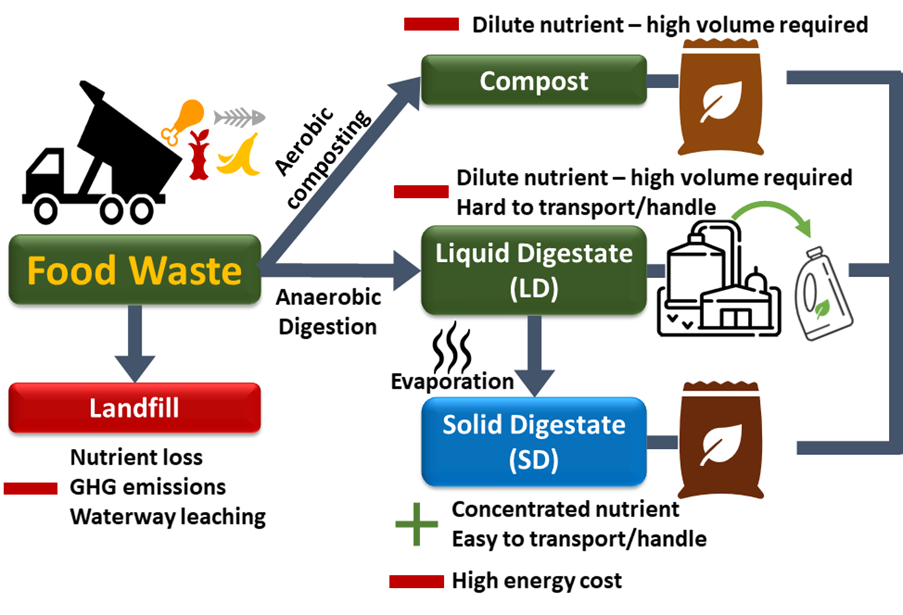
However, methods to treat food waste come with their own challenges (Figure 1). Traditional composting methods result in carbon dioxide and nitrous oxide emissions, and the composting process reduces the nutrient value of the end product.
During anaerobic digestion, microorganisms break down organic material in a sealed, oxygen-free tank. This produces a biogas – a mixture of methane and carbon dioxide – which can be used as a renewable energy source, and a liquid digestate.
However, the digestate is bulky, high in water, heavy, and with low nutrient value, making it costly and difficult to transport and handle. As such, it is usually
recycled through the digester or disposed of in sewage rather than used on agricultural land as a fertiliser. Solidifying the digestate could ease these
logistical challenges but doing so leads to a large loss in nutrients, particularly ammonium.
The research
This research was part of a Soil CRC PhD project by James O’Connor from the University of Western Australia, which investigated how food waste biofertilisers affect soil chemistry, nitrogen dynamics, gaseous emissions from the soil, and crop growth and yield.
The project compared four common and emerging food waste fertilisers:
- Compost – food organics garden organics (FOGO) compost, i.e. the Green Bin
- Liquid digestate (LD) from anaerobic digestion
- Solid digestate (SD) from anaerobic digestion
- Acidified digestate (AD)*
The products were combined with and compared to urea ammonium nitrate (UAN).
*During the research, it was discovered that significant amounts of nitrogen were being lost while converting liquid digestate to solid digestate. This led to further experiments to stabilise the digestate (creating solid, acidified digestate) which was tested on soil chemistry, biology, crop growth and yield.
Research findings
Soil nitrogen content and N2O emissions
Soils amended with liquid digestate had comparable nitrogen (N) levels to UAN amended soils but emitted 23% less nitrous oxide (N2O). This indicates replacing UAN with liquid digestate could supply an equivalent amount of available N in the soil with lower N2O emissions.
Compost and solid digestate treated soils had considerably lower available nitrogen levels than liquid digestate and UAN, and associated lower N2O emissions.
Plant (ryegrass) growth
Due to higher available nitrogen, ryegrass grew better in the liquid digestate and UAN soils than the compost and solid digestate soils.
However, combining compost and solid digestate with UAN led to synergistic effects, improving soil properties (higher microbial biomass carbon, less of a reduction in soil pH) and plant growth more effectively than using UAN alone. Solid digestate + UAN gave the largest ryegrass shoot biomass, 310% higher than the control.
Soil microbial dynamics
All food waste derived fertilisers boosted beneficial plant growth promoting bacteria, indicating enhanced plant growth potential. All soils treated with food waste fertiliser had a higher abundance of Burkholderia, a nitrogen fixer, and potentially more nitrogen-fixing capabilities. However, the digested amended soils also had more denitrification genes, indicating the potential for more nitrogen loss via volatilisation compared to conventional mineral nitrogen fertiliser.
Microbial biomass carbon (MBC) reflects soil microbial activity, with higher MBC levels indicating higher microbial activity and healthier soils. Over 56 days, solid digestate + UAN was the only treatment with a significantly higher level of MBC than the control. It also had significantly higher MBC than all other treatments except solid digestate.
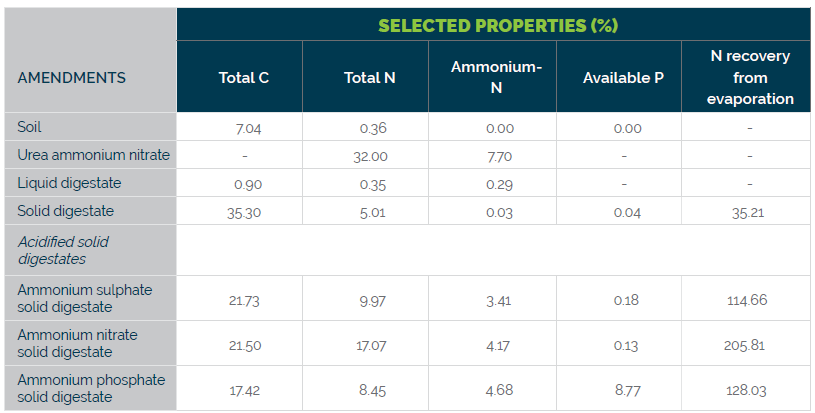
The lack of significant differences in MBC between treatments and the control are likely due to the high total carbon in the control soil (7.04%, see Table 1). In soils with lower carbon, we would expect the food waste fertilisers to provide a source of carbon and nitrogen to promote microbial biomass biosynthesis and accumulation.
Improving nutrient retention in solid digestate
Evaporating liquid digestate to solid digestate reduces storage and handling problems at digestion plants, however, this causes nitrogen loss via ammonium volatilisation (ammonium in liquid to ammonia gas), decreasing the available nitrogen content and viability of the product as a fertiliser.
Acidifying the liquid digestate before evaporation prevents this ammonium loss. The liquid digestate was acidified with three acids – sulphuric, nitric, and phosphoric acid, producing ammonium sulphate, ammonium nitrate and ammonium dihydrogen phosphate salts, respectively.
Advanced analyses (Fourier Transform Infrared Spectroscopy, X-ray crystallography, scanning electron microscopy and energy dispersive X-ray spectroscopy) confirmed the presence of these ammonium salts, i.e. they were not being lost during evaporation, and further characterised the products.
Table 1 compares the selected properties of the various acidified digestates. Note the higher ammonium-N and N recovery from evaporation in the acidified digestates compared to the untreated solid digestate. Ammonium was completely retained in all acidified digestates, whilst there was 99.7% reduction in ammonium content and 63.8% reduction in total nitrogen in solid digestate.
Table 1. Selected properties of the various amendments.
Impact of acidified digestate on soil properties and crop productivity
Acidified digestate treated soils had:
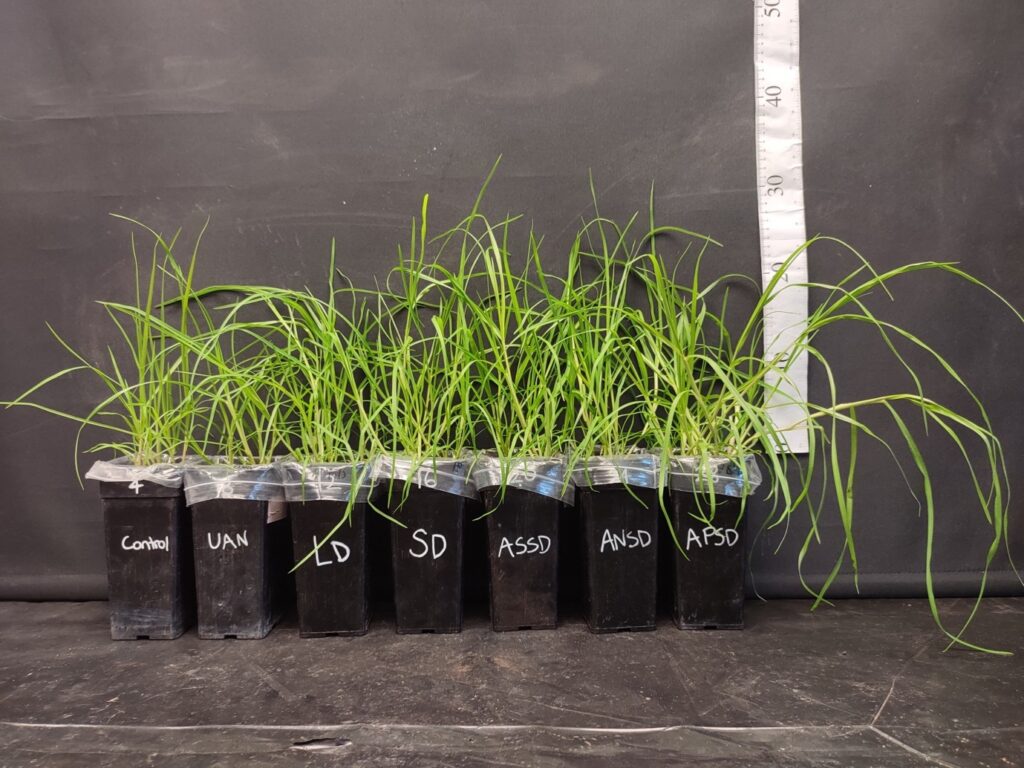
- significantly higher shoot and root biomass than the control. Results were highest in the ammonium phosphate digestate treatments due to the high bioavailable phosphorus
- higher macro and micronutrient accumulation in the plant growth
- more proteobacteria, indicating a greater capacity for nitrogen fixation, nutrient cycling, and promoting plant growth.
UAN did not improve plant growth over the control, likely due to the acidic nature of the soil (Figure 2).
For wheat, the acidified digestate products, liquid digestate and UAN had a bigger impact on crop growth and yield. Raw liquid digestate, acidified digestate products and UAN had significantly higher yields (all >2.93 t/ha) than control (0.09 t/ha) and untreated solid digestate (1.05 t/ha). The highest grain yield was on the ammonium phosphate digestate treatment (3.78 t/ha). Control and untreated solid digestate had the highest grain protein content (12.67% and 11.57%, respectively), a function of the dilution effect where protein decreases as yield increases.
The poor performance of the untreated solid digestate compared to the acidified solid digestate lends further weight to the acidifying technique as a method to improve the nutrient content and make a more valuable product, comparable to UAN.
Significance of the findings
The novel fertilisers developed from acidified digestate retain ammonium during the evaporation process and have substantial benefits over raw liquid digestate and untreated solid digestate. Acidified digestate products are solid, dewatered, and nutrient-enriched, addressing the logistical challenges currently faced by anaerobic digestion facilities. They enhance the sustainability and efficiency of food waste management by producing a stable product that is safe to store on-site and reduces transportation costs.
The food waste management industry can significantly benefit from adopting this acidification process.
Enhancing the value of biofertilisers will drive investment in sustainable practices like anaerobic digestion, effectively reducing the amount of food waste sent to landfills.
Next steps
This is an important study evaluating enhanced solid digestate on soil fertility and crop productivity. While it highlights the potential of these novel fertilisers to agriculture, there is much to learn regarding economics, cost effectiveness of acidification and evaporation, transport and handling, use in different agricultural contexts and environmental conditions, and further assessment of GHG emissions and carbon footprint impacts.
Soil CRC PhD student project 3.S.001