Executive summary
Pesticide application in agricultural practices is essential for increasing crop production to meet the world’s increasing demand for food and raw materials. However, most of the commonly used pesticides are lost during farming or agricultural practices which can have a residual effect on the environment and human health. The cost-effective management or, ideally, the eradication of insects and weeds through efficient applications is critical for sustainable and increased agricultural productivity. Controlled release of pesticides by novel materials is a promising strategy for managing residue issues when pesticides are being applied.
This project focused on the utilisation of low-cost clay minerals for the delivery of one representative pesticide (imidacloprid), which could help reduce loss and residue and achieve targeted and sustainable release. The project comprised three main phases: (1) literature review; (2) synthesis and characterisation; and (3) loading and releasing. The overall aim was to develop a controlled releasing material for imidacloprid. This research project represented an important initiative in the development of controlled release of pesticides and has the potential to be validated in field and pilot studies for agricultural application. It is currently at the technical readiness level 2–3.
In this project, we first conducted a literature review on the utilisation of various materials for pesticide delivery including, but not limited to, organic, inorganic, natural and nanoporous materials. A workshop discussion was also conducted to engage perspectives from farmer groups. This enabled the research team to better understand the requirements for loading and releasing in field applications. Various clay minerals were reviewed for their ability to deliver pesticides. Selection criteria were set for the selection of raw materials for pesticide loading.
Low-cost clay minerals were used for the preparation of carrier materials which were chemically treated on their surfaces. The treated materials were characterised using various techniques in order to understand the surface charge and functional group changes and utilised for the loading of imidacloprid. The treated materials demonstrated higher loading of imidacloprid than did the raw materials.
The clay minerals were further incorporated with polymeric materials to prepare bead products that can be deployed for the slow release of imidacloprid. The clay particles provided an organic and inorganic network that formed a porous structure for the presence of imidacloprid. The materials can release imidacloprid for more than 10 cycles. Morphological analysis of the materials indicated a porous structure and the incorporation of imidacloprid.
The release behaviour in the water and soil samples indicated the influence of the carrier material, soil type, and preparation procedure on the release kinetics. The potential utilisation of these materials in soils requires further investigation in sugarcane farming areas and evaluation of pest control efficacy. The results will firstly be useful for future research, and secondly lead to the use of low-cost materials for slow-release pesticides.
Objectives
- Potential of nanocarrier materials for encapsulated imidacloprid
- Investigate the loading techniques and mechanism for imidacloprid encapsulation
- Investigate the releasing pattern of pesticide from the carrier materials
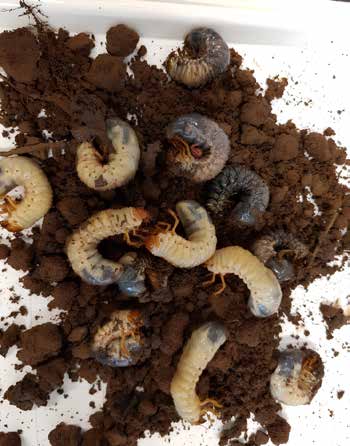
- Evaluate the efficacy of encapsulated insecticide on canegrub control
Results
This project focused on the development of controlled-release pesticide for agricultural application, exemplified by the significant support provided by the sugarcane industry. Imidacloprid is heavily used in the sugarcane industry but it has residual effects on the surroundings and soil functions. The project incorporated three research activities: (1) literature review, (2) synthesis and characterisation, (3) loading and releasing. The key findings are listed below.
- Porous structure carrier materials with low-cost, biocompatible and ecofriendly properties are promising for the development of controlled-release pesticide. Various organic- and inorganic-based materials could be utilised while natural clay minerals are selected for this project given their low-cost, abundant, locally available, environmentally friendly, and manipulatable properties.
- The chemical treatment of clay minerals enhanced the entrapment and sorption of imidacloprid on the materials. These were achieved through acid erosion and organic functionalisation for the active surface properties. The loading method using sorption proved to be more feasible and easier to be scaled in the pilot study.
- The incorporation of clay and modified-clay minerals in the polymer product enhanced the product’s strength. Larger amounts of imidacloprid were loaded on the product compared to the commercial product. The releasing pattern was similar for both products while the elongated release of imidacloprid in soils was required to verify the releasing behaviour in realistic conditions.
The research results are useful and have important implications for the further development of controlled-release pesticide for commercialisation in the agriculture industry. The research project represents a great opportunity for future research being conducted in this important area.
Next steps
Consideration for future research in the following aspects:
- Collaborate with farmers to conduct pest control studies to understand the efficacy and further refine the synthesis of materials
- Understand the residue issue of active ingredient in soils.