
PhD Student Profile
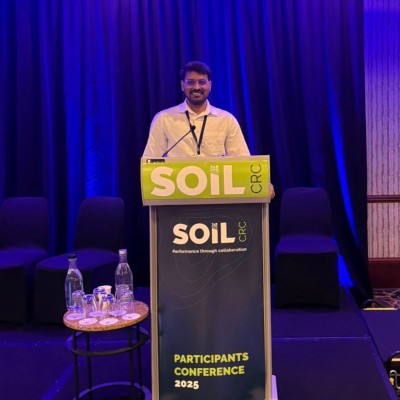
Dr Vijay Kumar Aralappanavar
Adelaide University
Herbicides underpin approximately one-third of the economic value of Australia’s broadacre cropping systems, accounting for 60% of total sales of crop protection products valued at $3.1 billion in 2021-22. Therefore, herbicides play an important role in Australian cropping systems; however, concerns are increasing about their accumulation in agricultural soils and potential effects on subsequent crops. Current analytical methods do not reliably or cost-effectively quantify plant-available herbicide concentrations, i.e. the bioavailable fraction.
My PhD project addressed this critical diagnostic bottleneck by developing, optimising, and validating a novel diffusive gradients in thin-films (DGT) methodology to measure bioavailable imidazolinone (IMI) herbicide residues in soils. This DGT tool proved as a better predictor of IMI herbicide bioavailability and phytotoxicity across contrasting soil types of Australia. By establishing soil-independent toxicity thresholds (E50) for commercially important crops (canola, barley, wheat, and lentils), this work provided a high-precision diagnostic tool to help growers to strategically plan cropping cycles, ensuring the crop rotation decisions are based on actual risk of IMI-residue injury.
PhD Title: “Developing a diffusive gradients in thin-films (DGT) methodology to assess bioavailability of herbicide residues”
PhD start date: September 2022
Supervisors: Prof Enzo Lombi (Adelaide University), Dr Casey L. Doolette (Adelaide University), Dr Binoy Sarkar (Adelaide University), Prof Peter Hoffmann (Adelaide University), Dr Mick Rose (Southern Cross University)
What interested you about this sort of research?
My research focuses on understanding the interactions between soils and agrochemicals. Deciphering these complex dynamics provides the foundational knowledge required for sustainable soil management while maximising the agronomic efficiency and safety of fertilisers and crop protection products.
What do you love about soil?
No two soils behave identically. I am driven to unravel how contrasting soil types interact with agrochemicals, that helps to optimise input costs, maximise crop yields, and build resilient farming systems.
What do you love about your PhD?
Standard soil extractions and plant-back guidelines often fail to predict crop damage from residual herbicides. My PhD project delivers a practical diagnostic tool for Australian grain growers to measure bioavailable IMI residues, empowering better crop rotation choices and safeguarding crops against carryover injury.
How will your PhD help to make a difference for farmers?
The developed DGT methodology offers a more reliable and robust framework for mitigating imidazolinone (IMI) residue carryover risks and guiding informed crop selection within rotational agricultural systems.
What do you want to do when you finish your PhD?
I want to be a researcher in the field of agricultural and environmental science.
Find out more
- See Vijay’s journal articles on Google Scholar
- Watch Vijay’s 2025 PhD research presentation
- View his 2025 research poster