
PhD Student Profile
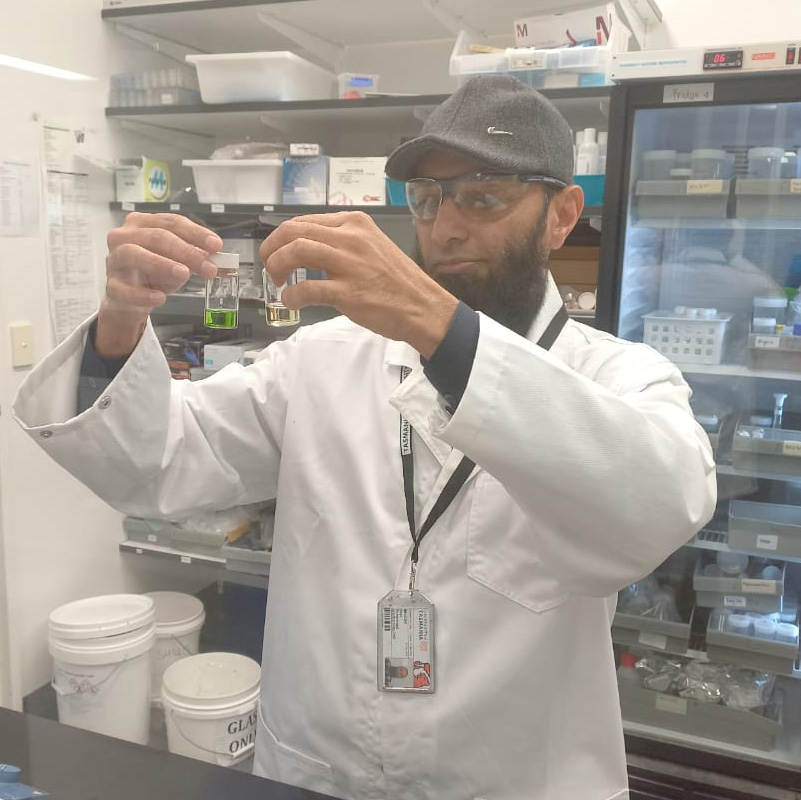
Muhammad Salik Ali Khan
University of Tasmania
Twenty percent of greenhouse gas (GHG) emissions come from the agriculture sector, with nitrogen fertiliser production and use playing a lead role. We need to reverse the climate change simply by adopting precision in using nitrogenous (N) fertilisers. This could be achieved by assessing soil N level right before application of fertilisers. Despite producing accurate results, the conventional methods are costly and time consuming.
My research focuses on developing a miniaturised analytical chip-like device capable of testing soil nitrogen rapidly, in the field, with accuracy and economically. The device would be fabricated using 3D printing and would have millimetre scale channels embedded in it. The soil extracts and colour developing reagents will be injected in these channels. A chemical reaction will take place and a colour will appear in the transparent chip. The colour intensity will correspond to the soil nitrogen level. The coloured image taken by a mobile phone camera will be translated into meaningful numbers.
PhD Title: “Development and optimization of Soil Health Chip: An affordable device for rapid field-based assessment of soil nitrogen status”
PhD start date: February 2024
Supervisors: Dr Fernando Maya Alejandro (University of Tasmania), Professor Michael Breadmore (University of Tasmania)
What interested you about this sort of research?
I am interested in developing a device to assess the soil nutrient level, ultimately calculating balanced nutrition for plants.
What do you love about your PhD?
I am greatly interested in plant nutrition. Just as humans need a balanced diet, plants also need balanced nutrition. Being able to apply the right amount of nutrients to plants to get the desired response fascinates me. My PhD is all about this, assessing soil potential and then applying the required nutrients precisely.
How will your PhD help to make a difference for farmers?
The farmers would be able to evaluate the nutrient status of their soils before fertiliser application. The rapid nature of the Soil Health Chip will assist farmers diagnosing nutrient disorder and its timely management, precisely and site-specifically.
What do you want to do when you finish your PhD?
I would like to work in a soil testing organisation. I believe it would be amazing going from paddock to paddock, meeting farmers, collecting soil samples, analysing them and providing advisory services to farmers.
Find out more
Read our PhD student profile: Meet Muhammad Salik Ali Khan
Find Muhammad on: