
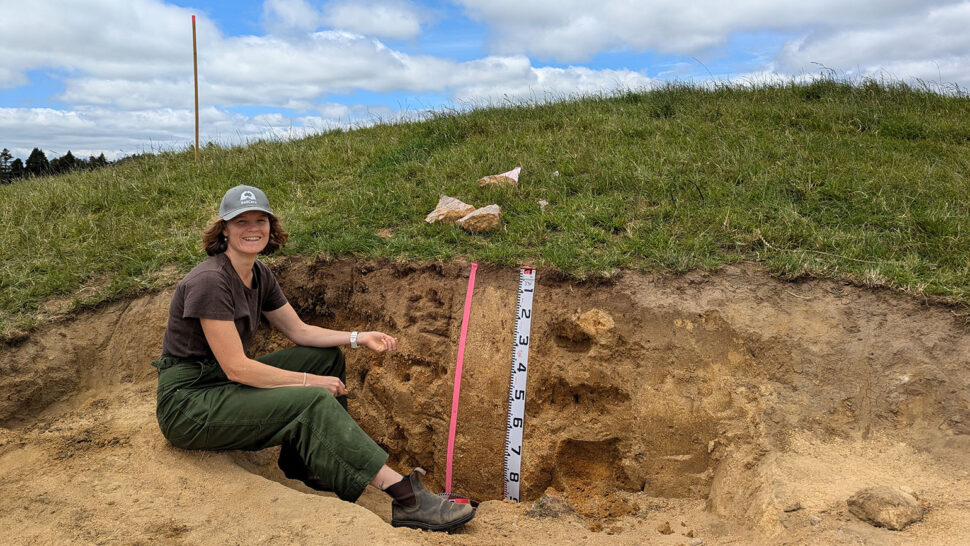
Soil CRC student Evanna McGuinness credits her late grandmother for inspiring her path in life and teaching her to view the world through a scientific lens – with curiosity, inquiry and critical thinking.
“She was a strong female role model, passionate about history, art, nature and the eternal quest of knowledge,” Evanna reflected, fondly.
“In her 70s, she was studying philosophy at the University of New South Wales – just for fun! I think it’s safe to say that I like the writing part of the PhD process more than most, and I definitely got that from my Granny.”
Evanna’s research project shines a light on subsoil organic carbon in an effort to improve our understanding of how organic carbon can be retained deeper in the soil profile.
Increasing soil organic carbon (SOC) can improve soil health and help to mitigate climate change. While research into SOC is growing, few of the present studies sample deeper than 30 cm below the soil surface.
“My project digs a little deeper, because we want to better understand what drives SOC retention and turnover in soils at depths of 30–100 cm.
“Work so far has involved field sampling, soil chemistry, GIS mapping and isotopes, which has been interesting. My future work will be mostly lab-based experiments, looking into how soil properties and structure might influence sequestration potential in subsoils, and maybe comparing grazing systems to remnant vegetation sites to see if we can draw some stronger conclusions from the isotopes data.”
This research has the potential to help meet the United Nations Intergovernmental Panel on Climate Change (IPCC) ambitious goal of restoring 4‰ of current SOC stocks in agricultural soils.
“So far, we’ve found that subsoils (30–100 cm) under perennial pastures in northeast NSW contain half of the total SOC stocks found in the top metre of soil – highlighting a hugely overlooked SOC pool,” Evanna said.
“We’ve been able to use isotopes to show that SOC stocks to 1 m are largely derived from the perennial pasture grasses, but have also shown that for some sites, SOC stocks at 30–100 cm show a lasting legacy of pre-clearing vegetation. The retention or turnover of this subsoil organic carbon is influenced by soil and environmental factors, indicating that some sites (and soil types) may be favourable for long-term sequestration of SOC.”
Evanna explained that understanding what is driving carbon (and other nutrient) turnover in soil at 30–100 cm depth can inform land management practices, which improve subsoil conditions, and hopefully promote deeper rooting plants.
“This could benefit crops access to subsoil nutrients and moisture, with potential yield benefits for farmers. This research is also important for informing SOC sequestration policy,” she said.


Where it began
A love of food and the way it brings people together led Evanna to work as a chef before the pressure of commercial kitchens became tiresome and she opted for a career change.
“My last role as a chef was in London, and the executive chef of the restaurant I was working in was steering the team towards improving sustainability, through reduced food waste, better consumer choices and direct collaboration with farmers,” she recalled. “Through that, I discovered farms moving towards regenerative agriculture.”
When Evanna returned to Australia, she knew that she wanted to contribute to a sustainable future. It was at that time that she came across Southern Cross University’s regenerative agriculture degree and decided to enrol.
“I wanted a role with a greater sense of purpose, and a direction that felt more aligned to my values. I think landing in agriculture research is a nice little step from that. After all, laboratory protocols aren’t that different to recipes, and they often involve salt, fat, acid, heat – the elements of good cooking!
“When I first started at university, I wanted to come out as a consultant, to be the traction for change, but I could also see the need for ongoing research,” she said.
Nearing the end of her studies, Evanna secured a highly-prized spot in CSIRO’s Agriculture and Food summer internship program – a 12-week research project.
Her experience with the program reinforced the importance of agriculture research and she realised that it might be a good fit for her. With a renewed focus, she started searching for research project opportunities that aligned with her interests and ended up joining the Soil CRC student cohort through Southern Cross University.
What comes next
Evanna said she enjoys the learning opportunities that her Soil CRC research project has provided, particularly the chance to learn beyond her project and work with others in her field.
“I’ve enjoyed opportunity to participate in soil judging, join field sampling trips and attend conferences, all of which have met my desire for a role that in some capacity includes travel – it’s what keeps life exciting for me.”
While keen to stay in research once her project is complete, Evanna said she likes to keep her mind open to other options as well.
“My dream role would keep me in agriculture and food research, with the prospect to travel (near or far) for fieldwork and collaborations. But I also like the idea of a leadership role in some field of natural resource management, collaborating with stakeholders in a catchment scale role, to the benefit of the broader landscape – hopefully still with a soil focus.”