
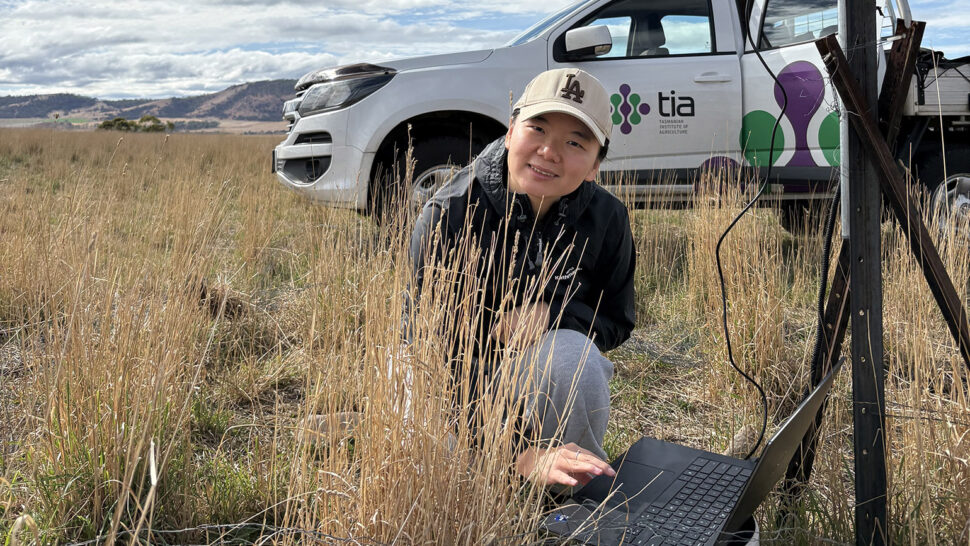
University of Tasmania Soil CRC PhD student Chenting Jiang loves a challenge, particularly the kind that involves using mathematical models and algorithms to solve complex, real-world problems. Her PhD research provides a new, more accurate AI-based system for predicting soil water retention function, which serves to benefit both the agriculture and the water management industries.
“My research stems from a clear need. Current irrigation practices include the use of soil moisture sensors, but still require expert opinion to estimate irrigation timing, which can be subjective and inconsistent across different soil and crop types,” Chenting said.
She saw the opportunity to leverage the vast amounts of soil moisture data already collected through advanced AI-driven analysis, to enable objective, data-based decision processes.
“I developed two hybrid models — the EnKF-fsolve model and the LSTM-PINN model — that integrate physical principles with machine learning and data assimilation techniques. These models are capable of simultaneously predicting soil moisture dynamics and estimating soil water retention functions. This provides a more complete and physically consistent understanding of soil water processes.”
The two models have been validated on four Tasmanian farms, demonstrating high forecasting accuracy and strong alignment with lab-measured retention curves. Impressively, the EnKF-fsolve model achieved an average R² of 0.99 in simulating soil moisture dynamics, demonstrating excellent performance across different conditions. The LSTM-PINN model achieved an average R² of 0.94 in predicting soil moisture one hour ahead and produced soil water retention curves that closely matched lab-measured results. These outcomes suggest strong potential for real-world application.
Chenting also developed an intuitive user interface, called AI-Hydra, which demonstrates how these models could be applied in practice (watch the demo video here).
“AI-Hydra shows how the system autonomously learns from raw soil moisture data to generate actionable insights, including dynamic soil moisture forecasts, plant-available water estimates, and retention curve metrics. By delivering fast and accurate insights, AI-Hydra enables confident and efficient irrigation decision-making in smart farming systems.”
Chenting’s research aims to bridge the gap between raw soil moisture data and practical, site-specific decision-making in agriculture.
“While farmers are the ultimate beneficiaries, my work particularly supports agronomy consultants, field advisors, and AgTech providers, who manage sensor data and often struggle to extract timely, interpretable insights from it.
“By generating dynamic soil moisture forecasts and interpretable retention curve metrics, the AI-Hydra system automatically identifies key thresholds such as field capacity, plant stress points, and plant-available water.
“This enables more confident and efficient irrigation scheduling, improved drought and climate resilience, and more consistent advisory support across farms.
“In doing so, my research helps unlock greater value from existing soil moisture monitoring infrastructure and strengthens the decision-making capabilities of those working directly with growers to manage water and soil under increasing climate pressure,” Chenting said.
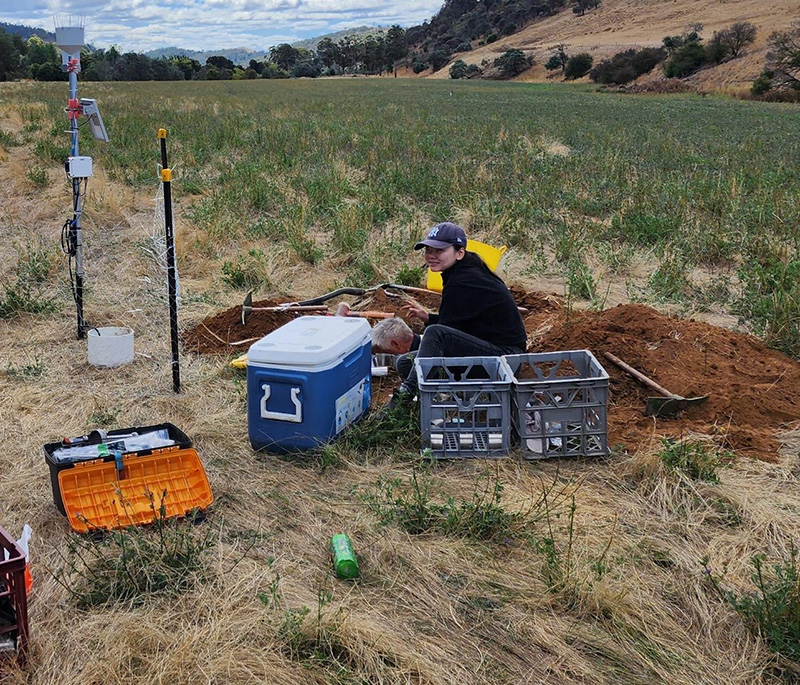
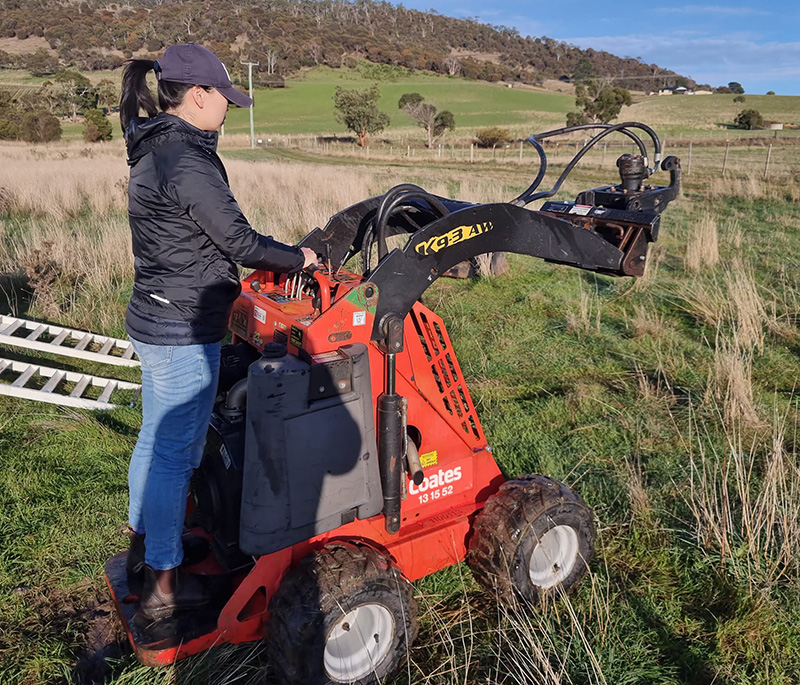
Chenting Jiang working in the field during her PhD with the University of Tasmania.
Where it started
Chenting was born in Baoji, a small industrial city in north-central China, worlds away from the laid-back city of Hobart, where she would later embark on her PhD with the University of Tasmania. It was an aptitude for mathematics and a commitment to learning that led her to study geographical science and economics at university, an experience she credits for broadening her horizons.
“My university studies gave me the unique experience of engaging with both natural sciences and social sciences,” Chenting said. “Through this, I began to understand the richness and diversity of the world, as well as the many paths one can take in life.”
After graduating, she spent several years exploring different careers – working as a high school teacher, an insurance consultant, and later in data and market analysis.
“I gradually realised that I enjoyed working with data and conducting research-driven tasks, and I felt the urge to strengthen these skills through further study. At the same time, I had a strong desire to explore the world beyond China.”
Chenting left her job and travelled to Australia on a working holiday visa, spending time living and working in different cities before returning to university to begin a Master of Information and Communication Technology at the University of Tasmania.
“During my studies, I actively sought research opportunities and was fortunate to work with a supervisor on agent-based modelling projects. He noticed both my mathematical strength and my background in geography, and introduced me to a research project involving machine learning for soil water retention functions,” Chenting said.
It was at this time that she realised how much she enjoyed building models that solve real-world problems, particularly when they can be applied in agriculture and practical decision-making.
This was the turning point that led her to apply for a PhD with the Soil CRC.
“I wanted to systematically develop my research skills and contribute to work that could have a meaningful impact.”
Challenge leads to a sense of purpose
Chenting is drawn to difficult questions.
“There is something deeply satisfying about diving into uncertainty, navigating through frustration, and slowly building a path toward a workable solution,” she said.
She spent nearly six months learning, designing, coding, rewriting, debugging, and wrestling with countless failed runs to achieve a near-perfect R² of 0.99 for the EnKF-fsolve data assimilation model.
“This result felt like a ray of light and renewed hope. It reminded me why I love research, not just because of the end result, but because of the process itself.
“For me, research is about constantly pushing my own boundaries, breaking through limitations in knowledge, methods, and even my own way of thinking. The iterative attempts to solve a difficult problem, no matter how frustrating, are what make the journey fulfilling.”
Chenting’s passion for complex problems is balanced by a strong desire to create something meaningful.
“I find it incredibly rewarding to develop something new, whether it’s a model, a method, or a tool, that hasn’t existed before. The process of designing, testing, and refining something from scratch excites me and gives me a sense of purpose,” she said.
“I’m also inspired by the possibility of turning research into something that can be used in the real world. When my work has the potential to support decision-making in agriculture or land management, it feels meaningful.”
What comes next
After completing her PhD, Chenting plans to continue working in research, particularly in the field of AI-based modelling.
“I’m interested in exploring how artificial intelligence can be combined with domain-specific knowledge to solve complex problems across a range of disciplines, especially where modelling and data-driven decision-making can lead to real-world impact,” she said.
“At the same time, I hope to further develop and promote the work I’ve done during my PhD, especially the AI-Hydra system. I want to find opportunities to bring it into wider use — whether through collaboration with industry, partnerships with government, or integration into digital agriculture platforms.
“My goal is to see the research make a meaningful impact beyond academia, supporting more resilient and data-informed practices on the ground.”
Chenting will present her PhD research at the 2025 Soil CRC Participants Conference in Perth Western Australia on 27 August. For details, head to our Events page.
Find out more
Read Chenting’s publications:
- Jiang, C., Hardie, M., West, D., Bai, Q., & Page, D. (2025). A hybrid EnKF-fsolve model for simultaneous dynamic soil moisture simulation and hydraulic parameters prediction. Journal of Hydrology, 660 (Part A), 133242. https://doi.org/10.1016/j.jhydrol.2025.133242
- Jiang, C., Hardie, M., Bai, Q., & Page, D. (2023). Evaluating HYDRUS-1D for inverse estimating parameters of the van Genuchten-Mualem model from daily soil moisture and weather data. Authorea. https://doi.org/10.22541/au.169901104.49885601/v1
- Jiang, C., Bai, Q., & Hardie, M. (submitted). A neighbour-aware LSTM-PINN model for physically consistent prediction of soil moisture and water retention curves. Water Resources Research. Preprint available at https://doi.org/10.22541/au.175466594.45672666/v1