
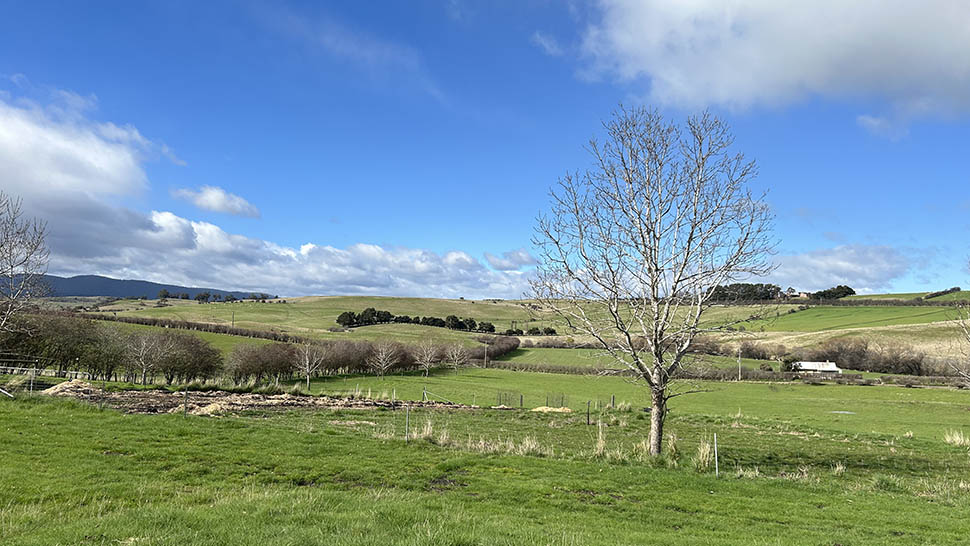
More than 2000 rural landholders across Tasmania have been invited to take part in the Soil CRC’s landmark survey investigating local land and farm management practices in Australia. Led by Associate Professor Hanabeth Luke from Murdoch University, the survey will inform the CRC’s activities and evaluation and will guide the priorities of our local partners, including the allocation of funds to support rural land managers.
This is the second time Tasmanians have been involved in the longitudinal survey, with results from 2022 indicating that the most important issues for rural landholders at the time were water security, the impact of feral or overabundant animal species on productivity, and changes in weather patterns.
“The 2022 data also indicated a strong level of personal responsibility among farmers to maintain the productivity of their soil. The four most common farming practices undertaken in the previous five years were soil testing, planting trees and shrubs, lime application and maintaining at least 70% ground cover,” A/Prof Luke said.
“By running the survey again, we can build an understanding of how land management practices change over time and examine if the results reflect national trends on social and economic factors shaping rural landholder decision-making.”
Local partners NRM South and Southern Farming Systems were involved in the previous survey and have partnered with Murdoch University and Charles Sturt University to deliver this year’s follow-up survey.
Regional Soils Coordinator for Tasmania, Belinda Nielsen, said the survey has already provided valuable insights into their region, and she is keen to find out what the latest data will reveal.
“The findings from the previous survey have been great for validating some of our observations of our region and have also added another layer of data to inform our activity planning,” Ms Nielsen said.
“We are interested to see if local priorities and practices have shifted, what services have been most beneficial and if any additional support is requested. This new data will enable us to better target our investment so that we can continue to deliver activities that support our region’s needs.”
The survey asks landholders about their land management practices, key challenges, sources of information, and the values that underpin their decision-making.
“We encourage all rural landholders who received the survey in the mail to complete it. Those who did not receive a notice can still complete the survey online,” A/Prof Luke said.
“If you want to influence planning and investment in agriculture and natural resource management in Tasmania, this is a simple way to get involved.
“The more responses we receive, the better the outcome for our local partners and the regions they support.”
How to complete the survey
Survey booklets have been mailed to a random sample of Tasmanian landholders holding land over 10ha in size. Notices have already arrived to allow landholders to complete their survey online or opt out if they wish.
Each notice includes a unique serial number that allows researchers to link responses to local soil and weather data. No individual property or landholder will ever be identifiable in reporting.
Landholders who do not receive a paper notice are still encouraged to participate by completing the survey online via the Soil CRC’s website.
For more information, contact Associate Professor Hanabeth Luke on 08 9360 7472 or Hanabeth.Luke@murdoch.edu.au.
About the Soil CRC Social Benchmarking Study
This survey is part of the Soil CRC’s national effort to deliver landholder surveys across six major farming regions, including Central West NSW, the Western Australian Wheatbelt, South Australia’s Eyre Peninsula, all of Tasmania, and the Wimmera and North Central regions in Victoria.
The project is building a national dataset to better understand landholder needs, support evidence-based policy, and strengthen the resilience of Australian farming systems. To date, around 5000 landholders across Australia have taken part.
Reports from earlier survey rounds can be viewed on the Soil CRC website.