Long-term, multi-site research underway through the Soil CRC is exploring the impact of innovative cropping and mixed farming practices on drought resilience. The aim is to better equip Australian farmers with the knowledge they need to prepare for future droughts.
With funding from the Australian Government’s Future Drought Fund, the project extends seven of the Soil CRC’s existing trials across four cropping regions, enabling data collection for up to seven years on a range of soil types and constraints with varying risk of drought.
Project Leader Professor Richard Bell from Murdoch University said insufficient rainfall is the main limitation to production in Australian farming. However, most crops yield less than their water-limited potential because of poor use of rainfall and reduced stored soil water capacity.
“Modest improvements in the extraction of soil water by overcoming subsoil constraints can result in significant yield improvements,” Prof Bell explained.
This project is investigating novel products and approaches to alleviate subsoil constraints and increase water use efficiency, soil health and soil carbon.
“Soil amendments and cropping solutions need time to change soil properties and results may differ yearly due to seasonal variability,” Prof Bell said.
“The long-term nature of this research will help to improve our understanding of these novel products and practices on drought resilience.”
About the experiments
The table below provides an overview of the long-term experiments underway at each field site.
| Trial site & year established | Experiment overview | Site management |
|---|---|---|
| Kweda, WA 2022 | Aimed at improving soil water and nutrient retention in the sandy duplex soil with shallow bedrock. It is using deep ripping with a Bednar machine and incorporating amendments such as gypsum and compost | Corrigin Farm Improvement Group and Murdoch University |
| Bullaring, WA 2022 | Assessing different clay rates (100 t/ha & 300 t/ha) along with spading and deep ripping, and crop sequencing and mixes to improve the soil water and nutrient retention on a deep sandy soil with multiple constraints | Facey Group and Murdoch University |
| Wathingarra, WA 2021-2025 | Site ended in 2025 with the findings that compost, mouldboard and spader are the promising practices to deliver consistent yield benefits over a 5-year period in the deep brown sand with severe soil water repellence | West Midlands Group and Murdoch University |
| Regans Ford, WA 2026 | Site started in 2026 as an extension of the Wathingarra experiment to further investigate some of the outstanding Wathingarra treatments such as spader and compost with some interventions such as clay mixing | West Midlands Group and Murdoch University |
| Lockhart, NSW 2022 | Focuses on improving soil health and water retention of the alkaline, poorly structured subsoils via deep placement of gypsum and organic amendments | NSW Department of Primary Industries and Regional Development |
| Condobolin, NSW 2025 | Building drought resilience in grain systems through diverse cropping solutions with summer cover crop followed by diverse multi-species intercropping | Central West Farming Systems and Southern Cross University |
| Burramine, Vic 2023 | Building drought resilience in grain systems through diverse cropping solutions with summer cover crop followed by diverse multi-species intercropping | Riverine Plains and Southern Cross University |
| Birchip, Vic 2024 | Building drought resilience in grain systems through diverse cropping solutions with summer cover crop followed by diverse multi-species intercropping | Birchip Cropping Group and Southern Cross University |
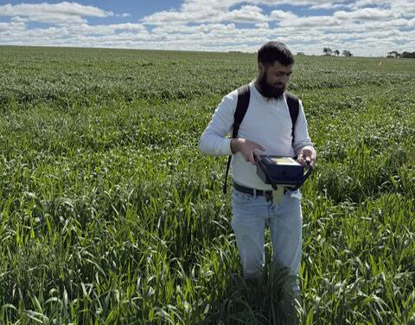
Amelioration strategies are being assessed using advanced soil chemistry and plant physiology techniques. Soil water content will be monitored using the novel BANDICOOT® soil probe developed by the Soil CRC.
The long-term field data is being used to extend our knowledge of resilience of crop yield by Agricultural Production Systems Simulator (APSIM) modelling, and of financial risk using economic analysis.
The 2025 season snapshot
Project Coordinator Dr Hassan Sardar from Murdoch University said the experiments are well established, with multiple growing seasons completed at each of the experimental sites as part of the current project and four to five years of data now available across the seven sites.
The crop and soil measurements taken during the 2025 growing season included plant establishment, NDVI, biomass, yield, grain quality and soil properties. Significant treatment effects have been found at all the sites in 2025, except Burramine.
Soil amelioration experiments
Kweda WA
Two trials at Kweda are examining various organic and inorganic amendments along with the deep ripping. The deep ripping via Bednar in 2022 is still providing yield benefits at Kweda as it was recorded with a significantly higher wheat yield (+ 0.5 t/ha) in 2025.
Bullaring WA
The Bullaring site is investigating cropping sequence, deep ripping and clay amelioration.
The 2025 crop results show that the number of plants and weeds at 5 weeks and 9 weeks after seeding, and NDVI at 7 weeks after seeding, were not significantly affected by the treatments. However, by the 13-week mark, the treatments had significantly affected the NDVI. One of the cropping sequences showed promise (Vetch + Lupin in 2024), producing significantly greater yield than the control. The main reason for this appears to be the nitrogen level boosted by the double legume sequence.
There were some statistical differences observed between the treatments in terms of the grain quality data, however those differences were not of great significance economically.
Wathingarra WA
The Wathingarra site investigated various organic and inorganic amendments along with soil amelioration practices such as spading and mouldboarding.
The 2025 season provided a clear test of whether treatment effects established at Wathingarra over four prior years had persisted into the fifth year and the return to cropping. Across all measurement types, the answer is yes. The spading, mouldboarding and compost treatments were among the treatments with the most consistent finding across the seasons.
Above-average in-season rainfall provided good growing conditions that allowed treatment effects to be expressed through improved nutrient capture and root access rather than simply moisture buffering.
The trial has now ended and a new site at Regans Ford (WA) is being established to further assess the most effective treatments from the Wathingarra site.
Lockhart NSW
At Lockhart, the project team is examining deep placement of gypsum, organic matter (lucerne hay pellets), engineered biochar and inorganic amendments.
For the 2025 season, grain yield responses at the Lockhart site demonstrated clear residual benefits from amendments applied in 2022, but a drier than average conditions may have masked treatment effects on post-harvest soil moisture content.
Despite significantly below average rainfall in 2025, deep gypsum still increased yield by 20% over the Control. The longer-term analysis (2022-2025) shows that deep organic matter+PAM and deep OM+Gypsum could provide more consistent yield benefits across a variety of seasons.
Cover cropping experiments
Summer and early season conditions were challenging for summer cover and winter crop establishment at the three cropping experiment sites. Growth responses to summer cover crop and previous rotations may become more evident following the full rotation.
The treatments in place at each site in 2025. are listed below.
Birchip (Vic) rotations:
- Control (wheat-lentil-canola with summer fallow)
- Three species summer cover crop (control with three species cover crop grown in place of fallow)
- Nine species summer cover crop (control with nine species cover crop grown in place of fallow)
- Brown manure (Vetch-canola-wheat with summer fallow)
- Multispecies green manure (13 species green manure-canola-wheat with summer fallow)
- Pasture (Vetch hay/pasture-fallow-wheat with summer fallow)
Burramine (Vic) rotations:
- Control (wheat-canola with summer fallow)
- Three species cover crop (control with three species cover crop grown in place of fallow)
- Nine species cover crop (control with nine species cover crop grown in place of fallow)
- Temporary intercrop (wheat and vetch-canola with summer fallow)
- Maximum diversity (wheat and vetch-canola and field pea with nine species summer cover crop)
Condobolin (NSW) rotations:
- Control (wheat-pulse-canola with summer fallow)
- Three species cover crop (control with three species cover crop grown in place of fallow)
- Nine species cover crop (control with nine species cover crop grown in place of fallow)
- Temporary intercrop (control with wheat and vetch in the vetch rotation)
Condobolin NSW
Intercropping, mix species and cover crops are under assessment at the Condobolin site. In 2025, most species produced some biomass, however heat stress is believed to have severely limited growth. There was no significant difference between the three and nine summer species mix.
Burramine Vic
The Burramine site is looking at intercropping and summer cover crops. Only sorghum produced biomass in the summer mixes sown in 2025.
Birchip Vic
At Birchip, the team is investigating multi-species summer cover crops followed by the main winter crops (Wheat, Canola, Lentil, vetch). As seen at the Condobolin site, most species produced some biomass in 2025, but heat stress is believed to have severely limited growth. There was no difference between the three and nine species mixes.
Economic analysis
The project team have submitted an abstract for the Soil Science Australia National Conference in November 2026 and hope to present on mapping the economic evidence on soil amendment technologies for drought resilience.
Next steps
All sites have been sown to crops in 2026. Future updates will be provided in the Soil CRC newsletter and across our project participants’ websites.
Birchip Cropping Group will host a Soil CRC roadshow on 11 August 2026, where Dr Hassan Sardar and Professor Richard Bell will discuss the long-term trials. Visit Birchip Cropping Group’s events page for more information.
While the Soil CRC comes to an end of June 2027, the funding from the Australian Government’s Future Drought Fund enables these experiments to continue until 2028.
Project participants
- Murdoch University
- Birchip Cropping Group
- Central West Farming Systems
- Corrigin Farm Improvement Group
- Facey Group
- Riverine Plains
- West Midlands Group
- Southern Cross University
- University of Newcastle
- University of Southern Queensland
- University of Tasmania
Funding acknowledgement
This project received funding from the Australian Government’s Future Drought Fund.