
Calcareous soils occupy about 60% of the cropping soils in south-eastern Australia, and more than 1.1 M ha of South Australian cropping areas are highly calcareous. These soils have a range of constraints limiting crop production and the effectiveness of improved agronomic practices.
Research underway through the Soil CRC is building on the legacy of our ‘Overcoming soil constraints in highly calcareous soils’ project (4.2.003), which developed innovative physical and chemical management packages to improve conditions on calcareous soils.
Co-funded by the Grains Research and Development Corporation and Primary Industries and Regions SA (PIRSA), the current project aims to provide integrated and sustainable soil phosphorus management strategies to farmers and advisers dealing with highly calcareous soils.
Research leader Dr Nigel Wilhelm from PIRSA said poor phosphorus nutrition is a major constraint to improved crop productivity on these soils, because the effectiveness of conventional phosphorus fertilisers is very low.
“Our previous research found a carbon coated mineral (CCM) to be one of the best performing strategies to increase crop growth in highly calcareous soils when applied in the topsoil. We attributed this to the more superior delivery of phosphorus (P) to the crop compared to conventional fertilisers,” Dr Wilhelm explained.
“The current project is further investigating CCM and biochars to improve soil P delivery and crop productivity.
“We are working closely with local farmer group Ag Innovation & Research Eyre Peninsula (AIR EP) to develop integrated solutions in a farming systems context, so that practical and profitable management options can be provided to farmers and advisers.”
Project update
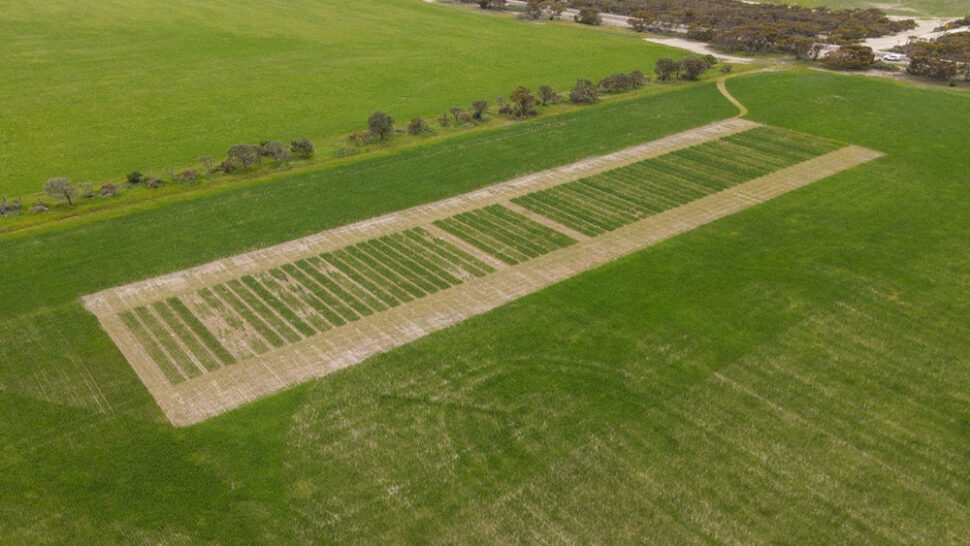
The project team conducted glasshouse pot experiments in 2025 prior to establishing two replicated field trials on a grey calcareous soil on the upper Eyre Peninsula of South Australia, near Port Kenny.
“The first field trial focuses on identifying an optimal rate of CCM for cereal crop performance, while the second trial seeks to assess the impact of other P sources on wheat P status and productivity relative to CCM,” Dr Wilhelm said.
Results from these two trials in 2025 showed that:
- P nutrition was an important driver of wheat performance on a highly calcareous grey sandy soil at Port Kenny, with yields nearly doubling from very low to very high rates of CCM.
- CCM performed well, but it appeared that was largely due to the added phosphoric acid not to its biochar component.
- Highest yields were obtained with phosphoric acid as the P source.
- Supplementing biochars with phosphoric acid performed no better than applying phosphoric acid alone.
- Wheat grew poorly when supplied only with biochar.
Unfortunately, the results from 2025 are not encouraging. They did not show that CCM, or biochars supplemented with phosphoric acid, are a superior source of P for crops growing on highly calcareous sandy soils, despite CCM performing well in previous studies.
Grain from the 2025 trials has been sent to a commercial laboratory for analysis of P content as a further assessment of effectiveness of P strategies. Grain P was 11% higher in wheat treated with CCM than with wheat treated with DAP at the same rate of P/ha. This suggests that CCM is improving P supply relative to DAP.
However, Dr Wilhelm noted that a valuable aspect of CCM as a novel P fertiliser is that it has shown residual benefits to the crop after the year of application in previous trials.
For this reason, in 2026 the two field trials have been re-sown with barley and without P fertiliser to assess residual benefits of all P sources from 2025. Prior to reseeding, assessment of P reserves in the topsoil were taken by soil sampling key treatments from 2025. It was found that while high rates of CCM (1 t/ha or greater) substantially increased reserves of plant-available P, CCM applied at the same rate of P as DAP resulted in similar and low reserves of plant-available P to DAP.
“If CCM continues to show residual benefits in crop performance, then the economic value of its use could improve substantially compared to a single season costing,” Dr Wilhelm said.
“In addition, there might be other long-term benefits for soil ecosystems after the application of CCM, such as the improvement in soil physiochemical properties, which would require further investigation.
“While one season of trials does not eliminate CCM, it is a setback for its prospects as a novel and more effective source of P for crops growing on very highly calcareous sandy soils.”
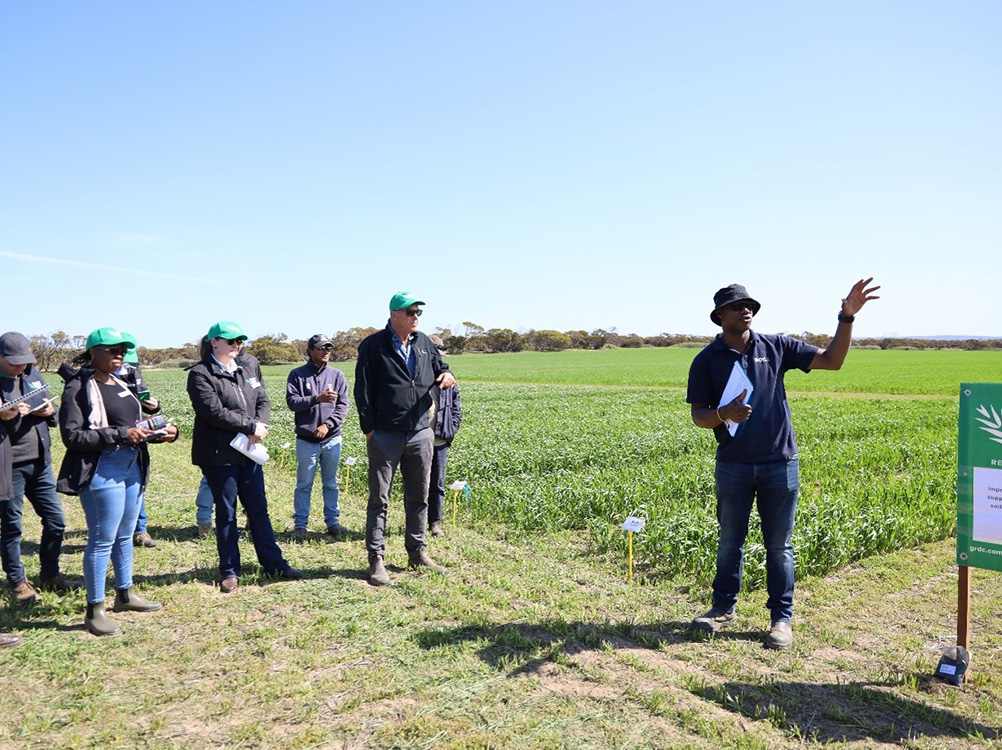
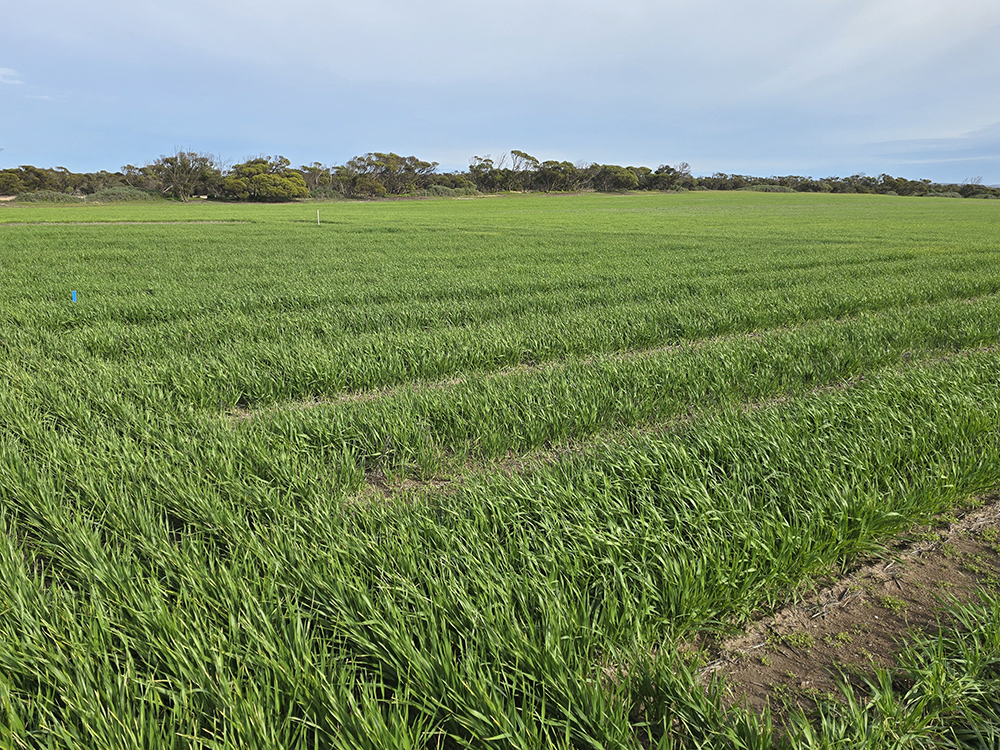
Left: Brian Dzoma (previously of PIRSA) presenting the Port Kenny field trials to the GRDC southern panel during their Spring tour in 2025; Right: The Port Kenny trial site in June 2026 where the barley is responding to very high rates of CCM from 2025 (image courtesy of Brian Dzoma).
Next steps
The 2026 trials will be harvested in November 2026 and the data analysed. Data from the field trials will inform modelling of economic solutions for improved soil P management.
“The research data will also assist with the development of a suite of universal next-generation soil constraint decision-support tools for farmers and advisers,” Dr Wilhelm said.
The final results and research outputs will be shared after the project concludes in April 2027.
Participants
- Primary Industries and Regions SA (PIRSA)
- Agricultural Innovation & Research Eyre Peninsula
Related resources
- Final project report for project 4.2.003: More profitable crops on highly calcareous soils by improving early vigour and overcoming soil constraints
- Research findings fact sheet for project 4.2.003: More profitable crops on highly calcareous soils by improving early vigour and overcoming soil constraints
- AIR EP infographic: Combatting calcareous soil challenges.
Main image: Port Kenny trial site in early September 2025 (drone image courtesy of AgCommunicators).