
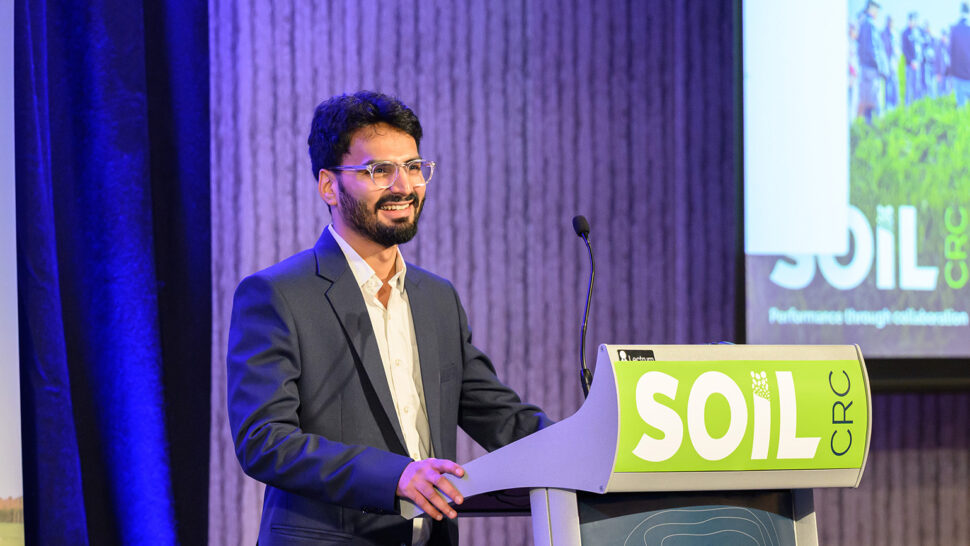
Soil CRC PhD student Bhavya Mod advocates that an ideal farming system must be both economically viable and environmentally sound. His PhD research aimed to deliver a sustainable solution for the soil problems faced by Australian sugarcane growers in North Queensland.
“I am passionate about holistic harmony, and it was important to me that my research aimed to achieve this,” Bhavya said.
“The sugarcane industry contributes $2.5 billion to the Australian economy annually, but some aspects of current farming techniques are unsustainable for both the growers and the environment.
“Sugarcane growers are faced with a number of challenges, including depletion of soil carbon, low effectiveness of fertilisers and low levels of silicon in the soil. They are also required to manage a large volume of green waste, which is often burned, generating greenhouse gas emissions.”
To address this, Bhavya’s PhD research set out to use sugarcane green waste as a resource and transform it into a sustainable fertiliser product.
He used sugarcane green leaves to synthesise biochar and silica nanoparticles and combined them into a functional hybrid material for soil application.
“The first component of the hybrid material is a highly functional charcoal. I used waste effluents like phosphoric acid to modify the charcoal, making it porous and enabling its function as a rich source of carbon and a slow-release fertiliser,” he explained.
“The second component, silicon nanoparticles, is a very effective supplement to improve silicon levels in soil and plants. These nanoparticles were synthesised from locally sourced sugarcane waste, making them cost-effective and practical.”
The resulting hybrid material provides an excellent source of carbon and silicon and can be incorporated with fertilisers like urea for effective and systematic delivery to crops.
Bhavya said farmers will be able to customise their desired combinations of fertilisers and pesticides to be loaded on this hybrid material, according to their needs.
“Our material therefore aims not only to improve crop productivity, but do it in a manner which is cost-effective, sustainable and circular.”
Besides improvement in soil fertility, Bhavya anticipates his research will provide farmers with a sustainable alternative to chemical fertilisers.
“It also provides an excellent tool for waste management, and a potential circular model for the sugarcane agro-industrial system.”
A journey of collaboration
Bhavya credits his PhD research for introducing him to a trusted network of collaborators who share his passion for sustainable farming.
“I’ve been fortunate to work with multiple stakeholders, from my university supervisors to local Queensland grower groups like Herbert Cane Productivity Services Ltd and Burdekin Productivity Services, who assisted me with farmer surveys and trial logistics,” Bhavya said.
His PhD was based at the University of Newcastle and was supervised by Professor Ajayan Vinu, Dr Gurwinder Singh and Dr Kavitha Ramadass from the university, as well as Dr Lukas Van Zwieten from the NSW Department of Primary Industries and Regional Development.
“I’m genuinely grateful for the support provided by my supervisors and by the Soil CRC, and for the opportunities, resources and counsel I received during my PhD,” he said.
“Thank you in particular to Dr Cassandra Wardle, Soil CRC PhD Program Manager, for being a trusted bridge between PhD students and the wider Soil CRC network – offering expert guidance and an empathetic ear when needed.”
What comes next
Bhavya said he is optimistic that his PhD will lead to a fulfilling career in the agriculture or environment sector, whether in a research or managerial capacity.
“I’m motivated by work that improves soil resilience while reducing environmental impacts and supporting sustainable farming systems,” he said.
“I would love to continue working in the sustainability, waste management and circular economy space. This is where my interests lie and where I believe I can make a positive contribution.”
Bhavya is open to work as an environmental scientist, postdoctoral researcher, environmental consultant or laboratory technician. If you would like to collaborate with Bhavya or discuss potential career opportunities, please reach out to him via LinkedIn.
Find out more
- Connect with Bhavya on LinkedIn
- Watch his PhD presentation: Porous carbon-based nanomaterials as a nutrient release scaffold
- View his PhD poster: Harnessing Sugarcane Waste for Sustainable Farming
Read Bhavya’s research publications:
- Mod, B., Singh, G., Perumalsamy, V., Ramadass, K., Kaur, H., Ruban, A.M., Van Zwieten, L. & Vinu, A. (2026). Urea-loaded Porous Biocarbons with High Specific Surface Area derived from Sugarcane Trash as a Slow-release Nitrogen Fertilizer. Materials Today preprint. http://dx.doi.org/10.2139/ssrn.6137516
- Mod, B., Baskar, A. V., Bahadur, R., Tavakkoli, E., Van Zwieten, L., Singh, G., & Vinu, A. (2024). From cane to nano: advanced nanomaterials derived from sugarcane products with insights into their synthesis and applications. Science and Technology of Advanced Materials, 25(1). https://doi.org/10.1080/14686996.2024.2393568