
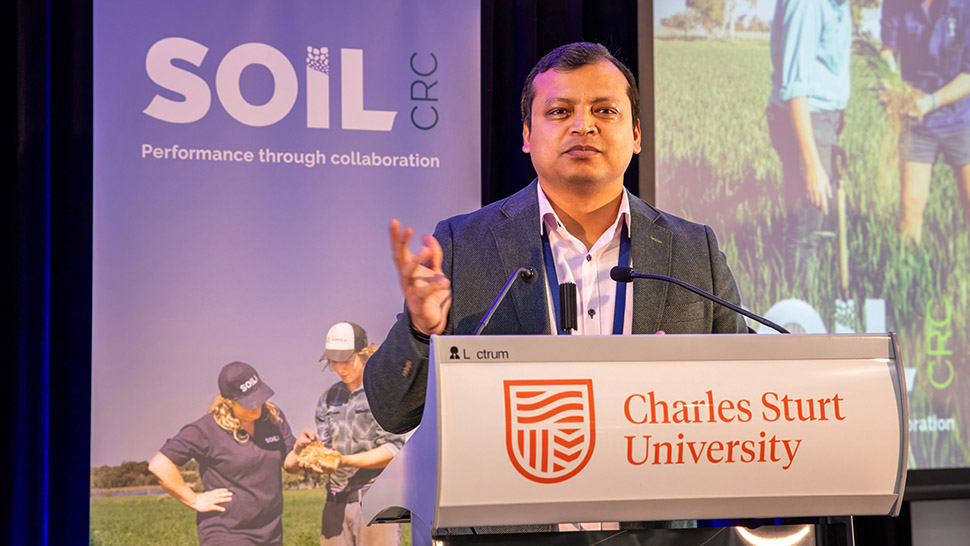
Congratulations to Dr Adnan Al Moshi who has completed his Soil CRC PhD and taken on a sessional academic (research) role at Federation University. Adnan’s PhD research investigated acoustic wave-based communication as an alternative to radio frequency signals for wireless underground sensor networks used in precision agriculture. In this article, he shares his journey of curiosity and discovery, from robotic arms in Bangladesh to acoustic waves in Australia.
Story by Dr Md Adnan Al Moshi, Federation University Australia
There is a question that has quietly run through everything I have built, long before I ever framed it as a “research question”: how do you make something actually work – not in ideal conditions, but in the real, messy, resource-constrained conditions people actually face?
Where it started: a constraint I could not ignore
During my Bachelor of Electrical and Electronic Engineering, I chose a problem that looked purely technical on the surface: industrial robotic arm manipulators to reduce hazards in industrial settings. But the real design constraint mattered more to me than the robotics itself. Commercial industrial robots simply were not affordable to import into a developing country like Bangladesh, which also lacked the capacity to manufacture them locally.
So, I built and developed a PC-based robotic arm manipulator running under a Real-Time Linux (RT-Linux) environment, coordinating two or more robotic arms executing multiple tasks simultaneously – designing the hardware, the circuitry, and the signal interfacing, and integrating a DAQ card to make it all work together in real time. It was not the most advanced robot in the world. But it was affordable, and it was mine, start to finish.
That work was later published in the IEEE International Conference on Industrial Engineering and Engineering Management and the International Journal of Energy and Power Engineering – an early signal that solving appropriate problems, not just impressive ones, was worth taking seriously. Across my undergraduate years, that instinct was reinforced from multiple directions, from a Vice Chancellor’s Award to Dean’s Awards across several semesters – external confirmation that the way I was choosing to work was one worth trusting.
Testing that instinct again – in a different domain entirely
As a Research Assistant, I carried the same principle into solar panel testing – designing for locally-available resources rather than imported assumptions. Then the instinct led somewhere unexpected: from circuits to communities. Joining BRAC International, the world’s largest NGO, as a Young Professional, I led ‘Driving for Women Empowerment’ and the Girls’ Education Challenge – applying the exact same discipline through stakeholder coordination, empathetic needs assessment, and cross-sector communication with government bodies, police, and local NGOs. What looked like a detour from engineering was really the same skillset, applied to people instead of circuits – listening carefully, building trust across very different stakeholders, and staying rigorous even when the “data” was a person’s lived experience. I went on to organise a campaign that reached 2.6 million people, confirming something I still carry today: rigour and care are not separate skills. They reinforce each other.
Back to circuits, sharper this time
That grounding is exactly what I carried into my Master of Social Change and Development, and then into my PhD with the Soil CRC and Federation University.
My PhD tackled a problem holding back precision agriculture: underground sensors that simply cannot reliably talk to each other, because radio signals die within a few metres once buried in soil. It was the same “works in theory, fails in the field” problem I had first met as an undergraduate – just with different physics. So, I turned to something almost counterintuitive: sound. I engineered and field-validated an acoustic wave–based communication system as an alternative to radio frequency signals, proving through modelling, laboratory testing, and multi-site field trials that it could transmit up to 38 metres underground – dramatically outperforming radio, and backed by a working prototype acoustic transceiver, not just a paper.
Today, as a researcher, I am pushing that further – designing amplification and modulation circuitry to extend that range to 60-100 metres, which would substantially reduce the number of nodes needed for large-scale agricultural deployment. Once again: not the most exotic solution possible, but the one that is actually deployable at the scale and cost real farms can support.
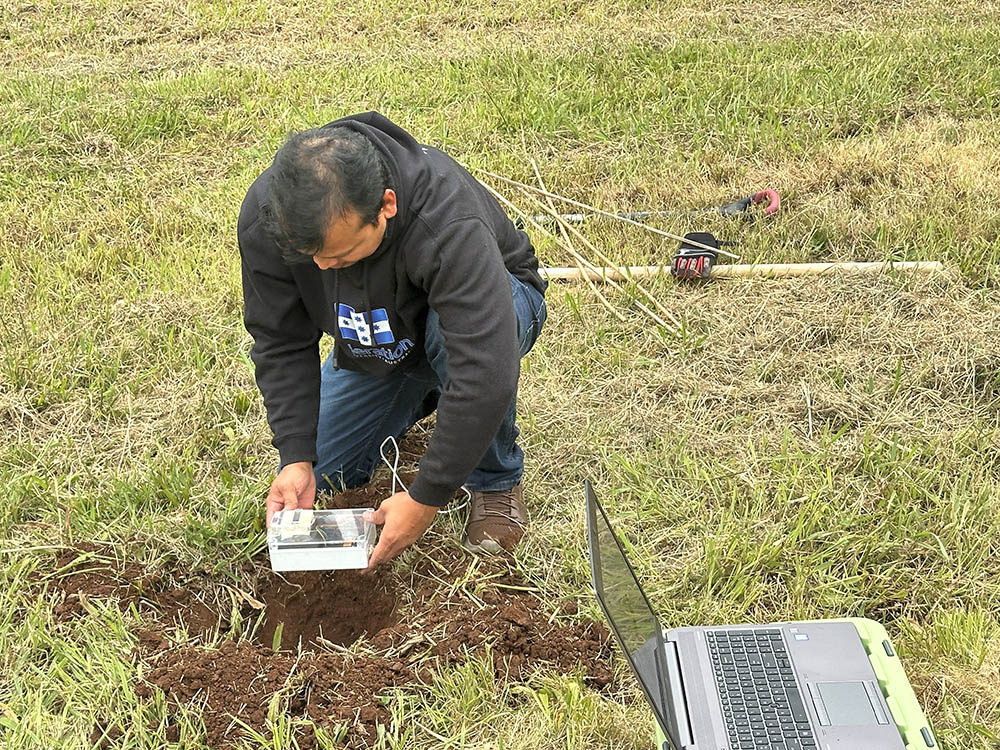
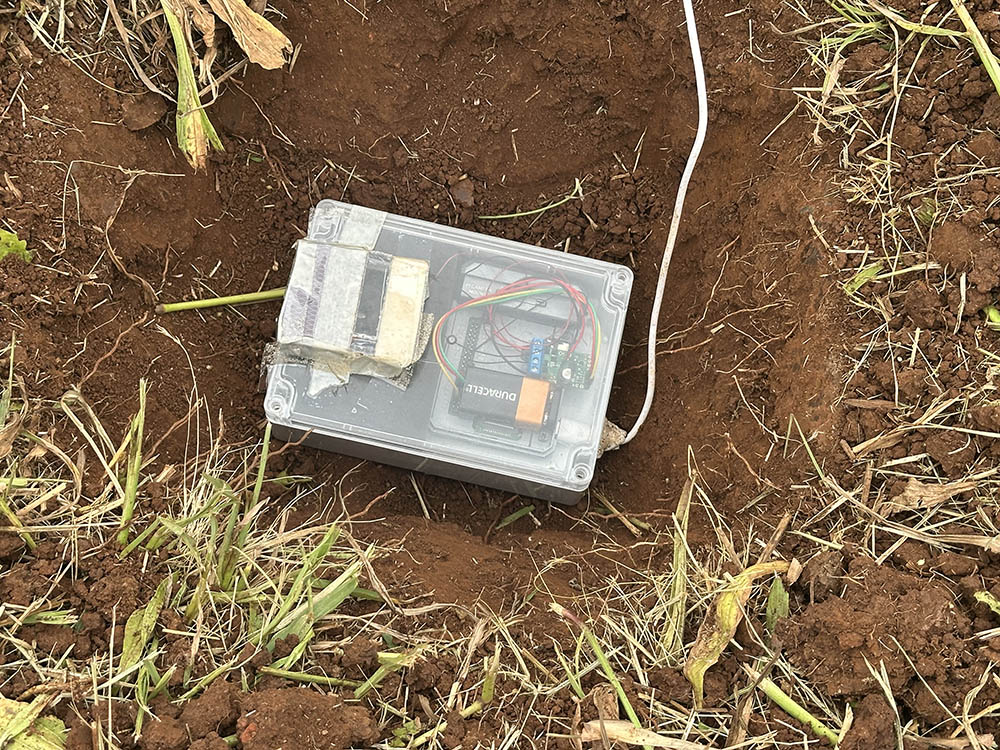
Adnan working in the field during his Soil CRC PhD.
The through-line
From a robotic arm engineered to make automation affordable in Bangladesh, to a solar simulator built to fit local realities, to child protection committees formed in rural communities, to acoustic waves engineered to survive dense, moist soil – the material has changed every time. The instinct has not.
Understand the real constraint. Design honestly for it. Validate relentlessly until it works – not in theory, but in the field, wherever “the field” happens to be.
Every marker of recognition along that path – the Dean’s Awards, the IEEE publications, the Vice Chancellor’s Award, seeing 2.6 million people rally around a cause I helped lead – hasn’t just been encouraging. It’s been evidence, at each stage, that this way of working holds up under real scrutiny. That’s what gives me the confidence to keep applying it to harder problems.
That is the kind of engineer and researcher I want to keep being. If you are working on smart sensors, IoT/IoUT systems, wireless communication, or acoustic R&D (or if you simply believe engineering should be judged by whether it works for the people who need it), I would love to connect.