
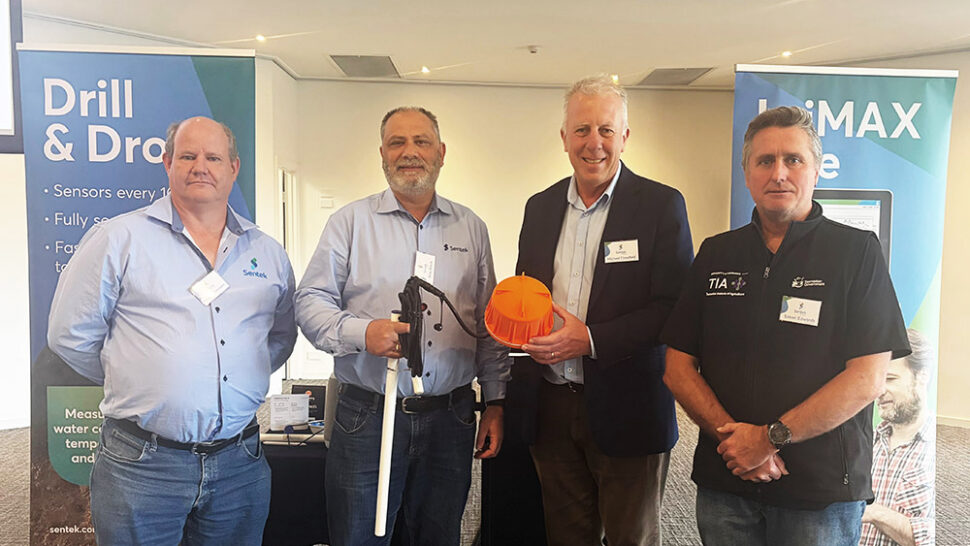
In May 2026, we announced that the Soil CRC has partnered with Sentek Technologies to commercialise and distribute its BILBY® Data Transmission Unit (DTU) throughout Australia and worldwide. Prior to this, we commissioned renowned agricultural economist Terence Farrell of Ag Economics to undertake an economic analysis of the Soil CRC’s investment in the development of the technology. We are pleased to share a summary of the Ag Economics report:
Australian farmers have been using sensors to monitor soil moisture and other critical soil measures such as temperature, pH and cation exchange capacity. These measurement devices require underground wiring to wide area networks or use an above ground transmitter to send data to nodes or phone towers. Some of these devices require trenches to install wiring and some must be removed prior to tillage operations and replaced again. Fences are often necessary to protect probes and transmitters from machines, animals, insects and corrosion which make them expensive to operate.
The Soil CRC and University of Tasmania (UTAS) solved this issue through a $3.23 million investment which developed the BILBY® DTU (Data Transmission Unit) in conjunction with their Adelaide based commercial partner, Sentek Technologies. The BILBY® DTU is a transmitter that can be buried below tillage depths and can send probe data up to 1000 metres for a period of up to 5 years. One of the UTAS developers, Dr Marcus Hardie, said that the unit could transmit data to a wide range of existing commercial receivers.
An independent assessment of the investment by Terence Farrell of Ag Economics has shown that the BILBY® DTU would save producers $300 against probes with WAN units attached or $1028 against wired probes that required trenches and expensive cabling. On average, producers would save approximately $664 for each probe in situations where more than 3 probes were required. Returns to agriculture in Australia were estimated to be $26.05 million over an 18-year period. In real terms, agriculture would benefit by $6.10 for every $1 that was invested in this Soil CRC project.
Other research has shown that soil moisture probes can save up to 10% of irrigation water which is finically valuable to irrigators and this saving may provide environmental benefits to downstream rural communities. The BILBY® DTU could also be used for sporting fields, golf courses, and marsh and wetland management areas.
Contact:
Economic Analysis completed by Terence Farrell from Ag Economics phone 0400 180 267 or email Farrelltcj@gmail.com
More information
Read the full report: CRC for High Performance Soils – BILBY® DTU Impact Analysis by Ag Economics.