
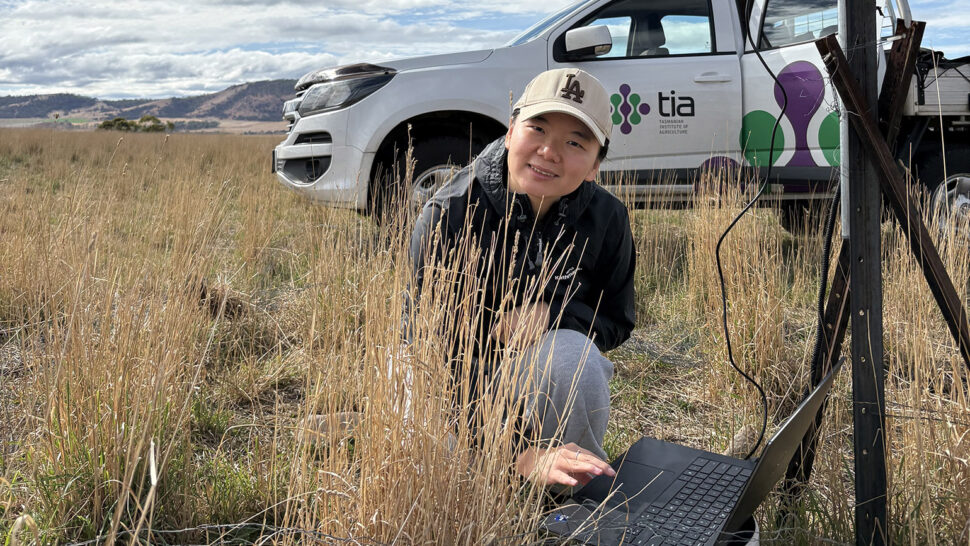
When we last caught up with Soil CRC PhD student Dr Chenting Jiang from the University of Tasmania, she was on the cusp of submitting her PhD thesis and was contemplating her next move – keep working in research or seek a different path?
Through her PhD, Dr Jiang developed AI-based modelling approaches for predicting soil water retention function and soil moisture dynamics, with potential application in both the agriculture and water management industries. But she had bigger plans for this technology.
“I wanted to see my research make a meaningful impact beyond academia, supporting more resilient and data-informed practices on the ground,” Dr Jiang said.
With support from Soil CRC Program 2 Leader, Associate Professor Nathan Robinson, Dr Jiang put forward a research proposal to the Soil CRC for a new short-term project to further develop her technology and move it towards farm readiness.
“Dr Jiang’s research already developed two impressive AI-based models that demonstrate strong scientific performance, but additional investment is expected to pave the way to on-farm implementation of this technology,” said Soil CRC CEO Dr Michael Crawford.
“And so, we are pleased to welcome Dr Jiang to the Soil CRC project leadership team, where she will translate the existing AI-based modelling to support end-user decision-making.”
The new project focuses on AI-HYDRA, an early decision-support concept that demonstrates how Dr Jiang’s two AI-based models – EnKF-fsolve and LSTM-PINN – can be applied in practice.
“My two models integrate physical principles with machine learning and data assimilation techniques and are capable of simultaneously predicting soil moisture dynamics and estimating soil water retention functions from multi-depth sensor data. This provides a more complete and physically consistent understanding of soil water processes,” Dr Jiang said.
“AI-HYDRA shows how the system autonomously learns from raw soil moisture data to generate actionable insights, including dynamic soil moisture forecasts, plant-available water estimates, and retention curve metrics.
“By delivering timely, site-specific and practical insights, AI-HYDRA can support more informed irrigation decision-making in smart farming systems.”
Dr Jiang’s latest research project, ‘AI-HYDRA: From soil moisture data to irrigation decisions’ (2.3.005), will further develop the technology and translate the modelling into a minimum viable decision-support prototype (MVP) that can help growers, advisors or grower groups to turn their own sensor data into practical, actionable irrigation recommendations.
“The aim is to close the data-to-decision gap, so the validated modelling becomes something growers and advisors can actually use in the field,” Dr Jiang said.
“Expected benefits include improved interpretation of soil moisture data, more informed irrigation timing, reduced risk of over-irrigation, improved water-use efficiency, and better decision support for productivity and profitability at the farm level.”
The project will also create an early adoption pathway through case study testing, stakeholder workshops, and targeted grower-facing outputs.
Riverine Plains, a Soil CRC grower group participant, will play an active role in delivering the project, including grower liaison, coordination of farm-based testing activities, co-development of extension materials, and member engagement activities.
Jane McInnes is the Head of Farming Systems at Riverine Plains and said that while advanced soil moisture monitoring technologies are increasingly accessible, their practical value is constrained by the gap between data capture and actionable irrigation decisions.
“Growers and their advisers can access dashboards and sensor readings, but translating that data into reliable irrigation timing recommendations, particularly for pressurised systems such as centre pivot and lateral-move configurations, remains a significant unmet need,” Jane said.
“We are excited to be involved in Dr Jiang’s research and value the focus on translating the validated soil-water modelling framework into an MVP that can be explored using real farm data and case study testing.
“This approach reflects the kind of applied, grower-facing translation that Riverine Plains members consistently identify as the missing step between research outputs and genuine on-farm benefit.”
Dr Jiang said she is grateful for the opportunity to continue to build on her PhD research and is confident that AI-HYDRA will be a legacy of the Soil CRC’s investment in the development of innovative soil sensing technology.
“I’m inspired by the possibility of turning research into something that can be used in the real world. When my work has the potential to support decision-making in agriculture or land management, it feels meaningful,” she said.
The project will commence in August 2026 and is scheduled for completion in early 2027.