
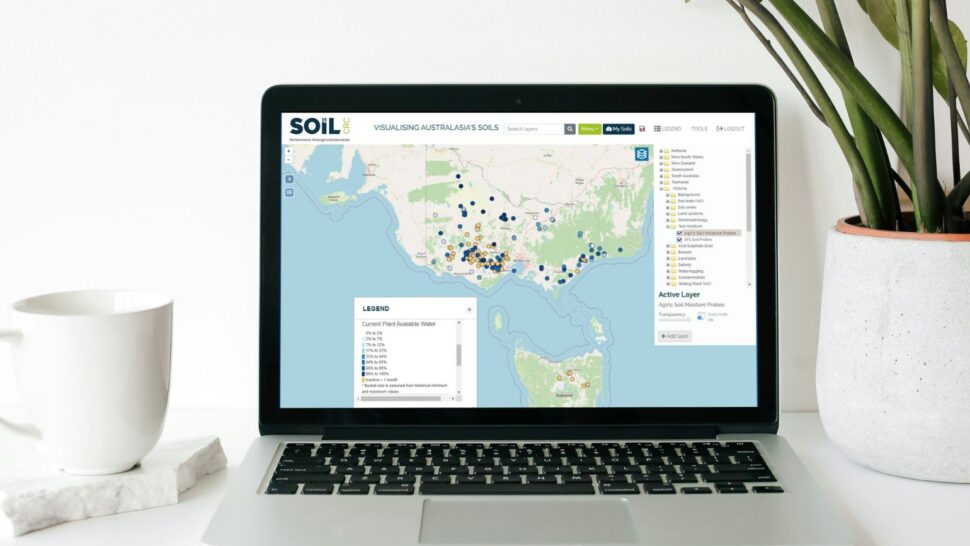
The Soil CRC’s Visualising Australasia’s Soils (VAS) project began in 2019 to provide Soil CRC participants with access to data, information and knowledge on Australian and New Zealand soils. It led to the development of a dynamic web-based portal that brings together a large array of public and private soil datasets for use by the Australian agricultural industry.
Now in its final phase (Phase 3), the project aims to transform the VAS portal into an enduring component of an Australian soils knowledge system that is both self-sustaining and inherently useful for research and education.
In addition to the public data, contributions from the project partners now include soil data from over 5,500 sites with approximately 15,000 samples and 250,000 observations, collected between 1988 and 2024. It also includes over 800 million soil probe observations.
Project Leader Associate Professor Peter Dahlhaus from Federation University said Phase 3 of the project is focussed on improving the accessibility of the existing data and adding more data and information to the VAS portal, to improve the depth and breadth of available data.
“This includes uploading ancillary data (such as soil profile datasheets, photographs, laboratory data sheets and reports) and inputting soil data collected in Soil CRC projects and by participants in the Soil CRC,” he said.
To facilitate this, Federation University’s Centre for eResearch and Digital Innovation (CeRDI) appointed two students to assist in mining and mapping legacy data from Federation University research theses and reports to include (as open data) in the VAS aggregator.
The University of Newcastle has also committed to making their soil datasets openly available for the Hunter region. Meanwhile, university researchers are benefiting from moisture and temperature probe data from a participating farming systems group that has been shared via a VAS data transfer agreement. This data will be used to calibrate machine learning models of soil moisture using remotely sensed data.
All publicly available datasets on the VAS portal have been updated to include meta data for data descriptions, contact details, and licensing information.
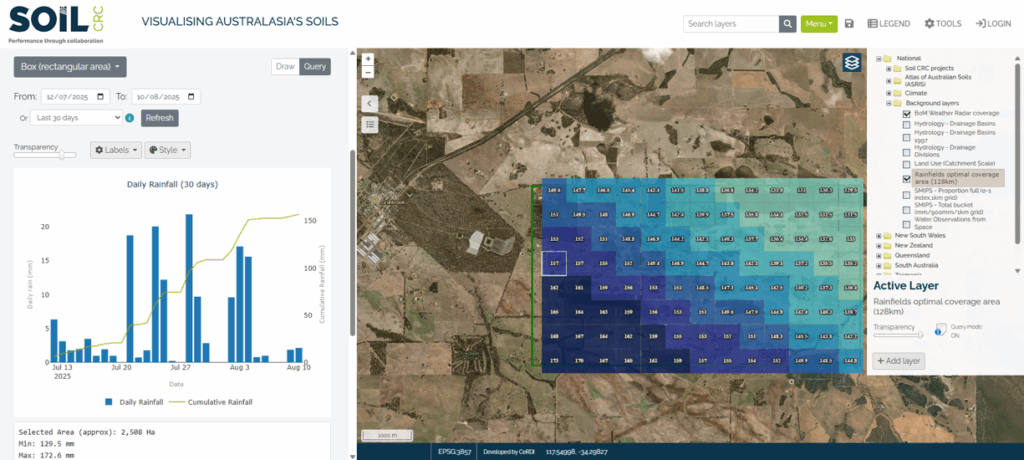
Associate Professor Dahlhaus said one of the most complex and innovative technical work packages for VAS has been the inclusion of a tool that draws data from the Bureau of Meteorology’s Rainfields system, which provides a calibration of archival rain radar data. This tool is based on the research outcomes of Soil CRC PhD student Dr Peter Weir.
“The integration of this data extends the capabilities for VAS and offers new opportunities for project partners to access weather data, mapped to regions and soil types,” he explained.
The project team have also made substantial progress in upgrading the web framework on which the VAS portal has been built.
“This provides a more robust, flexible, and efficient means to add functions and applications to the VAS system, including a metadata catalogue, addition of links to ancillary data, and easier self-serve for adding data sets,” Associate Professor Dahlhaus said.
“Phase 3 will also harness artificial intelligence to add value to soil performance data, and enhance the reporting of soil quality, function and target values for high performance soils.”
The project team are developing a governance model, including data governance and stewardship guidelines, for managing VAS beyond the life of the Soil CRC.
The final phase is a collaboration between Federation University, the University of Newcastle and a Community of Practice involving Soil CRC participants across Australia, including Burdekin Productivity Services, North Central CMA, Riverine Plains, Southern Farming Systems, Western Australian No Till Farmers Association (WANTFA) and West Midlands Group.
“The primary goal of the Community of Practice is to foster continuous learning and development, enabling our project partners to stay updated with the latest technologies and innovations relating to the portal,” Associate Professor Dahlhaus said.
“The Community of Practice will establish and agree on key use-cases, which will be developed and implemented over the coming months to enhance the value of VAS outcomes for all project partners.”
Associate Professor Dahlhaus emphasised that this is challenging research that requires an understanding of both the physical and social barriers to data sharing, as well as identifying what motivates data custodians to share their soil data.
“The project involves finding the value proposition for the participants and end-users and managing the technical challenges of making it all work in an intuitive-to-use, seamless and effortless manner,” he said.
Research has been conducted using social science methods to examine the perceptions, role and application of VAS by project partners. Led by Dr Alison Ollerenshaw (Federation University), the project team identified that there is broad agreement in the contribution of VAS, and anticipated expectations for soil data sharing and management using the portal.
However, data custodians remain reluctant to openly share data. The reasons are complex, but generally include:
- Data custodians’ uncertainty about whether they had the right to share soil data
- Farmer groups’ need to retain the trust of their members
- Concern about VAS sharing their data with other federations (in the future)
- Concern that long-term data availability and security may cease with the project
- The difficulty in supplying the required metadata (e.g. who ‘owns’ these data?).
Activities are underway to address these challenges and to build the value proposition for VAS that will enhance its adoption and application by data custodians and industry stakeholders. Ongoing research will also be conducted to explore and extend the insights about VAS from stakeholders and to assess its contribution as a federated soil data knowledge system. The research will provide evidence that will inform and guide future data federations.
The project team explores these challenges and opportunities in more detail in an article published in the Soil Use and Management journal: ‘The Opportunities and Challenges Associated With Establishing a National Soil Data Repository From Public and Private Actors’.
How it started
The first phase of the project wrapped up in 2021, delivering an online portal that brings together a large array of reliable soil datasets from government agencies, industry and grower groups, and individual farmers. With the involvement of Landcare Research New Zealand, it covered both Australia and New Zealand.

Phase 2 (2021-2024) added greater functionality to the VAS portal, including a self-serve data management system, improved filtering and reporting, seamless interoperability with the Australian National Soil Information System (ANSIS) and the inclusion of soil sensor data.
“Throughout all phases, the key objectives of VAS are to motivate soil data custodians to make their data findable, accessible, interoperable and reusable (FAIR), and align with other national and international soil research data initiatives to maximise discovery and reuse,” Associate Professor Dahlhaus said.
Find out more
Associate Professor Dahlhaus will be speaking at the 2025 Soil CRC Participants Conference in Perth Western Australia on 27 August. For details head to our Events page.
Watch our project spotlight video (2024)
Project participants
- Federation University Australia
- University of Newcastle
- Burdekin Productivity Services
- North Central CMA
- Riverine Plains
- Southern Farming Systems
- Western Australian No Till Farmers Association
- West Midlands Group