Key points
- Australia’s soils are fragile and prone to degradation. Many Australian growers already invest in improving their soil, but the market pays them the same whether they do or not. There are potential rewards (premiums) in consumer markets, but consumers cannot see how food is grown, and certification is needed to verify claims and build trust.
- For certification to work, it has to pay its way for producers. Premiums and market access matter most, and auditing must be rigorous without adding cost and paperwork. Standards that include outcomes and that are set to local conditions are also important for producers.
- Specific design choices for certification can enhance consumer willingness to pay. Graded certification (gold level), verification of the percentage of the premium paid to producers, indication of the measurable ecosystem benefits of soil stewardship, and inclusion of soil alongside water, biodiversity and animal welfare are key ways that certification can increase willingness to pay.
- A new certification scheme focussed only on soil may not be the best way to reward farmers. Australia already has many schemes covering soil inconsistently, and growers often need to meet several overlapping sets of requirements to access markets. Coordinating those schemes so a grower can demonstrate good soil management once and access multiple markets would do more than adding another scheme. This requires government or industry to lead.
The challenge
Australia’s soils are fragile and prone to degradation. Many producers already invest in improving their soil, but the market rarely rewards them for it. Switching to better soil management can be expensive upfront, and the payoff can take years to appear. This creates a risk of underinvestment and further soil degradation.
Soil stewardship means managing production to maintain or improve soil health and productivity. Common practices include reducing tillage, rotating crops, maintaining groundcover and adding organic matter.
Consumer markets offer producers a way to earn a financial return for these practices. International and Australian research (including Soil CRC funded
research) shows that some consumers are willing to pay more for products grown with good soil management. However, because consumers cannot see how food is produced, claims about soil stewardship need to be certified. Certification verifies those claims and builds consumer trust.
In Australia, soil certification is currently ad hoc and uneven. Multiple schemes exist, with inconsistent or overlapping requirements for soil management. Effective certification also faces several barriers. Soil types and climate vary widely across the country (making standards difficult to develop), different stakeholders have different needs and must agree on a shared approach, auditing is difficult to do cost-effectively, and producers need to receive sufficient reward to take part.
The Soil CRC project ‘Understanding and promoting good soil stewardship’ (1.1.003) found that a consumer market for soil stewardship exists but certification is needed to turn soil stewardship into rewards for producers. Little research exists on how certification of soil stewardship works in consumer markets.

Our research
This project set out to determine what a fit-for-purpose soil certification scheme might look like in Australia, and how certification could be strengthened to generate financial rewards for producers. The project had several stages, each building on the last.

A literature review of research on certifying sustainable agriculture, alongside an audit of 26 Australian and international certification schemes, identified the key issues and challenges in certification, and the arrangements that could be applied in Australia.
Interviews with 32 stakeholders including farmers, grower groups, soil scientists, agronomists, certification scheme managers, government representatives, retailers, manufacturers, bankers and financiers explored the drivers, benefits and barriers associated with certification.
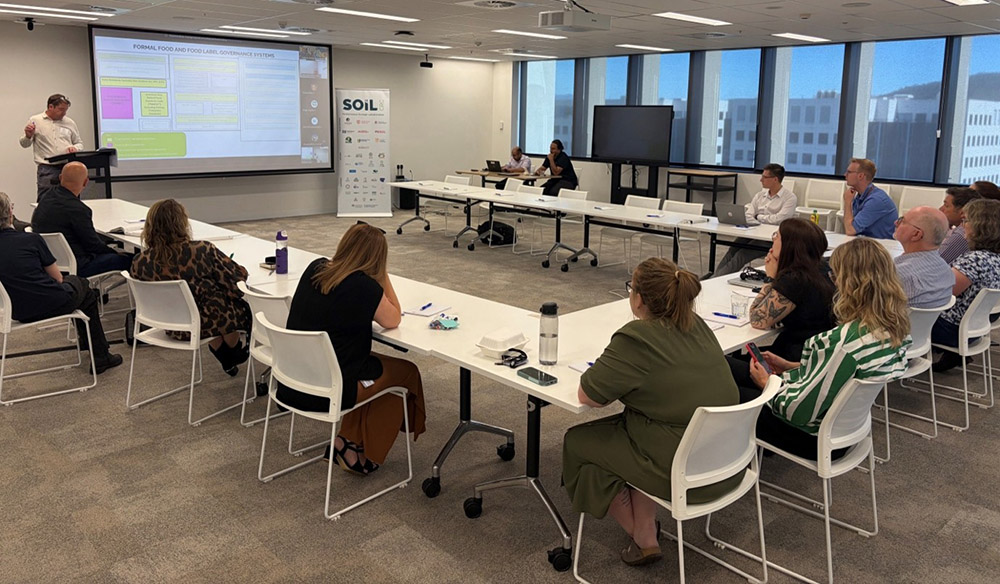
Design workshops with representatives from producer groups, government, retail and manufacturing, finance and soil science explored what an optimal soil stewardship certification scheme might look like. Earlier phases of the research had identified a set of ‘design options’ for different aspects of a certification scheme, including what the standards should cover, auditing method, benefits for farmers, and how the scheme would be governed. Auditing options, for example, included third-party auditing, peer auditing, self-assessment, and remote technology. Participants were shown these options and worked in groups to choose the best combination, producing two draft certification schemes.
Grower focus groups with 33 producers from central west New South Wales, northern New South Wales, southern Queensland, and western Victoria reviewed the two draft certification schemes and gave their views on which design options were acceptable.
For each option, producers indicated whether each aspect should be definitely included, maybe included, definitely not included, or whether they were unsure. For example, producers commented on whether the standards should be based on practices (e.g. crop rotation), outcomes (e.g. a measure of soil
carbon), or a mixture of both.
A consumer survey of 5,500 Australian consumers measured their willingness to pay for products certified for soil stewardship, tested on two products: a 1 kg bag of potatoes and a 600 g packet of wheat biscuits.
Recommendations drew these findings together to identify opportunities for improving soil stewardship certification in Australia.
Research findings
The findings provide insights into producer needs for certification of soil, the impact of different design options for certification on willingness to pay for
soil stewardship, and the importance of better governance of certification, including of soil.
A key finding was that while Australian consumers will pay more for food grown using good soil management, a new soil-only certification scheme may not be the best way to reward farmers for it. Soil is better considered as part of a broader scheme that also covers concerns such as water, biodiversity and animal welfare, and supported by better coordination of the many schemes that already exist.
Producer needs
Producers were clear that certification has to pay its way. Premiums and market access mattered most. However, many were sceptical that premiums can be achieved and sustained, with some having left other certification schemes for that reason. They accepted independent third-party auditing as necessary but costly, and were open to cheaper methods such as satellite imagery and reuse of soil-test data, as long as these methods proved accurate enough to be trusted. Peer auditing was not an acceptable auditing option.
On the standards they would have to meet, growers preferred a mix of practices and outcomes with enough flexibility for local conditions such as soil type and drought. They saw value in graded certification though some producers wanted more information about grading and thought other producers might not support it.
Producers also valued design options that provide on-farm assistance including financial support for soil-testing, online education, and opportunities to meet and learn from other producers. When presented with several of these support options in the focus groups, almost all producers chose every option on offer. Many existing schemes provide no on-farm assistance at all, so adding these options may make a scheme more appealing to producers.
Consumer feedback
Earlier Soil CRC research (project 1.1.003) identified household segments willing to pay more for good soil management practices. These results give further insight into that consumer appetite.
- The results indicated a willingness to pay for products grown with good soil management:
Willingness to pay was higher for soil stewardship than for conventional and organic products. - Consumers were willing to pay more for increased carbon storage, increased nutrients in the soil, and greater soil biodiversity. This indicates that consumers recognised and were willing to reward practices contributing to soil health and carbon sequestration.
The results also showed that specific certification design choices can enhance consumer willingness to pay:
- Consumers were willing to pay for schemes with a focus on soil, but they were willing to pay more for schemes which included soil alongside water, biodiversity and animal welfare.
- Consumers were also willing to pay more for schemes that focussed on helping Australian farmers.
- A top-tier “Gold” certification raised willingness to pay the most.
- Consumers were willing to pay more if a higher percentage of the premium is paid to the farmer.
- Third-party auditing was not essential to willingness to pay, though consumers would pay more for it. This is an important finding because there is an assumption across the value chain that ‘independent’ auditing is necessary to meet consumer expectations. Unlike producers, consumers supported peer auditing and were willing to pay for it.
Optimal design options for a scheme that certifies soil stewardship
Findings from across the research program were combined to identify design options most likely to work in Australia and promote rewards for producers. These include:
- Standards that combine practices and outcomes, set to local targets such as a soil pH range or a measure of soil carbon, so they can accommodate variation in soil type and climate.
- Graded certification (for example, Gold, Silver, Bronze). This is not regularly used in Australia, where most schemes are binary, with a producer either certified or not. Grading rewards better soil management more than basic certification does, encourages continuous improvement, and could support larger and more sustained premiums.
- Guarantee of reward provided to producers, shown as the farmer’s share of the premium on a consumer label.
- A broad scheme focus. The UK Red Tractor scheme shows a model which already works overseas, which lowers the risk of introducing the approach in Australia.
- Auditing that is rigorous but does not place unnecessary cost or burden on farmers. Costs can be reduced through remote technologies, making routinely collected soil-test data available for auditing, and mutual recognition between schemes.
- Peer auditing and self-assessment. This could also cut costs but drew very little support from producers or others in the value chain. However, peer auditing (though not self-assessment) was acceptable to consumers, and was linked to a willingness to pay.
- Practical support for growers alongside the financial reward, including online education, feedback on performance indicators, field days, advice on commercialisation opportunities such as ecosystem payments, and help with soil testing costs.
Meta-governance
Australia’s certification landscape is fragmented. Some schemes address soil extensively while others do not address it at all. Producers often have to meet several overlapping sets of requirements to reach markets. No single new scheme can fix this. Better coordination of the schemes themselves, referred to as meta-governance, would reduce the burden of fragmentation. This means promoting consistent language and standards, benchmarking schemes against a common reference, sharing audit information and data, and giving clear guidance on how soil should be included in standards. Stakeholders across the value chain wanted this kind of active coordination.
Significance of the findings
The findings provide a roadmap for the design of sustainable agriculture certification schemes in Australia. They outline which design options could be included to enhance rewards and benefits for producers, while still meeting the needs of other stakeholders.
The project makes a new contribution on how the reward reaches producers. Consumers are rarely told what share of a premium the farmer receives. When they are given this information, willingness to pay increases as the farmer’s share increases. Schemes could use this on labels to create genuine benefits in consumer markets for producers engaged in soil stewardship.
Meta-governance could make an important contribution to improving certification arrangements. Producers will benefit if there is a reduction in duplication or mismatched requirements between schemes. Ideally, meta-governance could create coherence between schemes so that producers only need to demonstrate something once to gain access to multiple markets. This coordination could be led by government, industry, or another body, as no individual scheme can govern the others.
A range of stakeholders will benefit from these findings. Scheme designers can use the roadmap of design options. Farmer groups and umbrella organisations can run localised standards and auditing. Government and industry can steer the wider network of schemes toward coherence, so that producers can demonstrate good soil stewardship efficiently and consumers can trust what certification represents.
Next steps
The findings feed into a further Soil CRC project ‘Market mechanisms for improved soil stewardship’ (1.1.006), which draws together results from across projects to enhance market rewards for producers. It is examining the market mechanisms for capturing and distributing the financial returns from soil stewardship, and running smaller studies to fill remaining gaps, including the effect of soil management on property prices.
The project is drawing on findings from across Soil CRC-funded research on markets for soil stewardship, to produce a series of reports tailored for different stakeholder groups, including industry groups, the finance industry, government, and retail and manufacturing. Understanding the opportunities
and current barriers for incentives in different markets can support decision-making and increase the uptake of soil stewardship practices.