Key points
- This project (1.1.003) investigated the potential for farmers to be financially rewarded for improved soil management and stewardship.
- 37% of consumers surveyed said they are potentially willing to pay more for food produced using soil stewardship practices. Willingness to pay increases if consumers are educated about soil stewardship practices.
- Confusion about the meaning of soil stewardship is hindering the activation of the consumer market for soil stewardship.
- The value chain is reluctant to provide financial incentives to farmers for soil stewardship practices, though there is willingness to support practice change in other ways.
- A small market for food produced with soil stewardship practices is emerging, however, most supply chain members believe that the majority of consumers are not willing to pay more for products made using soil stewardship practices. This does not align with the project’s research findings on consumer willingness to pay.
- There is a need to better understand the cost for farmers to transition to and use soil stewardship practices.
The challenge
Financial incentives for farmers to use good soil management techniques are limited. Soil stewardship practices involve managing and reconfiguring production processes to maintain and increase soil performance, health and/or productivity. Practices include, but are not limited to, reducing tillage, rotating crops, maintaining groundcover and adding organic matter.
Consumer demand for food produced using soil stewardship practices is one opportunity for farmers to realise a financial benefit. However, there is a lack of understanding about consumers’ willingness to pay, their knowledge of soil, and communication strategies that might motivate consumers to pay for food produced with improved soil stewardship practices.
There is also a need to understand the opportunities and barriers to rewarding farmers for good soil stewardship across the value chain, including in food retail and manufacturing organisations.
Our research
Led by Professor Mark Morrison (Charles Sturt University), this project sought to understand if and how farmers could be rewarded for good soil stewardship practices. The research used a mixed methods and iterative approach.
Consumer focus groups
Three rounds of focus groups with consumers explored their knowledge of soil and soil stewardship practices and their motives for paying extra for food grown using soil stewardship practices. This helped the team develop and test communication materials designed to activate the consumer market for soil stewardship. The project also tested different messages about the benefits of soil stewardship.
Communication materials
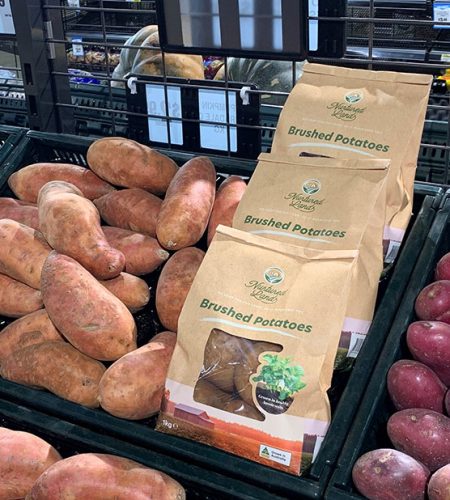
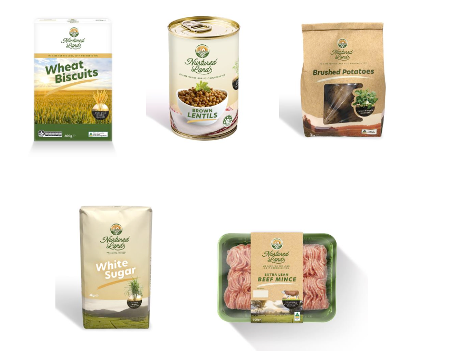
A fictional brand, Nurtured Lands (Figure 1), was created and supporting communication materials were developed including a brand logo, two websites, eight television commercials, an advertorial for lifestyle magazines, packaging for five key products (breakfast cereal, mince, sugar, potatoes and lentils), three infographics, and certification logos. Celebrity gardener, Costa Georgiadis, was engaged as a fictional ‘brand ambassador’. The communications materials were tested in the focus groups, in interviews with value chain stakeholders and 6,500+ consumers in the online survey (see below).
Stakeholder interviews
Key stakeholders in the supply chain were interviewed to understand their perspectives on packaging design, certification, consumer willingness to pay, and rewarding landholders for improved soil stewardship practices.
Literature review
An archival analysis and literature review focused on current practices related to rewarding landholders for soil stewardship and the drivers for change within sustainable supply chains.
Consumer survey
An online survey gathered responses from over 6,500 consumers, asking them about their household demographics, shopping habits, grocery expenditure, and their understanding of soil stewardship.
The survey data helped segment the consumers into five distinct market groups, based on the features they value most when selecting products. These segments were analysed further to understand their purchasing behaviours, attitudes, demographics, and how they responded to various marketing communications.
Discrete choice modelling, a statistical method used to predict choices between distinct alternatives, was used to assess the willingness of consumers to pay a premium for the Nurtured Lands brand, or for existing brands if they used organic farming, adopted soil stewardship practices, or both.
The modelling also helped determine the market share of the Nurtured Lands brand and evaluated the influence of marketing materials on consumers’ willingness to pay for products that use soil stewardship practices.
Research findings
Consumer knowledge and interest
Most consumers have limited knowledge about soil and soil stewardship practices, and there is little awareness of the difference between organic, regenerative farming and soil stewardship practices. There is more awareness around chemical and pesticide use, drought, food miles and packaging issues. However, there is significant interest in learning more about soil stewardship.
Market segments and willingness to pay
The online survey identified five market segments and their willingness to pay for food produced using soil stewardship practices. Two segments (Natural and sustainable shoppers and Health conscious) account for 37% of the market and are potentially willing to pay more for food produced using soil stewardship practices. Education on soil stewardship increases this number. Another segment named Younger, pragmatic jugglers (10%) are on the fence, while the remaining 53% of the market, who are price sensitive or are sceptical about marketing claims, are unlikely to pay more. If there was no price premium, sales of food produced using soil stewardship practices would likely increase.
While a proportion of consumers primarily base their product choice on price alone (39%), consumers have various motives for choosing, or paying more for, products with soil stewardship features. Motives included ‘good for my health’, ‘good for the environment’, and ‘good for farmers and their communities’.
Communication materials
Communication materials need to be tailored to different market segments. Messages highlighting health benefits, environmental benefits, and support for farmers and their communities resonate with various groups.
Messaging is important. For example, the Natural and sustainable shoppers were most likely to trial Nurtured Lands products after seeing the television commercial focussed on the ‘reason to pay’, while the Younger, pragmatic jugglers were most likely to trial the brand after seeing the television commercial featuring the ‘brand ambassador’, Costa Georgiadis (Figure 2).
Having different types of communication materials is essential. Overall, the website and advertorial had a much greater impact on consumer preferences than the longer television commercials. However, participants only saw one randomly assigned television commercial on one occasion. Further research is required to determine if an ad campaign over several weeks could increase impact.
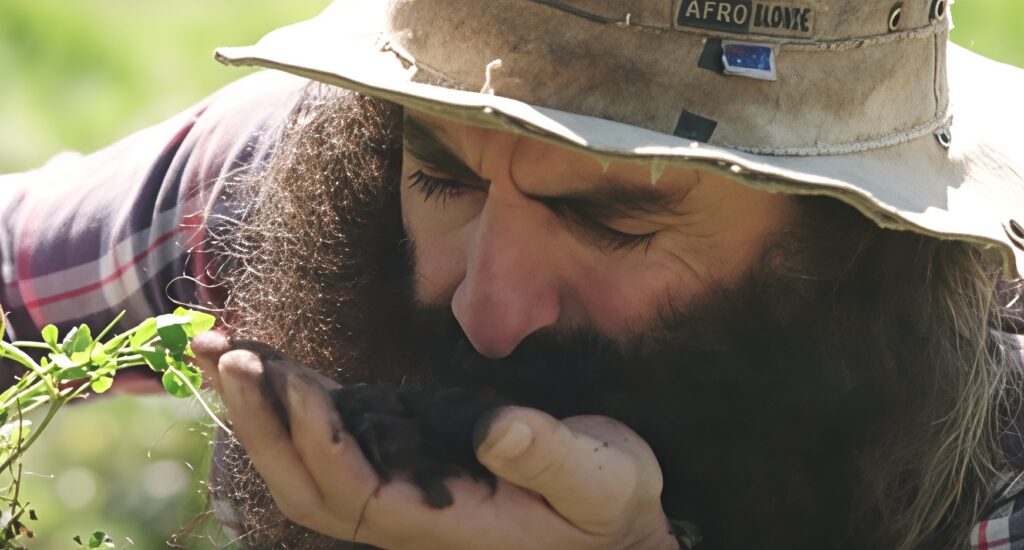
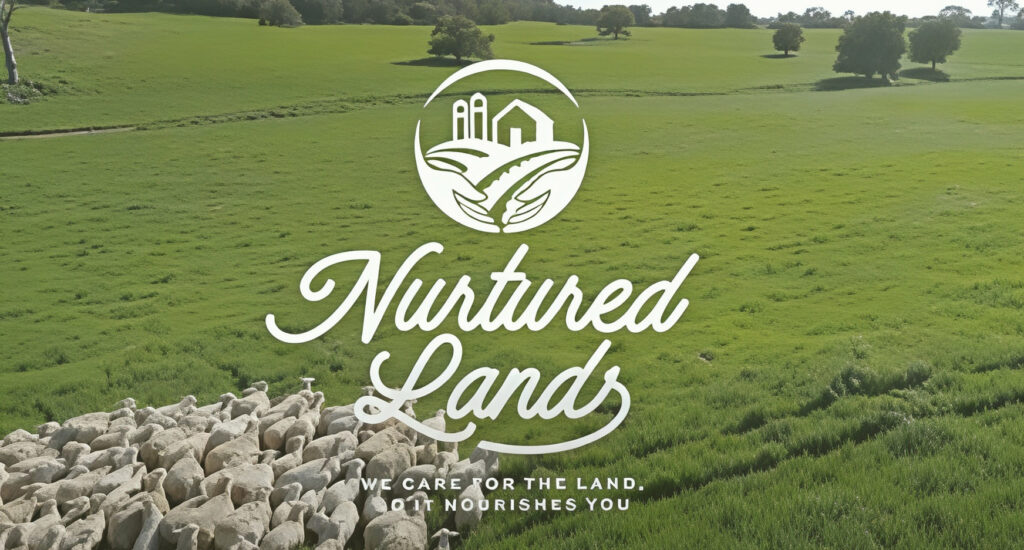
Figure 2. Screenshot from the television commercial featuring Costa Georgiadis (left) and general soil stewardship commercial (right).
Certification schemes
Trust is an important issue for consumers. Many are already sceptical about existing certification schemes and vague claims. However, certification would clarify what constitutes quality soil stewardship practices and could be used to build trust over time.
Certification and brand ambassadorship will be important elements of a communication strategy aimed at marketing products produced using soil stewardship practices.
Value chain insights
The market for products made using soil stewardship practices is emerging. Small, boutique producers and retailers are already demonstrating that there is a niche market for food produced in this way.
However, most supply chain members believe that, apart from the niche segment, consumers are not willing to pay more for products made using soil stewardship practices.
Some multinational manufacturers are supporting soil stewardship practices through education or favourable contract terms, but there is reluctance to pay a premium for these practices. A narrative of ‘win-win’ is regularly used by lead firms where farmers are seen to receive productivity gains and manufacturers get improved reliability and other cost reductions.
Market activation
Opportunities to increase consumer willingness to pay for soil stewardship practices include:
- Creating communication materials that stimulate interest in purchasing food produced using soil stewardship practices.
- Providing a reason to pay more for soil stewardship practices, such as increased cost of production.
- Articulating the quality attributes/benefits associated with soil stewardship (for example, increased nutrient density and assisting to reduce climate change).
- Developing a distinct brand for soil stewardship products to:
- Target the market segments more likely to pay for soil stewardship practices
- Clearly communicate the benefit of soil stewardship and increase consumer understanding and appreciation
- Differentiate from other products promoted as ‘organic’ which raises trust issues in some consumers
- Build trust and credibility by consistently representing soil stewardship practices.
Some drivers of change for activating the consumer market are relatively underutilised, including supportive government legislation and policy and normative pressure (from consumers, professional organisations, not-for-profits, and others).
Risks for farmers
Farmers face the risk of having to adopt soil stewardship practices for market access, where lead firms pass on the costs and risks to the farmers without fairly compensating them through higher prices. Based on international evidence, this will be an increasingly important risk to manage over time.
There is a need to better understand the cost for farmers of transitioning to and using soil stewardship practices. This information will be important in helping farmers and farmer groups negotiate price premiums.
Significance of the findings
There is substantial potential to shape or activate the consumer market to better reward farmers for use of soil stewardship practices for multiple different products. There is market potential to developing brands that embody soil stewardship practices.
While there is scepticism among manufacturers and retailers about consumers’ willingness to pay, there is evidence that a substantive proportion of consumers are willing to pay more for products developed using soil stewardship practices. These findings are consistent with evidence emerging internationally that consumers are willing to pay for soil stewardship practices.
Next steps
Certification is an important aspect of activating consumer markets for soil stewardship. This is being addressed in a follow-on Soil CRC project, ‘Soil stewardship certification potential’ (Project 1.1.005).
A research project led by Soil CRC PhD student Christopher Wilmot is further investigating the role of supporting government frameworks, policy and legislation for activating consumer and other markets for soil stewardship.
Further research is recommended to articulate the specific features of or outcomes from soil stewardship that are important to consumers. Research is also recommended to determine how soil stewardship practices influence these features, and how this can be meaningfully and reliably communicated at point-of-purchase. This may include other features such as nutrient density, microbial activity, water use or carbon.