
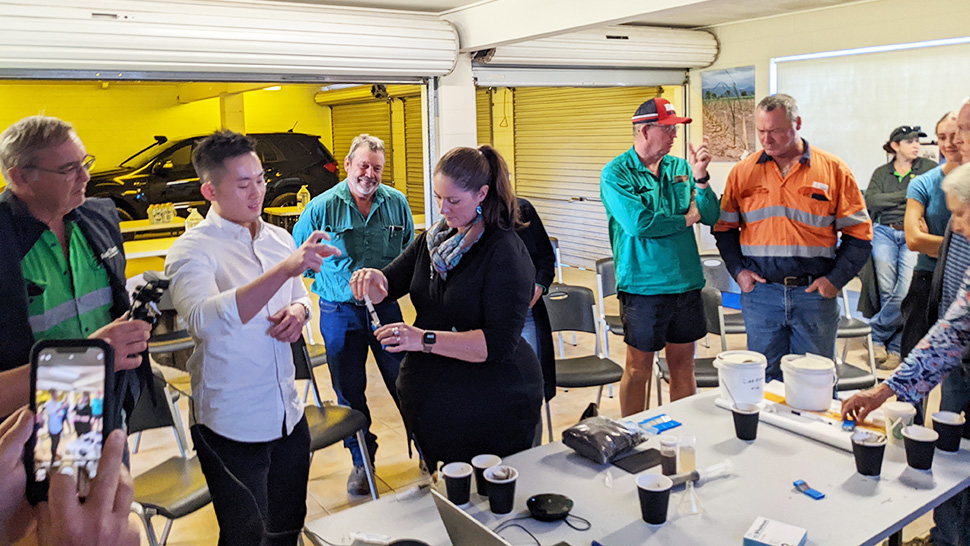
The Soil CRC is excited to be leading a new research project that aims to transform nutrient measurement for the sugarcane industry. Funded by Queensland’s Department of Primary Industries (DPI) and managed by Sugar Research Australia (SRA), the project will adapt the CRC’s innovative ‘lab-on-a-chip’ (LOC) technology to enable growers to measure sugarcane nutrients in real-time.
The LOC consists of an in-field testing kit that works with a smartphone app to deliver on-the-spot nutrient analysis and recording. It was initially developed through Soil CRC research led by the University of Newcastle (UON) to measure soil pH and macronutrients, and will now be further developed to deliver instant estimates of nitrates and phosphates in sugarcane tissues.
The LOC is a compact 3D-printed plastic device that contains chemical reagents tailored to specific nutrients. With built-in calibration standards for quality assurance, the technology provides accurate, real-time data, offering a faster and more cost-effective alternative to traditional laboratory analyses.
Dr Liang Wang from UON, who led development of the LOC for soil nutrient analysis, said he was excited to continue to work with the University of Tasmania and the Soil CRC’s North Queensland grower groups, Burdekin Productivity Services (BPS) and Herbert Cane Productivity Service Limited (HCPSL), to modify the technology for the sugarcane industry.
“The LOC has been a labour of love for our researchers, including our talented PhD students, one of whom has since moved into a research technician role within the project team at the University of Tasmania,” he said.
“The device has evolved over six years of research effort and industry feedback to ensure it is fit-for-purpose and easy to use in the field.
“We have received significant interest from the sugarcane growers, and it is fantastic to be able to advance this technology to benefit their industry through the DPI funding and with support from Sugar Research Australia, who are managing the project.”
Adapting to meet the needs of the sugarcane industry
The device will provide on-the-spot analysis at critical plant growth stages, so growers can be confident they are using the appropriate nutrient management practices for improved crop productivity and least environmental impact.
By integrating the technology with a smartphone, data can be recorded on the spot and revisited and tracked over time.
“Because soil nutrient levels vary significantly within a field (due to texture, organic matter, moisture and microbial activity), the technology has been developed to measure readings in plant tissues – such as sugarcane’s leaves, stalks and juice samples – during key growth stages,” Dr Wang said.
“The portable LOC device aims to provide a user-friendly and economical way for growers to increase and accelerate nutrient testing to enhance the effectiveness of their fertiliser application. When the tool is released, it will set a new standard for precision agriculture in the sugarcane industry.”
The project team has already developed an extraction method for determining nitrate concentrations in sugarcane tissues, with phosphates expected to follow.
Industry feedback highlights LOC benefits
Rob Milla, BPS Manager and Extension Agronomist, said it was exciting to be involved in the project and to see the possibilities of this new technology for sugarcane growers.
“The LOC will give our growers accurate information directly from the paddock to reinforce their farm management practices and enable informed decision making,” he said.
HCPSL Manager and Extension Agronomist Adam Royle added that details of the project to date had been received with great interest from growers in the Herbert and Burdekin districts.
“I expect the enthusiasm we are seeing in our region will spread throughout the industry as more growers and agronomic advisors learn about the LOC technology and discover how it can enhance their on-farm nutrient management,” Mr Royle said.
Soil CRC CEO Dr Michael Crawford said it was fantastic to see the collaboration between researchers, PhD students and industry through the LOC projects and to witness how the technology had evolved because of this.
“The end goal is to take the LOC technology to market so Australian farmers can get their hands on an accurate in-field nutrient measurement solution that will save them time and money,” Dr Crawford said.
Related articles
Acknowledgement
The latest project, ‘Rapid field-based sugarcane tissue measurement using an integrated smartphone and lab-on-a-chip system’, is fully funded by Queensland’s Department of Primary Industries and managed by Sugar Research Australia. View the project webpage.


Main image: Demonstrating the lab-on-a-chip to staff and growers at Herbert Cane Productivity Services.