
Key points
- Hedonic pricing method involves statistically estimating the impact of land and soil characteristics on land prices. It is the main approach used for identifying and understanding the impact that soil quality may have on land prices.
- This qualitative research was essential to reveal what motivates farm purchase decisions and to inform the next phase of the project.
- Farm buyers fall into at least three categories – life stylers, additional property purchasers and for profit investors both domestic and international.
- Soil management history may not be one of the top three considerations. Availability of water, profitability, infrastructure, soil quality as identified through visual indicators, and topography appear to be most important in farm purchase decisions.
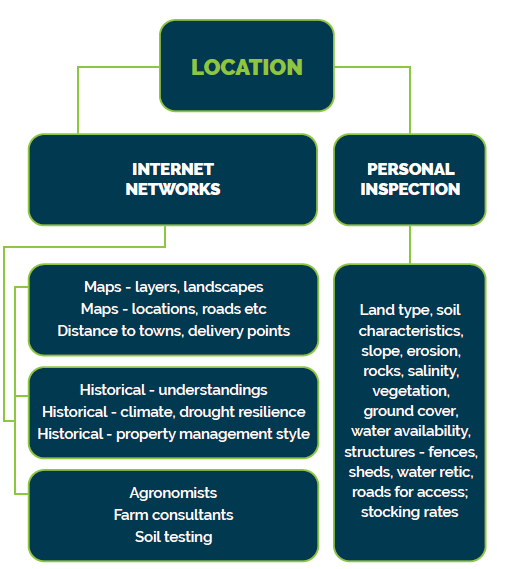
- Purchasers gain their information from local knowledge, personal networks and real estate networks.
Our research
Researchers conducted semi structured, one-to-one telephone interviews covering nine topic areas.
The interviews were conducted individually with 16 participants from four Australian states. They comprised additional property purchasers, real estate agents or consultants who had a range of experience over a long period of time. There were no interviewees from either the life styler or international purchaser segments, however some of the interviewees were able to comment on these segments in their discussions through association with them.
Researchers identified what factors prospective farm purchasers consider in their search for a new property, their motivations and what influences their willingness to pay. They discussed how the soil characteristics of potential properties influences the choice between properties. The participants were asked why they made decisions to purchase, interest in soil characteristics, and pre purchase information gathering. They were also asked about their sources of information when they investigate buying a new property.
Information acquisition process
Findings
Corporate buyers cared more about soil characteristics and soil testing than other segments. Farmers in the situation of ‘landlocking’ would often overlook soil conditions in their search for any available local land to purchase; with an understanding that any obvious deficiencies could be overcome over a few years through improved management practices.
The importance of best management practices in purchase decisions were ascertained by asking participants about nine current practices. NB: One participant was both expert and farmer.
Table 1. Land management practices sought
| Practice | Yes | No | Maybe |
|---|---|---|---|
| Minimum / no till | 9 | 4 | 3 |
| Minimum ground cover | 12 | 1 | 3 |
| Permanent pastures | 10 | 3 | 3 |
| Fence eroded / erodible areas | 9 | 3 | 4 |
| Divide paddocks | 9 | 4 | 3 |
| Organic practices | 4 | 8 | 4 |
| Trees, windbreaks | 9 | 5 | 2 |
| Stocking rates | 10 | 5 | 1 |
| Grazing rotation | 9 | 5 | 2 |
Other comments, practices looked for: Contour banks, rabbit controls, fencing for rodents or dogs, wary of CTF has risk of channels, wary of chemical storage areas, usage and residues, leaky dams.
There may be reasons why potential purchasers (and sellers) and agents do not consider soil related factors. These include issue avoidance, lack of understanding, unwillingness to change practices, a lack of recognition of the importance of soil for profitability, and difficulty in communicating about soil to potential purchasers. These factors could be addressed through the development of tools designed to help farmers understand how soil factors and soil management influence both property prices and other business model outcomes, and in future education campaigns.
The project team concluded that farmers and real estate agents should be part of the research cycle to ensure their input into future research questions and designs.
Outcomes
The results provided insight into the variables to include in a future hedonic pricing study valuing soil features and soil management practices.
The interviews showed that different segments of farm purchasers have different attitudes towards soil feature and soil management practices when purchasing. Recognising these segments and their differential views and motivations will be important when completing a future hedonic pricing study. It will also inform those seeking to activate the property market through a future educational campaign.
Next steps
- Conduct a hedonic pricing study to identify the value of soil features and soil management practices in the Australian context. This will involve seeking access to datasets to develop property price models that use relevant Australian land and soil type characteristics.
- In the case study area, employ the identified farm sample frames to collect farmer data to supplement secondary data. Farmer data will permit the identification of the influence of farmer motivations and specific land management practices on propriety prices.
- Collaborate and share data with Soil CRC programs that are investigating apps for soil monitoring, testing and remediation.

This project has additional funding provided by the NSW Government Department of Industry’s Research Attraction and Acceleration Program (RAAP).